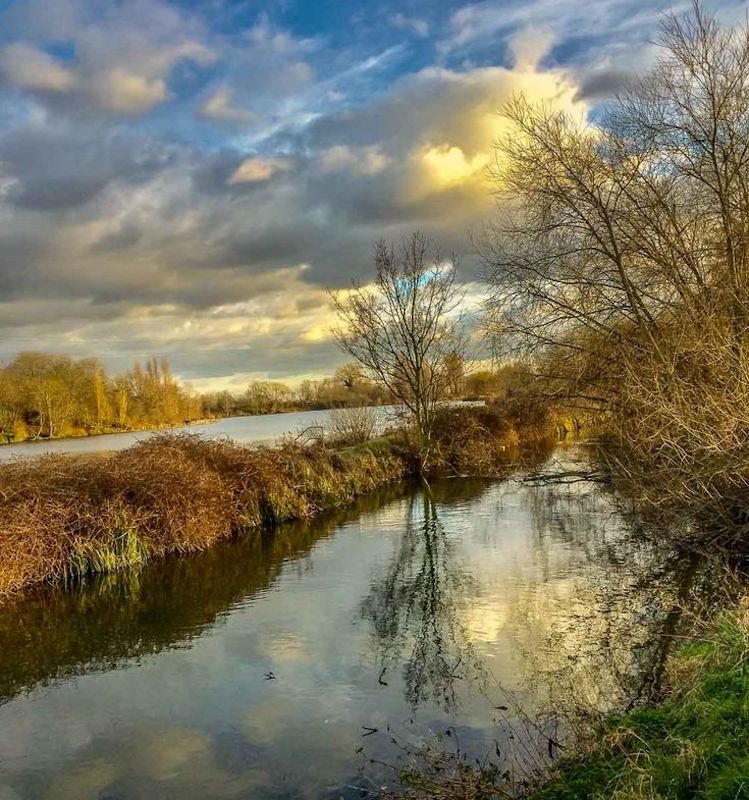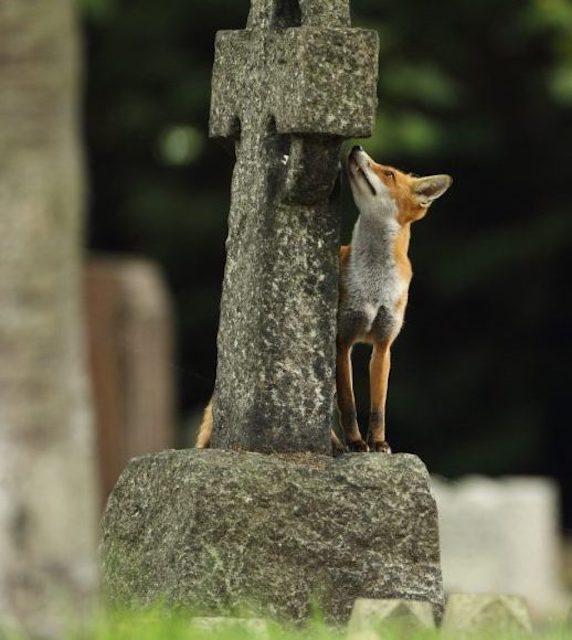

Wildlife Matters explores Britain’s Wildest Cities and starts in wild London, in West Norwood Cemetery, one of London’s wildest places, where urban wildlife survives and flourishes. To begin, we’ll explore some of the fascinating wildlife in London, their habitats, and the challenges they face in an urban environment.
While London is most commonly associated with bustling streets, iconic landmarks, and vibrant city culture, another side of the capital is worth exploring: its diverse wildlife.
So grab your walking boots, camera, and oyster card and join us as we explore the wild side of England’s capital city.
One of my favourite London wildlife haunts is West Norwood Cemetry. Even if you are familiar with the cemetery and its precious green space, there is a lot more going on than you might be aware of … but let’s start with a little bit of history:
West Norwood Cemetery opened in 1837 as one of the Magnificent Seven private cemeteries built to alleviate overcrowding in existing London parish burial grounds.
In the first fifty years of the 19th century, London’s population more than doubled from 1 million to 2.3 million. Today, the cemetery is owned by Lambeth Council and remains a working cemetery.
Like so many other cemeteries, West Norwood provides invaluable ‘green space’ to the city and is home to abundant wildlife.
Around twenty years ago, I was involved in surveying the cemetery many times and found it to be a valuable haven for various fauna, including foxes, bats, stag beetles, and thirty-five species of birds, including woodpeckers and tawny owls, living amongst veteran oak and lime trees.
The flora is equally impressive, with Mature trees—including a number from the ancient Great North Wood—predating the cemetery by hundreds of years. One line of thirteen oaks (with various estimated dates between 1540-1640 and 1677-1711) forms a medieval boundary north-south across the highest point of the cemetery. Four other trees (three oaks and one Field Maple) predate the graveyard.
But today, we have a permit to spend the afternoon, evening and night here at West Norwood Cemetery. This could be a wild night in the heart of the capital.
The first thing to note is that it is still daylight, and I am watching three foxes.
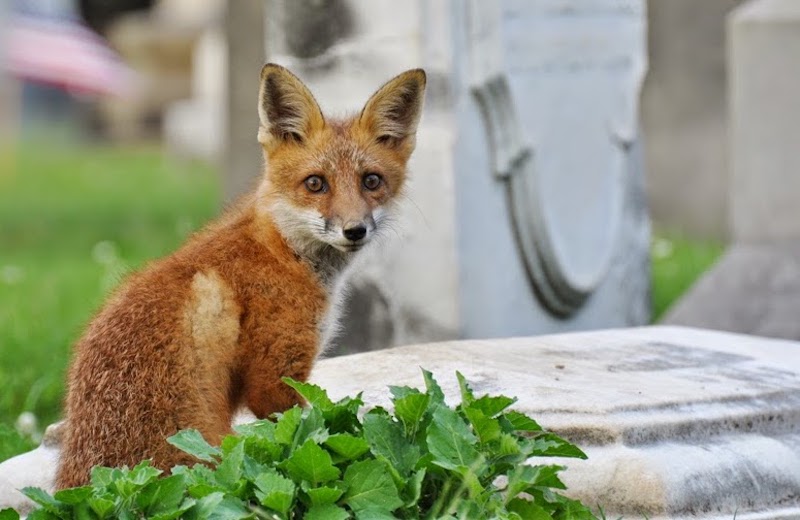
A dog fox, a vixen, and a lone individual female, possibly one of their cubs from last year, who remains close but not too close to what I believe could be her parents.
The vixen looks thin and has been suffering from mange. Her fur is growing back, and I hope she is recovering her fitness. The Dog Fox stands close by her as she lays grooming in the late afternoon sunshine. He guards his partner but tolerates the female fox no more than 100 metres away.
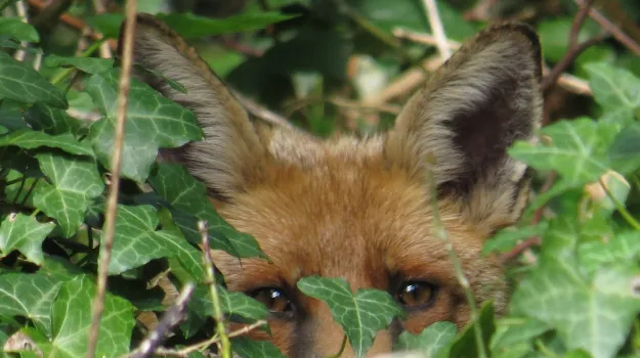
This young fox has a stunning fiery red coat and bright amber eyes. She is on high alert, her ears and nose twitching constantly.
A woman approaches the area and opens a small box she is carrying, and the reason the foxes are gathered here becomes clear. She has food.
She puts down a selection of sausages before opening a small Tupperware and placing several neatly made sandwiches around the edges of the pile. She then walks away toward the cemetery’s wall, where the younger fox has hidden away in the undergrowth.
The dog fox and vixen approach. The vixen takes two sandwiches in her mouth, moves to the edge of a thicket, and eats them.
The dog fox has loaded up with sausages and a couple of sandwiches before he trots off towards the vixen and drops them close by her.
He returns several times to the sausages, loads his mouth to capacity, and trots away in the opposite direction. He will cache them for later.
He finally clears the food and returns to where the vixen has been eating it. He joins her, and they both eat before they begin some mutual grooming.
Meanwhile, the young female fox leaves the cover of the scrub to gather the sausage and sandwiches that the woman left for her.
She had removed them all from my view from amidst the gravestones and, I imagine, cached them before returning to the shrubbery’s sanctuary.
It was time for me to leave the serene scene for a while. I’m sure the woman had been providing medicated sandwiches to the vixen, helping her regain her health.
So many wildlife heroes quietly and silently do so much to support urban wildlife.
Stag Beetles
In 2019, lottery funding was used to survey several London cemeteries for a rare insect with an amazing lifestyle. The insect made a bit of a stronghold for itself in the heart of London.
The stag beetle is the largest in Britain and is found in South East England, particularly in South and West London.
They prefer oak woodlands but can be found in gardens, parks, and cemeteries, where hedgerows are maintained.
The larvae, which can grow up to 110mm, depend on rotting wood that is decomposing to feed on and provide shelter. They can live underground and have been found up to 50cm deep. It can take up to six years to develop before they pupate and become adults.
The adults have a much shorter lifespan: they emerge in May with the sole purpose of mating and usually die before the end of August.
Keep a look out around dusk on balmy summer evenings when the males fly to look for mates.
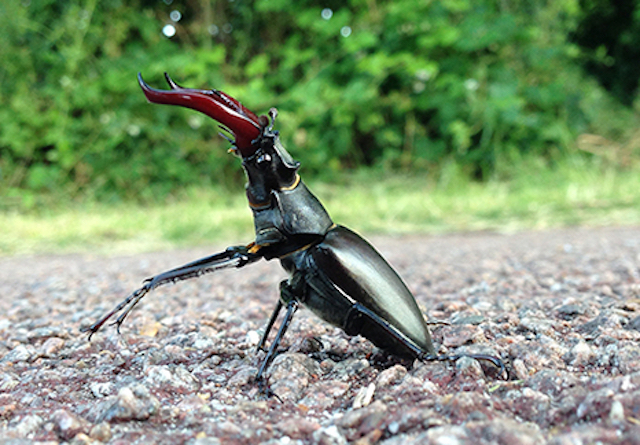
Once the male has found a mate, he displays his oversized antlers to her and hopes she will be suitably impressed. These dramatic antlers have no other use than this display and to ‘rut’ with other male stag beetles that may have their eye on the same mate.
The males will ‘rut’ by locking antlers and dualling, similar to deer rutting. It is just as dramatic, although on a smaller scale, and can result in broken antlers or even antlers being ripped from the body.
If the female is impressed by his antlers, they will mate. The female will return to where she emerged to lay her eggs, provided enough decaying wood exists.
Stag beetles prefer loamy soil, so they are not found in chalk soils, such as on the north and south downs, and very few are found north of the midlands.
Another consideration is rainfall. Stag beetles don’t like wet or waterlogged soils, so areas with high rainfall or flooding risks do not have them.
London cemeteries provide the ideal habitat with trees and hedgerows, rich, undisturbed soils, and, of course, London has a reasonably stable, warm and dry climate.
Stag beetles spend most of their life cycle underground as larvae. Depending on the weather, this can take three to seven years. Prolonged cold weather can extend this process. Once fully grown, the larvae will leave the decaying wood they’ve been feeding on to construct a giant cocoon in the soil, where they pupate and eventually transform into adults.
The adults spend the winter underground in the soil and typically emerge from mid-May onwards. By the end of August, most of them will have died. They do not survive the winter. During their short adult lives, male stag beetles spend their days basking in the sun to gather strength for their evening flying activities in search of a mate. They cannot consume solid food but will take moisture from plants.
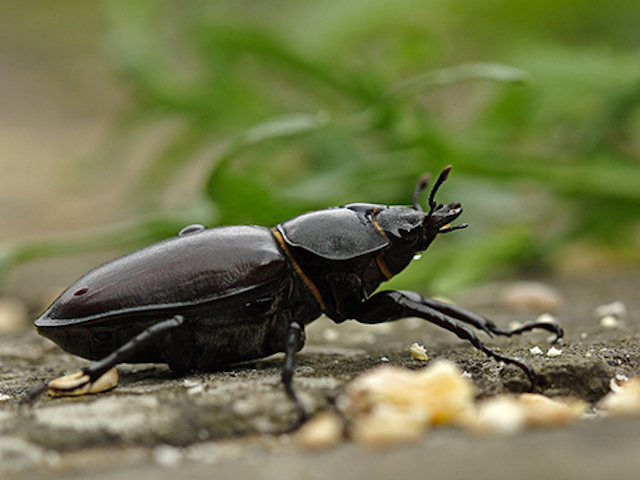
Females are also capable of flying but are typically found on the ground. At dusk tonight, we observed a female on the ground. I am hopeful that she is seeking a mate. When her wing covers open, but she does not fly, I am confident she releases pheromones to attract male stag beetles.
Now, it’s a waiting game. The sun is setting in the west, and the cemetery has closed for the night. We are alone with the wildlife.
They are a remarkable sight if you’ve never seen a flying beetle. They are proficient fliers who can travel considerable distances and reach heights of at least 200 meters, as evidenced by the swifts, swallows, and kestrels that hunt stag beetles in flight—yet another challenge for the stag beetles to overcome before finding a mate.
As I sit in the fading light, my gaze alternates between the female on the ground and scanning the sky for potential male stag beetles. Then, it happens. A male stag beetle arrives and lands nearby. Immediately, he begins his display with his antlers.
It is fascinating to watch as he moves sideways around her and frequently stops with his antlers in different positions—a bit like a knight displaying his sword skills in days gone by.
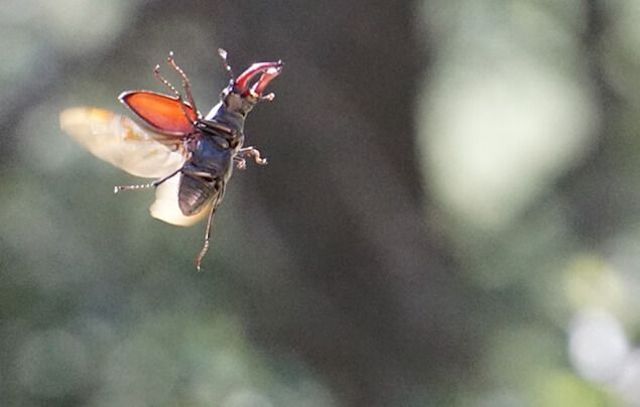
His antler dance is a success, and her wing cases open. They mate before he flies off, no doubt in search of another mate.
Tawny Owls
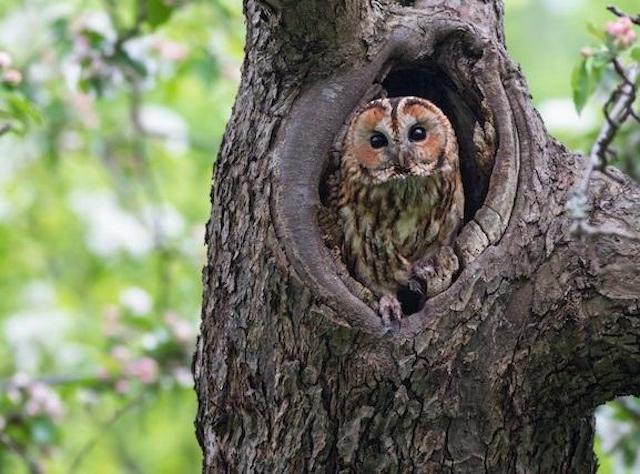
Our final species for tonight is a night-flying bird, another species you may not expect to see thriving in the heart of London.
From local knowledge and previous visits, I know that a pair of tawny owls nest in the oak trees that line the edge of the cemetery, and that is where we are heading now.
They have three owlets this year and are now of an age where they will come out onto the branches to strengthen their wings and await food from the parents.
The nest is a traditional hollow deep within an old oak tree, and this pair have used this nest site for several years.
When I arrived, I settled down on a grass path between rows of gravestones. From here, I had a great view of the nest hole and was ready for the evening’s activities to begin.
Tawny Owls are early nesters. Their single clutch of two to three eggs is laid asynchronously every two days or so, and incubation lasts approximately 30 days.
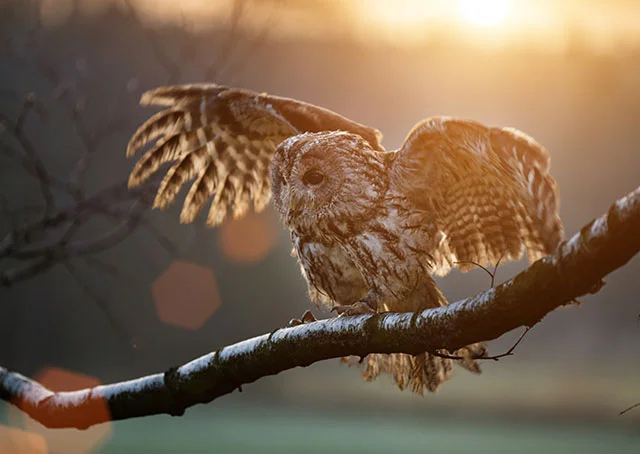
Fledging occurs after around five weeks, often in May,
Tawny owlets can often be found on the ground during the early summer. If you are sure it is a tawny owl, you should leave it as they are excellent climbers who will return to the nest area.
With that said, other owl species, such as barn owls, would need help if found on the ground, so it is essential to know the owl species you have seen. If you need more time, take a short video and send it to the local wildlife or bird rescue team, which will be able to advise you.
The fledged owlets depend on their parents for food for up to three months after leaving the nest. Once darkness falls, they will sit on the branches of nearby trees and beg for food; that is what we hope to see tonight.
The three chicks were all ‘branching’ nearby and soon began to make their distinctive calls to the parents, signalling that it would quickly be supper time.
The parents were already out in the area. The cemetery is large, especially for central London, at 16 hectares—around 42 acres—a territory that could support two or three more pairs of Tawny owls.
Of course, that depends on food availability and nesting spaces in trees.
Within minutes, the male tawny is back with a vole and fed to the largest chick on my right side. Soon after, the female, easily identified as considerably larger than the male, appeared to feed the second-largest chick and the third and smallest chick was left calling.
This is the way of owls and many raptors, or birds of prey who will put their mani efforts into the first, and generally largest chick, and the last chick that could be two weeks younger than its elder sibling could be sacrificed and even fed to its siblings if hard times or weather impacts on the parents hunting.
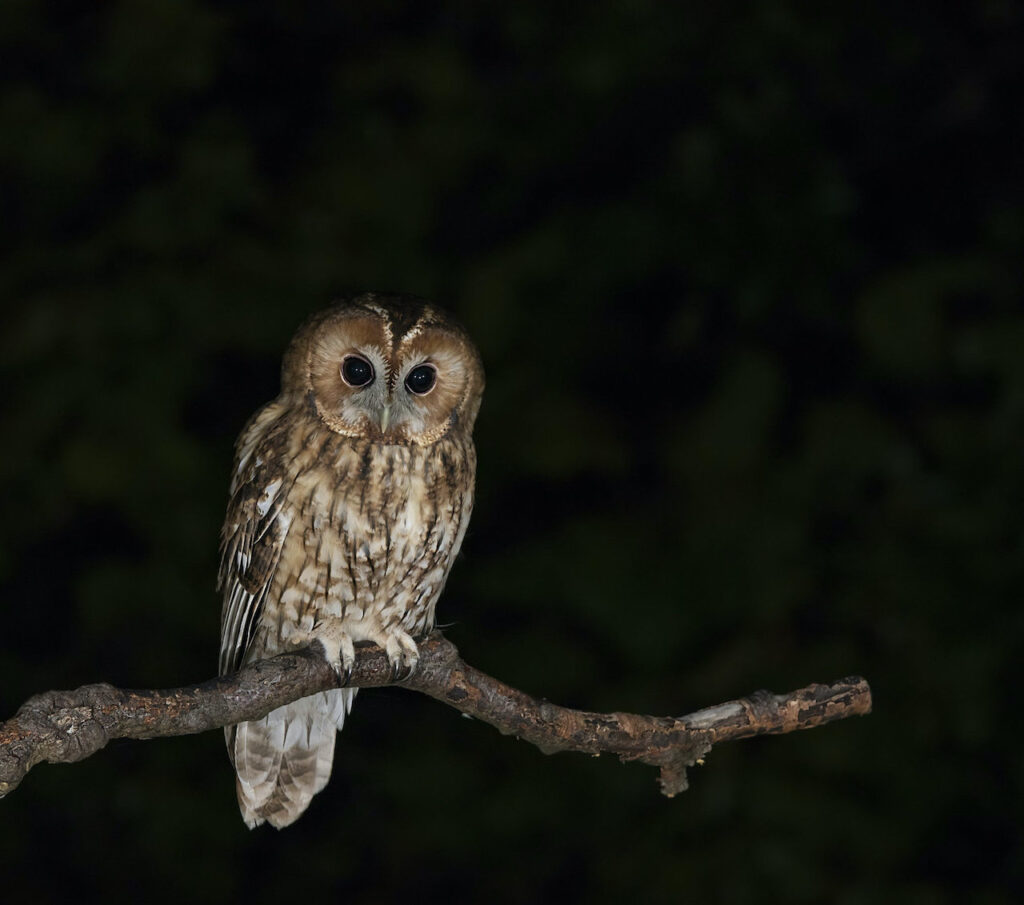
I watched this repeat for around two hours before returning to my original location to watch the Fox family.
This year’s cubs now look like their parents but have yet to grow into their long legs and sleek, lean bodies.
They are still playful and spend most of the evening and night playing, hunting, pouncing, and jumping on each other.
I was staying the night and had a sleeping bag and tarp that I had put up in the corner secured to a tree and wall. I settled to eat some supper and settle down to sleep, with the haunting sound of the tawny owl’s twit-wooing as they coordinated and checked in with each other and the occasional yelp of a fox cub that had had a nip from the vixen.
Of course, the city makes low-level noise at night, and artificial light blocks all but the brightest stars from the sky. Even the moon looks pale and subdued as it drifts into a deep, comfortable sleep.
If you enjoyed this blog, please check out more of our wildlife blogs here, or you may prefer to listen to the Wildlife Matters Podcast here.
If you want to support our work
Please click on the Wildlife Matters Patreon Community.
Please click to join the Wildlife Matters SubstackCommunity.
You can donate here.
Further Reading
Natural History Museum – Urban Wildlife
Wildlife Trusts – Urban Wildlife
London Wildlife Trust – Living Landscapes