
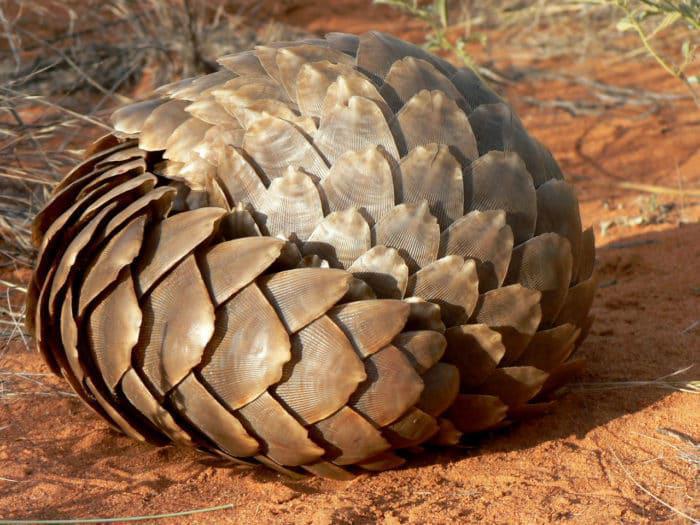

The story of the Pangolin has become tragic in recent years. From their humble origins, these scaly ant-eaters roam through Africa and Asia. The pangolin stands out as the most poached mammal in the wild. It is a unique and fascinating creature.
Around ten years ago, I was a CITES Committee member looking at how more protection for Pangolins could be implemented at the following COP meeting.
And that began a personal journey that saw me return to Tsavo National Park in Kenya, where I had previously worked on projects with elephants and rhinos.
The ground pangolin, the Cape or Temminck’s pangolin, is found in the Tsavo area. A second species of Pangolin is the White-bellied or tree pangolin. This species is only found locally in the Kakamega Forest, a community reserve and government-protected area. The third Pangolin species is the Giant pangolin, found in the Lake Victoria Region.
There is a fourth pangolin species in Africa. The black-bellied Pangolin is not found in Kenya; its home range is in the west around Nigeria.
The word pangolin originates from the Malay word “pengguling”, which means “something that rolls up”. This refers to the pangolin rolling itself into a tight ball as a defence.
It is said that Pangolins have been on Earth for roughly 80 million years. They can be found in 51 countries across Asia and Africa and live in various habitats, from tropical forests to thick brush and grasslands.

There are eight species of Pangolin—four in Asia and four in Africa.
With that widespread habitat, Pangolins are a diverse species. In this article, we will take an in-depth look at the African Pangolin species but will return in a separate article to discuss the Asian pangolins.
Three of the four African Pangolin species can be found here in Kenya.
The ground pangolin is one of the most widespread African species. It prefers scrubby, savannah woodland at low elevations.
Like most pangolin species, it lives in burrows, which have semispherical chambers and can sometimes be large enough for a person to stand up in.
In West and Central Africa, the giant pangolin is distributed in various habitats, including primary and secondary forests, swamp forests and wooded savannahs.
The Ground Pangolin (Smutsia temminckii), named after the Dutch Zoologist who first recorded it, is the most widely distributed African pangolin, occurring mainly in southern and eastern Africa. The black-bellied pangolin (Phataginus tetradactyla) is an arboreal pangolin species in west and central Africa. The white-bellied pangolin (Phataginus tricuspis) is Africa’s most frequently encountered pangolin. The white-bellied pangolin is southwestern. The Giant Pangolin (Smutsia gigantea) is the largest extant pangolin species, and its range extends along the equator from West Africa to Uganda.
The Ecology of Pangolins
So, let’s examine the ecology of Pangolins and some fascinating facts. Firstly, Pangolins belong to the order Pholidota.
Despite all the scales, pangolins are not reptiles but mammals.
They are solitary animals active at night when they hunt for their insect prey, which they locate using an acute sense of smell.
If threatened, they will roll into a tight ball, sealing itself with its muscular tail.
One of the first things that strikes you about Pangolins is the length of their tongues. They are massive. A pangolin’s tongue can extend 10 to 15 cm beyond its lips.
Its tongue starts deep in the chest cavity, which is attached to the lowest part of the breast bone. When not in use, it can be drawn back into a cartilaginous structure, which is out of the way.
Once you understand the Pangolin’s diet, the long tongue makes so much sense because 90% of a ground pangolin’s diet comprises ants, with the remainder being termites. A single ground pangolin can eat an estimated 70 million insects in one year.
A pangolin does not have teeth. Instead, as a pangolin feeds, it laps up insects with its saliva-covered tongue. When it brings the tongue back into its mouth, a bony projection scrapes off the insects and swallows them. With the help of the small stones, sand and soil that it consumes with the insects, its muscular stomach grinds the insects into an easily digestible product in the stomach.
Pangolin Scales
A pangolin’s scales make up 20% of its body weight. These scales are made of keratin, the same protein substance which makes up our hair and nails, and, of course, rhino horn.
Although keratin has no scientifically proven benefits, it is popular in certain traditional medicines. We will look into this in more depth later in the article.
A pangolin walks on its hind legs, using its front legs and tail as a counterbalance. It has one pup per year, and the baby rides on its mother at the base of her tail.
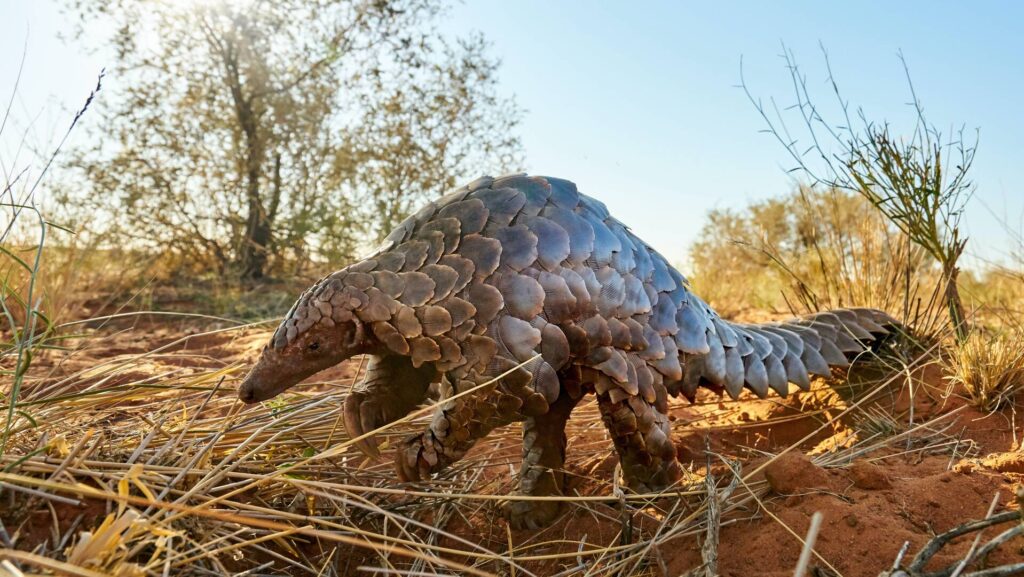
Ground Pangolin (Smutsia temminckii)
Ground pangolins tend to ‘adopt’ the abandoned burrows of warthogs and aardvarks.
The Ground pangolin is an unusual member of a group of pangolins among the world’s most critically endangered and illegally trafficked animals.
They are armour-plated and distinguished from other mammals due to the layer of protective horny scales. They are Africa’s second-largest and most widespread of the four pangolin species.
When threatened, Ground pangolins can roll themselves into an almost impenetrable ball, wrapping their strong tail around their body, exposing only their sharp scales to any predator.
The ground pangolin is solitary and nocturnal, although it will venture out often in the late afternoon in winter.
It spends most of its time on the ground, though it can climb and swim well. It usually walks slowly, with its head swaying and tail dragging on the ground, although it can run and walk on two legs.
Ground pangolins can dig their burrows but prefer to live in those dug by spring hares or anteaters and sleep curled up in them. Little is known about their communication, but they probably use visual cues, smells, sounds, and touch.
Ground pangolins are polygynous, meaning they will have multiple partners, with males fighting fiercely for access to a female.
Breeding occurs throughout the year, even while females are rearing young. Gestation lasts about 139 days, and usually, one young is born.
Births take place in an underground shelter. The babies are carried on the Mother’s back, at the base of the tail, from around two weeks old.
A pup will stay with its mother for around three months and may accompany its father for an extra month, though this is rare. Then, it becomes wholly independent but remains in its mother’s home range until it is about one year old.
Females breed once they are three to four years old, and males reach maturity around the same age, but they may only breed once they are five to seven years old.
Ground pangolins are threatened due to the tremendous economic value of their flesh and scales and the loss of their habitat to agriculture.
Lions and hyenas are among their natural predators, and they can be killed by brush fires and electrocuted by electric fences.
Ground pangolins are considered widespread but quite rare. The IUCN Red List and other sources do not provide the population size of this species.
These animals are currently classified as Vulnerable (VU) on the IUCN Red List, and their numbers continue to decrease.
Ecological niche Due to their diet, Ground pangolins have an essential role as predators of colonial insects within their ecosystems.
Ground pangolins often walk on their hind legs when looking for food. The other name for the Ground pangolin is Temminck’s pangolin, named after the Dutch zoologist Coenraad Jacob Temminck.

White-Bellied Pangolin (Phataginus tricuspis)
The white-bellied pangolin, the tree or three-cusped pangolin, is the most common African forest pangolin.
They are found throughout much of central and western Africa, as far east as southwestern Kenya and northeastern Tanzania. Semiarboreal specialists prefer lowland tropical and savannah forests and have shown some adaptation to commercial plantations.
The White-bellied Pangolin is named after the white skin exposed on the underside of its body. It stands out from other Pangolin species by its smaller size, more enormous eyes, and hairy forelimbs.
They range in size from 60 to 105 cm, and their long, prehensile tail contributes about half of their entire body.
Along with their clawed feet, this tail helps them climb trees and move around in the high branches. Their sharp, overlapping scales protect them as they curl up into a ball when in danger.
White-bellied Pangolins are predominantly nocturnal. They feed exclusively on ants and termites, and their long tongue can extend up to 25cm for easier access to prey.
Breeding is continuous, and females give birth to a single young after a gestation period of approximately 150 days. Male home ranges can stretch up to 30 hectares, while female home ranges are much smaller and average 3-4 hectares. They are found on the ground while foraging or crossing open patches of land, but they quickly ascend the nearest tree when disturbed.
Also known as the Tree Pangolin, the White-bellied Pangolin is equally at home in the trees as it is on the ground.
These scaly mammals are found across Africa, predominantly to the west and centre of the continent.
They mostly live in moist tropical lowland forests but can also be found in dense woodlands with nearby water courses, forest-savannah mosaics, and sometimes abandoned oil palm stands.
Pangolins are considered one of the world’s most trafficked animals, and the latest IUCN assessment classifies White-bellied Pangolin as Endangered.
Populations of White-bellied Pangolins have declined by up to 40 per cent over the past twenty years.
This dramatic drop is driven by forest habitat loss, the intercontinental trafficking of their scales to Asia, and increasing local use and consumption of bush meat.

Giant Pangolin (Smutsia gigantea)
The Giant pangolin has its most significant populations in Uganda, Tanzania, and western Kenya but is also thinly distributed across the west coast of Africa. It prefers forests, rainforests, and savannahs as its habitat.
The Giant Ground Pangolin is the largest of the eight pangolin species, reaching up to 1.8 metres long and weighing up to 33kg.
They are covered in protective scales and can roll into a defensive ball to protect every part of their exposed body when danger is near. They also have long front claws for digging and ripping into ant colonies and use their long tongue to feast on ants and termites.
As their name suggests, Giant Ground Pangolins are terrestrial species. They spend the day resting under piles of plant debris, in thickets, under fallen tree roots, or in burrows.
Pangolins have few defences, but if predators get too close, they roll into a tight ball to protect themselves.
Their reproductive biology is not well known. Breeding may be seasonal, and females usually give birth to a single young, possibly annually but perhaps every second year. A baby pangolin will ride on its mother’s back while nursing and eating ants until it becomes independent.
The solitary, nocturnal, and elusive nature of the Giant Ground Pangolin makes conducting surveys challenging. As a result, little information is available on population abundance or densities.
They prefer to reside near water sources and spend their time on the ground, unlike the White-bellied and Black-bellied Pangolins, which like to move through the trees.
The biggest threat to the Giant Ground Pangolin is humans.
Populations of Giant Ground Pangolins have declined due to a combination of forest loss, which is a severe threat, and, in common with all pangolin species, the intercontinental trafficking of their scales and increasing rates of exploitation for local use and consumption.
Pangolin scales are highly valued in traditional Chinese medicine, and it is estimated that between 2015 and 2019, more than 400,000 African pangolins – the Giant Ground Pangolin included – were trafficked either within Africa or bound for Asia.

Black Bellied Pangolin (Phataginus tetradactyla)
Black-bellied or long-tailed pangolins are diurnal, arboreal species that are which are found on the west coast of Africa,
The common name, Ipi, comes from its physical characteristics, such as its extremely long tail or the dark hairs that cover the underside of its body and limbs.
The Long-tailed pangolin has a characteristic very long tail reaching a length of around 60–70 cm (24–28 in). The tail contains 46–47 caudal vertebrae, a record among mammals. The body can reach a length of 30–40 cm (12–16 in) and weigh 2.0–2.5 kg. The males are larger than the females.
Even with the long tail, this species is the smallest of eight species of pangolins.
Like other pangolins, the Long-tailed pangolin is covered with nine to thirteen rows of overlapping, artichoke leaf-shaped keratinous scales. The scales are dark brown with a brighter rim, which serves as camouflage.
The feet have large, curved claws. The tip of the tail is bare and contains a sensory pad that allows the individual to seek out and grip branches. They do not have teeth, and their tongues are very long. The abdomen, underside of the limbs, and face are covered in dark fur instead of scales.
Long-tailed pangolins are native to parts of western and central Africa and have also been found as far west and north as Senegal, across the continent to Uganda, and south into Angola.
They are found in areas such as the Congo Basin and Guinean forests. These animals prefer to live in moist, tropical riverine and swamp forest environments but have been observed in altered forests (bush) and agricultural areas of former lowland rain forests. They are usually found near water.
Long-tailed pangolins are solitary and shy creatures. They are almost exclusively arboreal, spending most of their time in the canopy region.
Their long, prehensile tails easily support their body weight and are commonly used to seek supportive holds. Occasionally, they dangle just by their tails.
Their durable claws also allow them to dig into the bark of the trees and pull themselves up into the canopy. When they cannot reach another branch, they have been known to extend their tails to the next hold and climb up it.
Despite spending most of their life in the canopy, Long-tailed pangolins are also apt swimmers. They occasionally drop from overhanging branches into streams below.
They move through the water with a quick, undulating movement.
Long-tailed pangolins are the only diurnal species of pangolin and have developed several techniques to protect themselves from predators, starting with their scales, which act as camouflage.
They roll themselves into a tight ball when threatened, exposing only their sharp scales. They may also emit foul-smelling fluid from their anal glands.
They have been observed sleeping (at night) in this rolled-up posture in tree hollows, epiphytes, tree ferns, or in old ant nests.
Long-tailed pangolins communicate with each other using pheromones that are produced in a pair of anal scent glands. The pheromones in the exudate are likely used to attract mates and establish territorial edges.
Long-tailed pangolins are myrmecophagous, meaning they primarily feed on ants. Using their well-developed sense of smell, they seek out arboreal ant nests, then tear them open with their strong, curved claws. They use their long, sticky tongues to capture escaping ants, pulling them into their mouths and swallowing them whole.
Little is known about the mating system and reproductive behaviour of Long-tailed pangolins. They are thought to mate throughout the year, with an average gestation period of roughly 140 days.
Females give birth to a single offspring at a time. The young are born with soft scales that harden within a few days. They ride on their mother’s tail for up to 3 months after birth and become reproductively mature at around two years of age.
Long-tailed pangolins are heavily hunted for the bushmeat and traditional medicine trade. They also suffer from habitat loss. However, they are relatively tolerant of moderate habitat modification, as seen in populations that have found homes in agricultural areas of former lowland rainforests.
The IUCN Red List and other sources don’t provide the total population size of the long-tailed pangolin. Currently, this species is classified as Vulnerable (VU) on the IUCN Red List, and its numbers are decreasing.
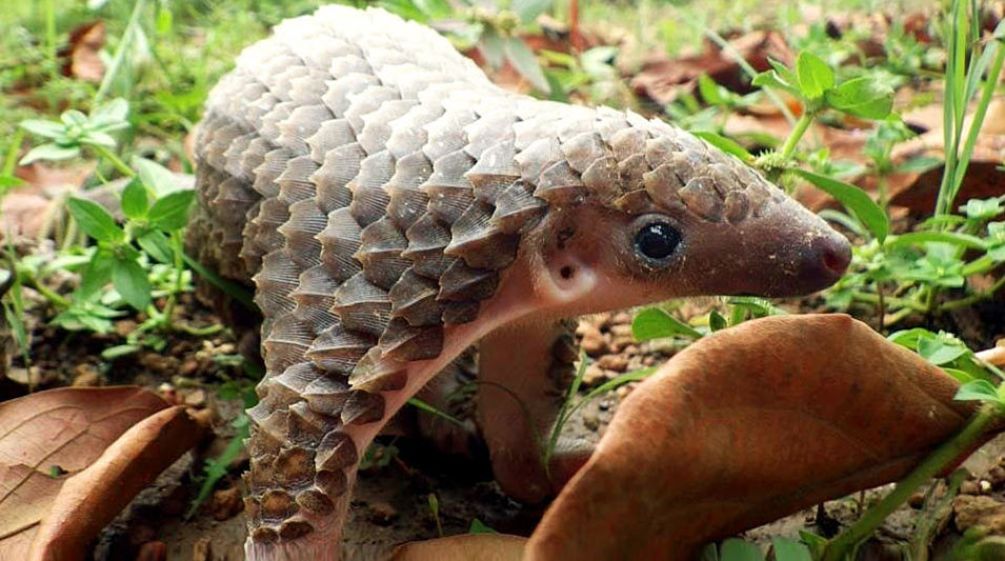
Why Are Pangolins Poached?
At first glance, many people think the Pangolin is a reptile due to its scaly armour, but it is the only mammal fully covered in scales.
Of the eight species of pangolins that live throughout Asia and Africa, four are critically endangered, and the remainder are currently vulnerable.
The biggest challenge facing the pangolin population is poaching.
Tragically, Pangolins are the most trafficked mammals in many parts of Asia, and they are being trafficked in Africa now to supply the Asian market’s demands.
Estimates of Pangolins poached vary, but reliably around 200,000 yearly and over 2.7 million since 2010.
Pangolins are highly valued for their scales, fetuses, meat and blood, which are said to have “magical” medicinal properties.
However, no scientific evidence supports the claim that pangolin scales or other body parts offer health benefits.
China, Vietnam and several other countries use pangolin scales for traditional medicine and consume the meat as a delicacy.
In 2019, 123 tons of pangolin scales were confiscated by Chinese customs.
Pangolins are excellent at hiding in the wild; depending on their species, they can be underground in burrows or hidden in trees.
Local hunters now smoke them out of trees and other habitats with fires. Poachers will also pull pangolins from trees and club them with machetes until they are unconscious.
Many pangolins are boiled alive while still bleeding and then placed in sacks for transport. These local hunters receive around US$ 1 per Pangolin, with the scales selling for up to $3000 US dollars per kilogram in Vietnam.
Pangolin meat is considered a delicacy in Vietnam, where the fetus is served whole in a broth. It is also a delicacy in China, where the scales have been used in traditional Asian medicine.
The illegal poaching and trade of pangolins is growing despite laws protecting these rare creatures on both continents.
Tragically, since 2021, Pangolins have become the most trafficked animals in the world, with the affluent far eastern countries prepared to pay the high prices demanded by the traffickers.
The trade route analysis of pangolin trafficking points to Lagos as the primary connection point both domestically and worldwide, including Southeast Asian countries.
Malaysia, Laos and Singapore are key transit countries for pangolin-scale shipments from Nigeria.
China and Vietnam are the leading destinations for these illegal shipments.

Can we save the Pangolin?
Pangolin conservation is crucial for several reasons.
Firstly, pangolins play a vital role in the local ecosystems by controlling insect populations, particularly ants and termites, which helps maintain ecological balance.
They also contribute to soil health through their digging behaviour, which aerates the soil and promotes nutrient cycling.
Moreover, pangolins are indicators of ecosystem health. Their presence or absence can reflect the overall well-being of their habitats.
Protecting pangolins helps safeguard biodiversity and the integrity of their ecosystems.
They also have cultural and economic value in many regions and significantly contribute to ecotourism.
Pangolins are victims of human greed and ignorance. Their scales are made of keratin, a protein compound similar to human fingers, toenails, and hair.
Keratin has no cancer-curing properties, either from a pangolin scale or a human fingernail.
Pangolin meat is said to have ‘magical properties. Fresh Pangolin scales are never used; dried scales are roasted, ashed, cooked in oil, butter, vinegar, and boy’s urine, or roasted with earth or oyster shells to cure various ills.
Amongst these are excessive nervousness and hysterical crying in children, women possessed by devils and ogres, malarial fever and deafness.
Eating a Pangolin fetus will not help a man or woman be more fertile, but the mother and her unborn baby have both died for this so-called traditional delicacy to help a couple conceive.
Pangolins have one baby per year, so this tradition significantly impacts Pangolin populations in the wild.
In Vietnam, a significant hub in the illegal trade of wildlife, pangolin scales are a popular product amongst Traditional Medicine practitioners because they’re thought to cure various illnesses and ailments.
TCM Practitioners have cited using pangolin scales to cure mammary gland blockages in breastfeeding women, treat rheumatism, stimulate blood flow, reduce swelling, promote the discharge of pus from wounds, and more.
The belief that pangolin scales can heal mammary gland blockages has led to dramatic increases in demand for the unique part, bringing the animal to the brink of extinction.
Relying on certain medicinal ingredients, particularly those that are wildlife in origin, can also have severe implications for the patient’s health, including possible viral infections and other dangerous reactions.
The future for the Pangolin species looks bleak. While many NGOs are working to stop the trafficking, the root causes of demand, however misguided it may be, from wealthy Asian countries and the poverty of many African people mean the trade will continue to flourish, with little chance of poachers or traffickers being caught and considerable profits to be made.
Pangolins share the same challenges as Rhino, who are also poached for their Keratin horns, which are used in the same ways as Pangolin scales. And, of course, Elephants are being killed daily for their ivory tusks – another sign of status and prestige in the Far East, in the same way we may value diamonds and gold here in the West.
We must continue to protect and educate to save some iconic animal species from extinction due to human greed and persecution.
Further Reading
IFAW Pangolins – The World’s Most Trafficked Wild Animal
If you enjoyed this blog, please check out more of our wildlife blogs here, or you may prefer to listen to the Wildlife Matters Podcast here.
If you want to support our work
Please click on the Wildlife Matters Patreon Community.
Please click to join the Wildlife Matters Substack Community.
You can donate here.