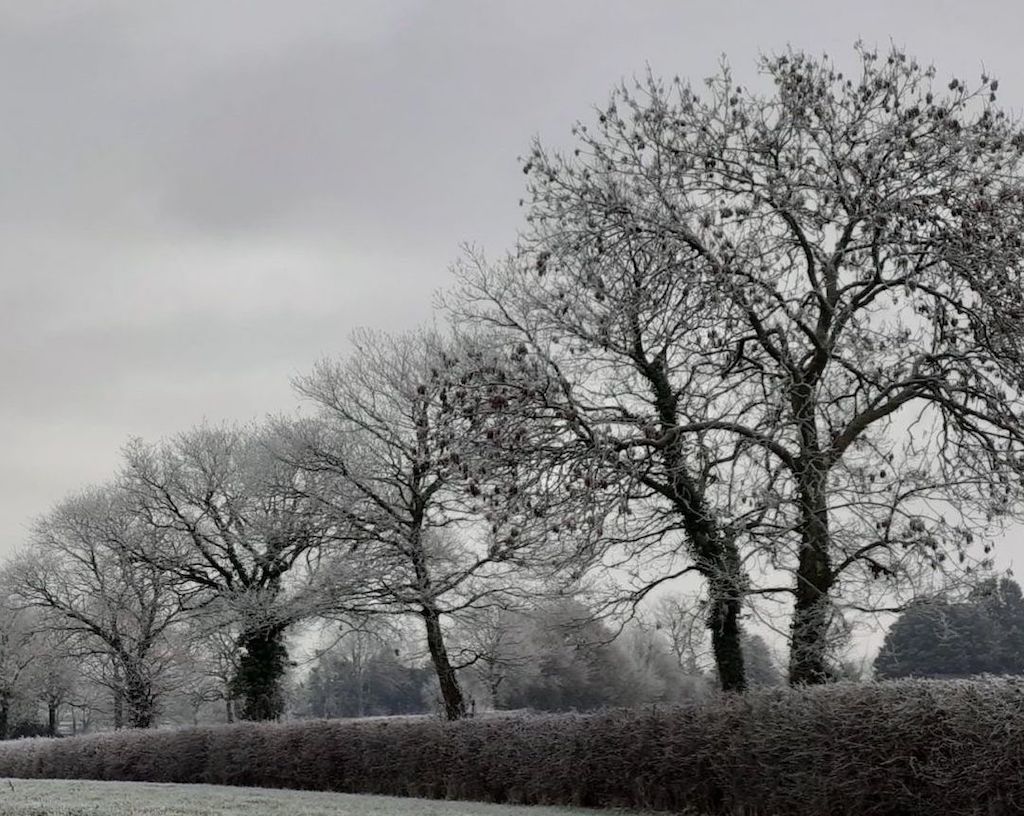
As I awoke, I was greeted by winter’s transformative touch. Overnight, a pristine layer of snow had gracefully draped the earth, casting a spell of ethereal beauty. Join me for a Winter Wildlife Walk in one of my favourite wild places.
It was chilly, minus three centigrade, as I left the house to pack the van for today’s adventure.
Anticipating the biting cold, I adorned myself with layers of warmth. From the snug embrace of waterproof boots and trousers to the comforting shelter of my winter coat, I was ready to brave the elements during my extended eight-hour sojourn.
Despite the weather, the journey to one of my favourite woodlands was uneventful. I regularly visit this woodland and know it well, which is important when you want to understand wildlife.
Every wild creature has specific needs, just like we do, so knowing what habitat provides them with food, water, shelter, and the chance to find a mate is crucial to finding that animal in the wild.
Today, I set out with a clear objective: to capture a Robin in the snow for an upcoming article on winter bird care. The anticipation of this encounter added an extra layer of excitement to my adventure.
I parked the van in the small car park and began layering my clothing. The thermal layer and walking trousers, which have become my everyday wear this winter, were supplemented with a long-sleeved base layer t-shirt, a fleece top, and my fleece-lined, warmest winter jacket.
As I sat on the van’s side door floor and put on my barefoot waterproof boots over my thermal socks, I was captivated by my breath, which was vapourising as it hit the chill air.
I put on my hat and gloves before picking up my tripod. Today, we have the big camera, as I refer to it. In reality, it is a secondhand Panasonic mirrorless camera with a couple of decent lenses.
I don’t consider myself a professional photographer, but I enjoy taking pictures of wildlife and have been fortunate enough that the wildlife often does something extraordinary when I have my camera with me.
Most of the time, I walk around with my Insta 360 action camera, and I have recently started a YouTube channel, Wildlife Matters, to share some of our wildlife adventures on video and through podcasts.
I identify with and enjoy audio. I am always listening to podcasts and have learnt so much about many subjects from them. Then, of course, there is music, which I have a lifelong love for in its many different genres. I listen to music daily and attend live music events as often as possible—but that is probably a subject for another day.
Today, I have my Zoom H5 to record background audio and my Rode Go Mics, which link to the camera and record my running commentary on the day. Most of it will be deleted, except for the occasional diamond in the hours of ramblings and rants.
I’m heading for a small thicket where a hedgerow ends, and the stream drops under the track I am following. I’ve seen Robins here before, and I think it should look good with its snow covering.
Upon reaching my destination, I was greeted by a breathtaking sight. The winter snow had transformed the landscape into a picturesque scene, with the crystal clear waters of the stream adding a touch of serenity to the setting.
I have placed myself behind some brambles and facing the old hedgerow that runs along the edge of this ancient woodland. Beyond it is a former arable field that has transformed into a wild meadow. Today, as far as I can see, it is a blanket of unbroken snow.
I set up the big camera on a tripod and my Insta360 facing the hedgerow to get some B-roll for the video. I sat in silence and waited for the robins to arrive.
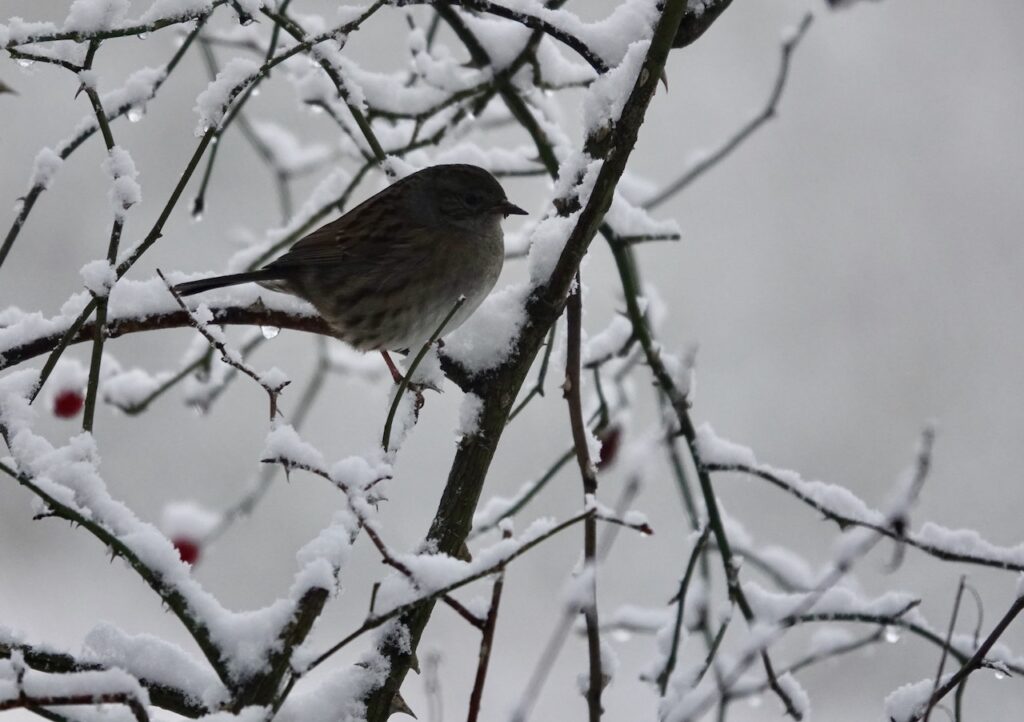
My attention was caught not by a robin but by a Dunnock, which is an excellent example of a hedgerow bird, formerly known as a hedge sparrow – although it is not related to sparrows, but is a member of a small family of birds called accentors. Also known as Passerines – meaning perching birds – Dunnocks love the security of hedgerows, where they feel safe behind thorns and brambles, secure from predators like foxes, cats, hawks, squirrels and rats who find it difficult to get into the hedge.
I was captivated as the Dunnock weaved its way through the hedgerow, occasionally hopping up into the branches of some of the trees that, although part of that ancient hedgerow had grown taller and looked a little like sentinels perched along the length of the hedge.
Dunnocks are fascinating, small birds that are constantly busy. On this cold morning, it was searching for food and seemed unconcerned by my sitting some 10 metres away behind the brambles—maybe it didn’t know I was there?
I couldn’t help but notice the array of colours on what I had always seen as a little brown bird. As with everything in nature, if you take time to observe, you will discover many layers of complexity. I think the almost pink legs and how they contrasted with the snow and the dark hues of the bare winter trees first fascinated me. Still, then I noticed the rich caramel with dark caramel contrast on the wings and head and in speckles across the otherwise grey chest and underparts, to how the beak is yellow at the base but dark ebony at the tip and how the eyes look black, but are a chestnut brown.
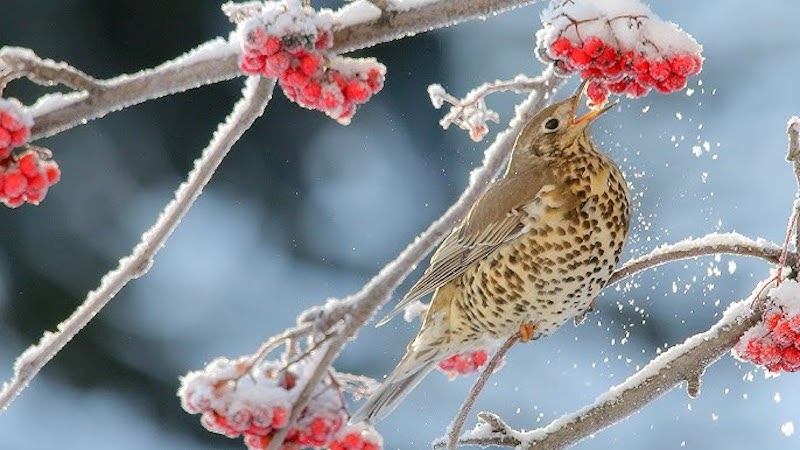
My encounter with the Dunnock was cut short by the arrival of a Song Thrush on the tree above. Although there was no threat to the Dunnock, I watched the Dunnock retreat deeper into the hedge and out of sight.
Above, the Song Thrush was perched on the Rowan tree and focused only on the plump red rowan berries that would be its breakfast this morning.
As the Thrush began to pull the berries from the tree, I could see this cascade of snow falling from the top of the bunch of rowan berries.
The Song Thrush is another underrated native bird. There is always excitement for wildlife watchers in winter with the hope of seeing Redwings and Fieldfare – both stunning thrush species, but look at our native species from the humble blackbird, the almost exotic mistle thrush and, of course, the beautiful song thrush that is currently feasting before me.
The chest’s speckles have a stunning colour palette. They range in brown shades from light to rich dark caramel, which beautifully contrasts with the creamy base feathers with a rich, creamy yellow hue.
The light brown upper wing colour is offset with wing bars ranging from a caramac chocolate bar to rich dark chocolate. The pink inner mouth contrasting with the yellow beak and dark obsidian eyes,
After a good couple of hours watching the other wildlife, I thought it was time to refocus on what I had come for—that winter Robin picture.
I moved further along the hedgerow and closer towards the old water mill pond along this track.
My boots crunched beautifully in the deep, undisturbed snow, creating that crunchy crackle sound that was a big part of my childhood.
As I walked along, the memories of rolling and making snow angels, the wooden sledge my Dad made and the frost on my bedroom window in the mornings – things I haven’t thought of for such a long time, and it felt good, Good to reminisce for a few moments before returning to the now and looking for a robin.
I put my stool down and set up the camera on the tripod, and there before me in the hedgerow was a robin – I knew they wouldn’t let me down!
Robins are curious birds; she seemed just as interested in me as I was in her. I say her, but it could be a male, as they are almost impossible to tell apart in their adult plumage.
The Robin made its way along the top of the hedgerow, occasionally dropping into its safety and security.
As I watched, I realised that it was heading towards a hawthorn tree with a good number of deep red haws – the berries of the hawthorn tree, which would provide a nutrient meal for a Robin.
Haw berries provide vital winter food for various birds and other species. They are worth seeking out at any time of year as they are an excellent tree for wildlife.
In winter, Redwings and Fieldfare will seek them out for the rich red berries; in spring, bees will flock to stunning white blossoms for pollen. Dormice and other rodents will feast on the berries in autumn to gain weight before hibernation.
They support caterpillars and a range of insects, but perhaps one of the main advantages is the long sharp thorns on their branches, which are easily avoided by small birds and mammals but not easy to avoid for predators such as sparrowhawks and, of course – people
Hawberries are also good for us. They have been used for centuries to make jellies, tinctures, and teas. They have a sweet, tangy taste and are packed with polyphenols, natural antioxidants that may have anti-inflammatory benefits, including lowering cholesterol and blood pressure and aiding digestion.
Some people use Hawberries to reduce anxiety and to make creams that are said to have anti-ageing effects. Haws are one of the natural compounds that form part of the medication a Doctor will give you if your heart has stopped.
These benefits come from a shrubby tree found in many hedgerows, parks, and ancient woodlands.
Back to the Robin, who had reached the haw berries and was pulling at one of them. The berries are relatively large for a robin-sized bird, and it had a bit of a tussle just by removing the berry from the tree.
I have observed that Robins are persistent and determined not only to see off other Robins – they are not very sociable birds – in fact, they barely tolerate a mate for the breeding season before going their way again. But they are territorial and will protect their food source, even standing guard by it throughout the day.
This Robin was clearly ‘off patch’ as it was on high alert, climbing the upper part of the hedgerow to wrestle the haw berries from the tree.
Once it had removed a berry from its small black beak, it dropped into the hedgerow to eat it safely.
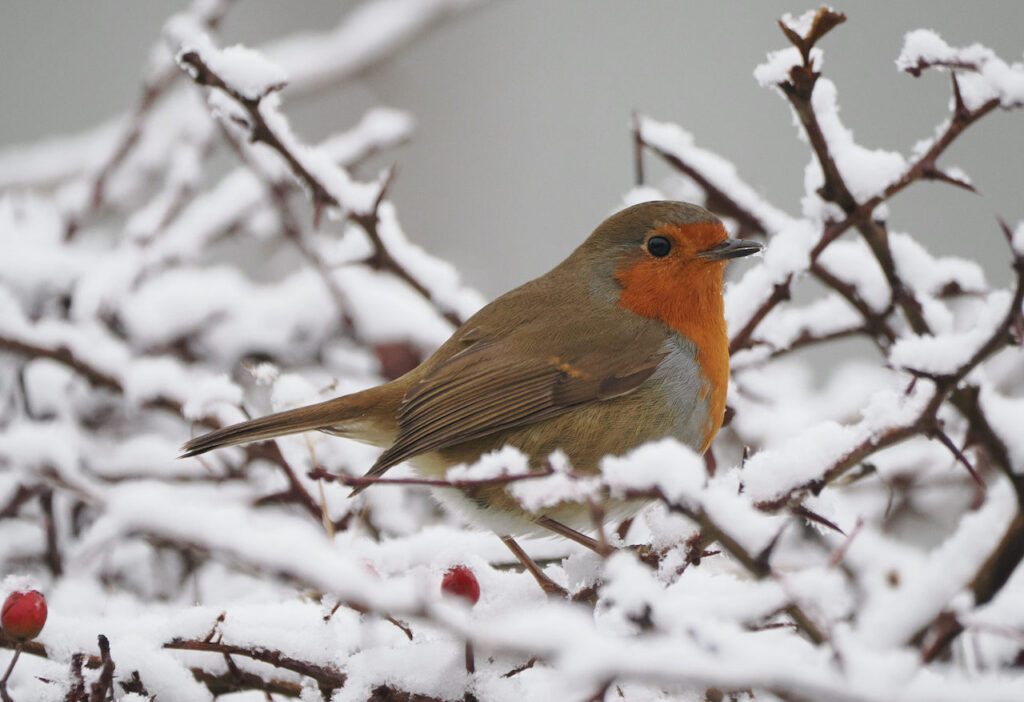
This wasn’t so good for me. I could not get a picture because it was too well hidden. I waited, hoping Robin would be back for seconds. I had no other choice.
If you have been gardening, you will know how a Robin will watch you and come in to clear the bugs and worms from any soil you have disturbed whilst planting. They will sit very close to you and often pose for a picture on the handle of your spade.
Fortunately, the Robin did return to the top of the hedgerow and once again began to pull at the hawberries. This time, I got a good collection of pictures highlighting the scale of the challenge and the effort the robin would make for one of these tasty treats.
My favourite collection is where the robin had a wee breather band with snow on the tip of the beak and water droplets on its bright red breast feathers, which contrast so beautifully with the snow and the dark snow-covered hawthorns.
Strangely, when the article was commissioned, they chose to use another picture, which is their prerogative, but it missed the point for me.
Of course, I have included it here, and I would like to hear your thoughts in the comments.
I was pleased to have got the pictures I had set out for, but as is often the way, Nature had a surprise or two in store for me, and my day was far from over.
Walking along the hedgerow, I noticed a point where it had thinned out, probably because a tree had died, leaving a gap in the hedge. I like to peer through the gap and look at the meadow area beyond, and that is what I did today. I glanced casually, stopped in my tracks and scrambled to set up the camera.
Fortunately, I was hidden behind the hedgerow, so my improvised fumbling with tripods, cameras, and stools was not the disturbance it could so easily have been
In the copse at the far side of the field, a pair of Roe Deer Doe were browsing the Barron branches for leaf buds.
As I settled and focused, I could see a male pheasant roosting in the branches of one of the trees, with the deer browsing beneath him. Of course, being a pheasant, he was not going to move, and he sat there, back to the deer, his stature clearly saying, “I am not moving.”
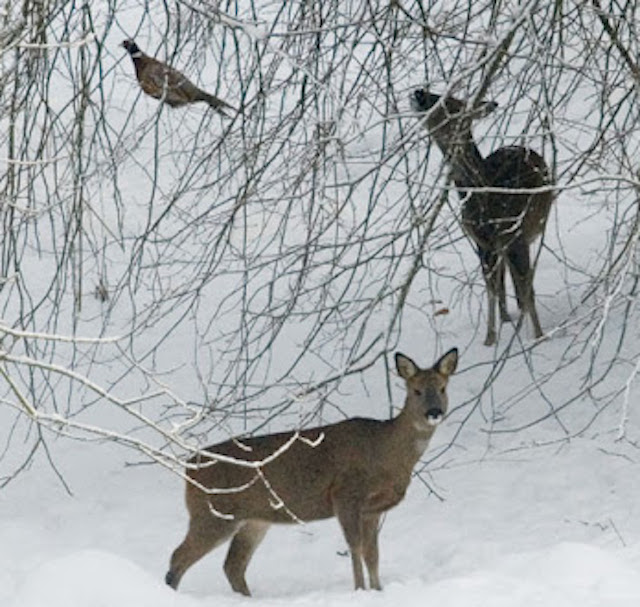
The Deer were not interested in the pheasant making his stand to maintain his perching spot, so they continued to browse around him.
This situation continued for quite some time, with the deer gaining their fill of the meagre scraps of foliage on the trees at this time of the year and the pheasant resolutely holding his roosting perch.
I hope you enjoy this picture from the collection. One of the Roe Deer is looking at me while the other browses the treeline, and that fabulous pheasant ignores the deer and me and looks to the eastern boundary of the copse.
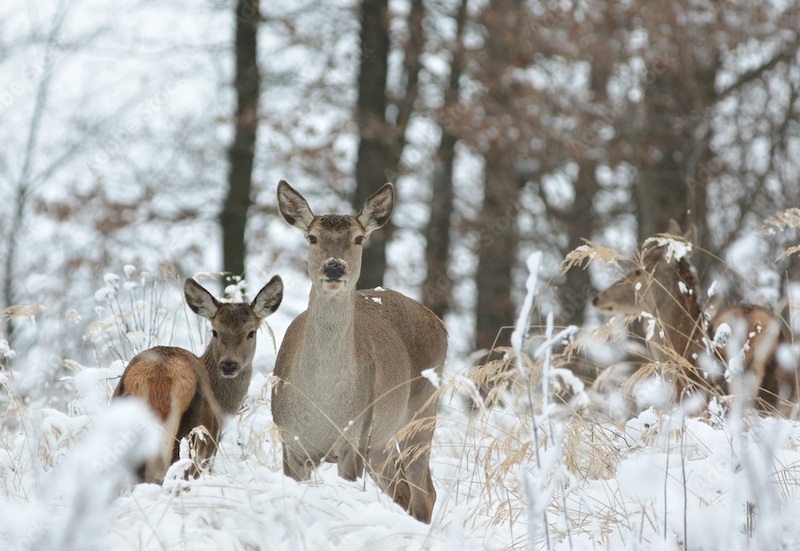
I have also shared a picture of the two Does – who may have been a mother and daughter. As they were leaving, they stopped and looked back in my direction. I was around 800 metres away from them and behind a tall hedgerow, but they knew I was there!
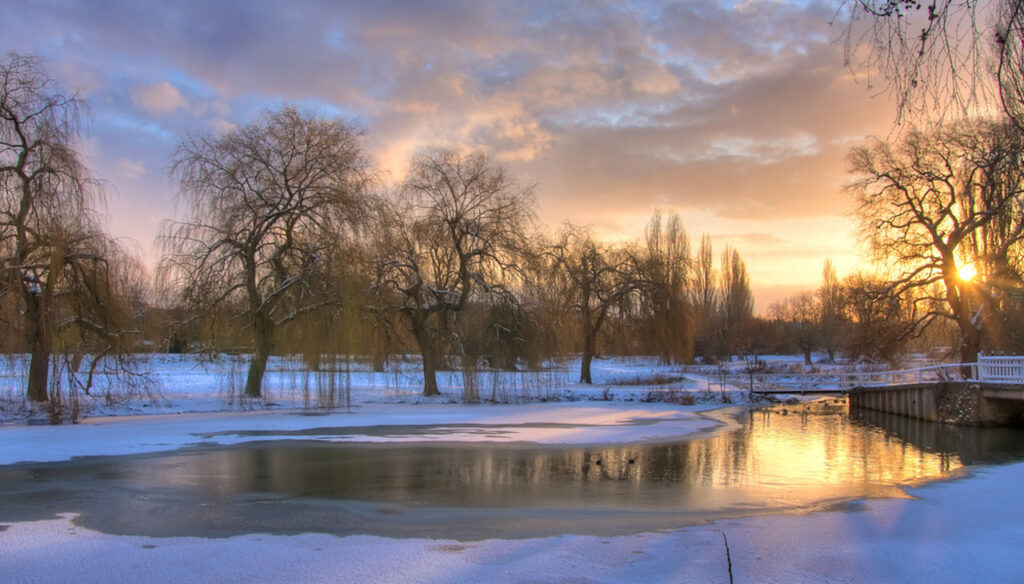
After sharing some magical moments with the Roe Deer, I decided to set off for Mill Pond. The low winter sun often creates incredible reflections on the water, and with the snow lying around the edge, it could be a magical winter scene.
It was late afternoon when I arrived at the Mill Pond, and the sun descended towards the horizon – work done for the day.
The pond was still partially frozen, and with snow lying around it and on the ice, it was the magical winter scene I had hoped for. I set up my camera and captured some stunning late-afternoon winter images.
While happily taking pictures of the lake, a brief flash of blue streaked with orange caught my eye. I knew what it was instantly.
I took my binoculars out and began to scour the banks of Mill Pond, and then I saw him. Sitting on the nearby tree, devoid of foliage and with snow piled on its small branches, this winter tree was not the best place to hide if you were a bright blue and orange Kingfisher.
Yet there he sat. Perfectly still. His bright orange breast matched the sun’s rays, making his iridescent feathers erupt with radiant electric blue.
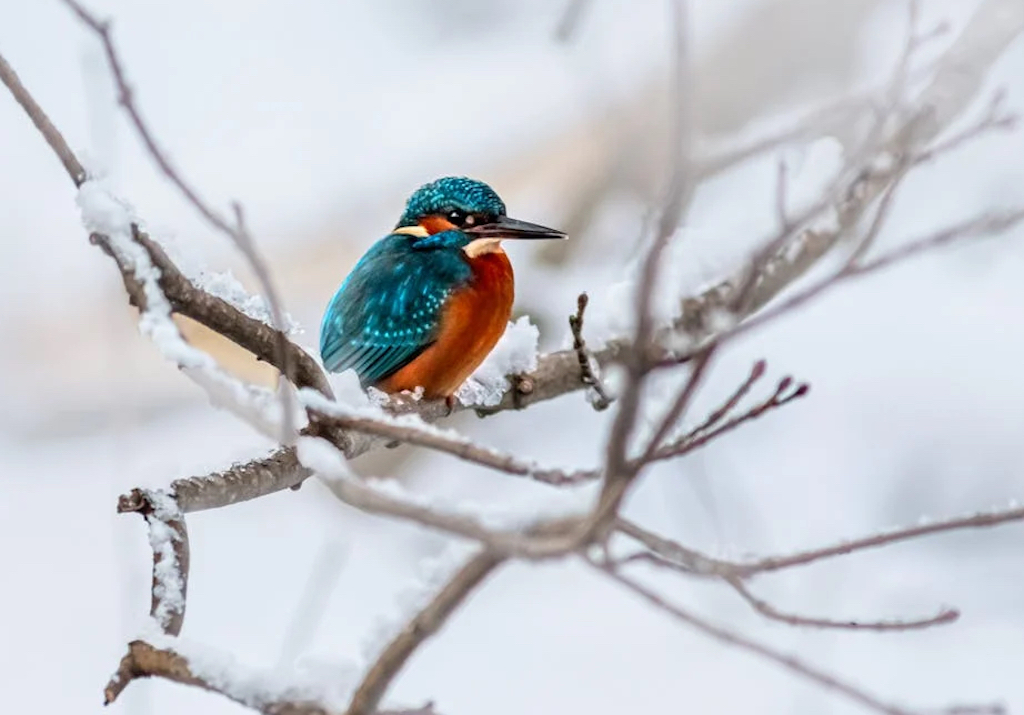
His head plumage was vibrant, as were the electric blue pin spots on his wings. His dark obsidian eyes were still, like the deep mill pond waters and a tiny water droplet perched on the end of his long, dark beak.
His feathers were not ruffled as they would be if he were cold and trying to regain body heat. I thought that he hadn’t been into the water for a little while, which meant there was a good chance he would be looking to feed before sunset.
I sat completely still and in silence, only occasionally moving my fingers to press the camera button and to prevent the cold from setting in through my fingerless gloves.
We sat and waited for what felt like an eternity. He wasn’t preening his feathers; it was as if he had gone into a trance as he reflected on the still, silent waters of the half-frozen Mill pond.
The cold was biting at my fingers, which were beginning to burn. A feeling I’m sure you know, but that isn’t so easy to describe.
Several minutes later, the Kingfisher moved, just a shuffle of the feet on the branch, the rest of his body remaining perfectly still. Then, a slight movement from his head as if something had caught his eye.
My frozen fingers ached as I stretched them to cover the button on the camera, and I slowly selected the rapid shot function that would take multiple pictures for one press of the button.
Again, we sat perfectly still and in complete silence. In the distance, I saw a dog walker and a beautiful collie, but they were on the far bank of Mill Pond.
Through my camera lens, I saw the Kingfisher move his head slightly and then launch from the branch; like an arrow released from a bow, he headed straight towards a gap in the frozen pond waters.
My frozen fingers reacted as quickly as possible to hit the camera button. The motor in the camera whirred as it took multiple images of the kingfisher dive, and then he returned to the branch.
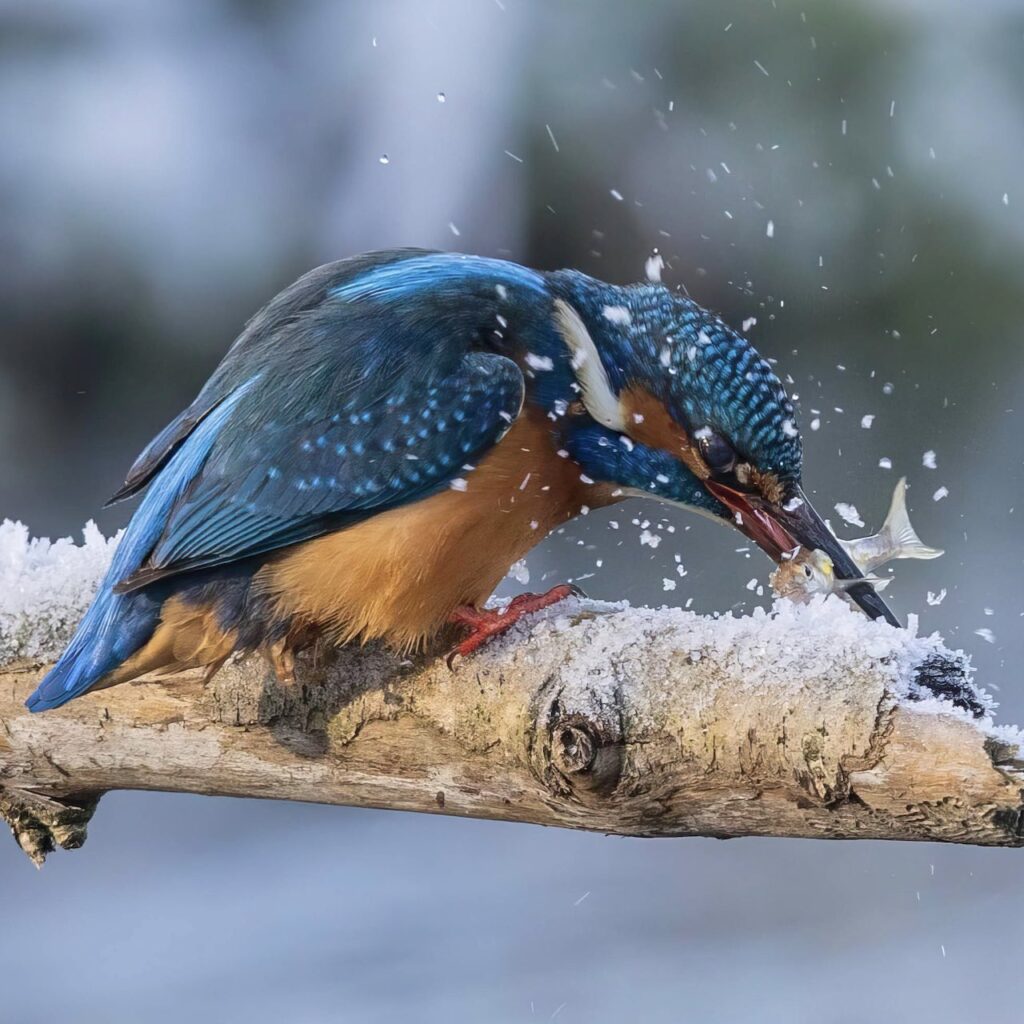
Nestled between his beak was a small fish, possibly a Minnow. The fish was positioned across his beak as the Kingfisher tried to move it around so he could swallow it head first.
The fish instinctively wriggled, hoping the kingfisher would let go of it and it could drop back to the safety of the millpond.
The kingfisher raised its head and slammed the fish against the branch. The snow on the branch flew into the air as the Minnow wriggled and twisted until the Kingfisher raised its head again and slammed the fish against the icy, snow-covered branch.
This time, the Minnow didn’t wriggle or move. I don’t know if it was stunned or had been killed, but it was now a straightforward repositioning of the fish, and it quickly disappeared down the Kingfisher’s throat.
The Kingfisher sat still for a few more minutes before flying off to look at another area of the pond with some open water as the ice had relented during the day.
I decided to pack up and return to the van. It would be about a twenty-minute walk, and I hoped that would warm me up.
As I walked along the track through the ancient woodland, reflecting on what a wonderful day I had just enjoyed in the winter woodlands, I remembered that I still had some homemade soup in my flask; that would be something to look forward to when I returned to the van.
As always, I hope you enjoyed today’s winter wildlife walk and that it gave you a little insight into how I spend some of my days. I wish more could be like this, but sadly, that is not the case.
I would like to hear about your adventures in nature. If you have any local places you would be happy to share with me, Wildlife Matters could see some of the wildlife in your patch of nature.