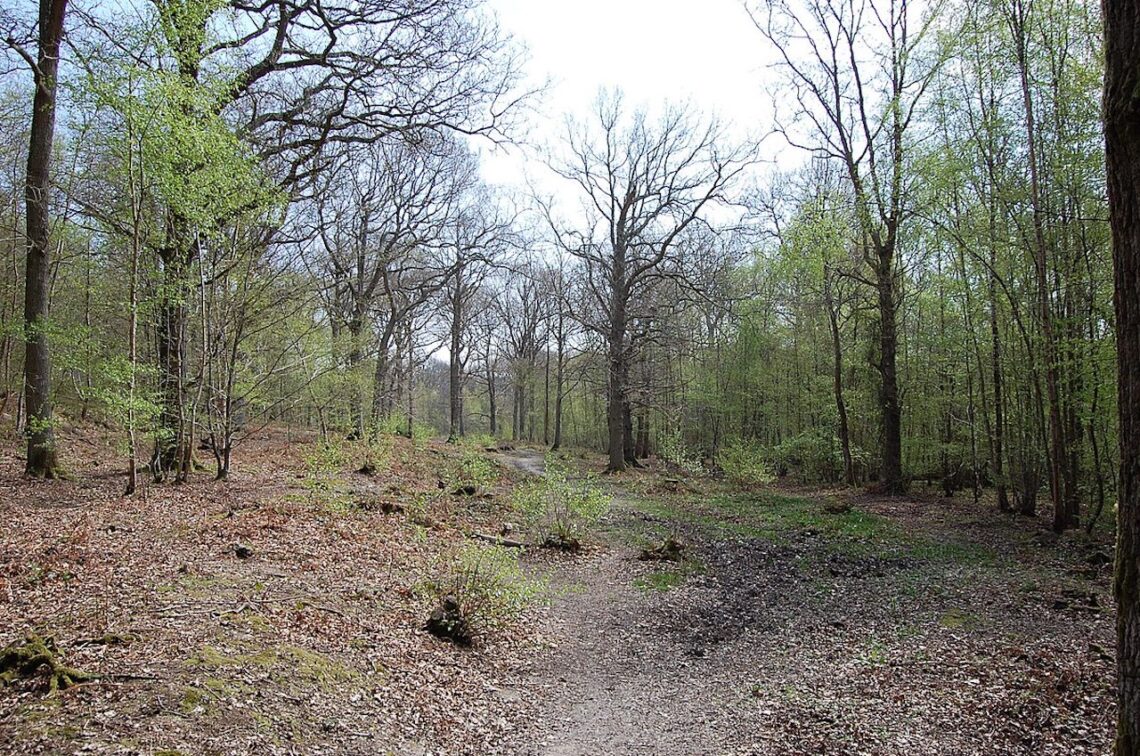

Today, Wildlife Matters has come to explore the High Weald in Flatropers Wood, a beautiful 38-hectare woodland, to search for some of the fascinating wild plants that can be found in winter.
This ancient woodland is known for its streams, ponds, and a spectacular display of bluebells in early spring. However, today, in the cold depths of winter, we embark on a journey of discovery. We are setting out to find some of the best winter plants in southern Britain.
The first wild plant I noticed was a clematis, which I spotted along the hedgerows during my drive this morning. Although it is abundant, many people tend to overlook it. When I inform them that it is a clematis, they are often in complete disbelief, as they typically associate the name with the pretty flowering garden varieties that climb in our gardens.
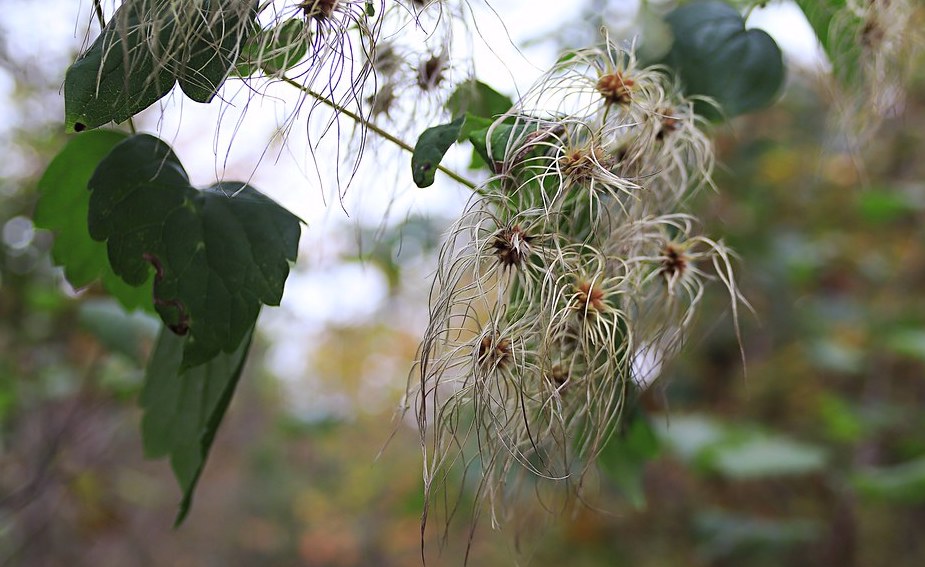
Traveller’s joy or Clematis vitalba
Old Man’s Beard, commonly known as Traveller’s Joy, is a wild cousin of the garden species. This woody climbing plant vigorously scrambles and climbs through trees and other vegetation. In winter, its feathery seedheads flow gracefully from the skeletal structures of the Barron woodland edge trees.
Traveller’s Joy can grow both vertically and laterally, extending up to 30 metres in either direction and sometimes in both at the same time. It disperses a large number of seeds that are attached to feathery filaments, which are carried by the wind. Due to its rapid growth and capacity to cover other plants, shrubs, and trees, Traveller’s Joy is considered invasive in many areas. Although it lacks tendrils, its branches can twist and adapt to secure themselves from other plants.
This plant features a one-pinnate arrangement with diametrically opposite branches at right angles. As the only native species of Clematis in the UK, Traveller’s Joy can become a fast-growing weed in other countries. It can climb to great heights and cause significant damage to trees.
The flowers emit a faint but sweet fragrance, especially when they bloom in large clusters. Unusually for a member of the Buttercup Family, it has four green-white sepals that curl beneath the flowers and are hairy. The styles eventually separate into fine, feathery filaments, each attached to a large seed in the centre—often numbering around a dozen.
The feathery filaments resemble an “Old Man’s Beard,” which is how the plant got its common name. The main stems are oval and may have two prominent ribs. As they mature, the stems become woody.
In Switzerland, these plants were historically used to make rope, bind crops, and weave baskets for storing onions.
However, it is essential to note that Traveller’s Joy is toxic. It contains Ranunculin, which, when ingested, is enzymatically converted into the poisonous Protoanemonin—a toxin found in all members of the Buttercup Family. Damage or maceration of the plant, such as by grazing animals, releases this unstable glucoside, causing nausea and often stomach cramps and diarrhoea.
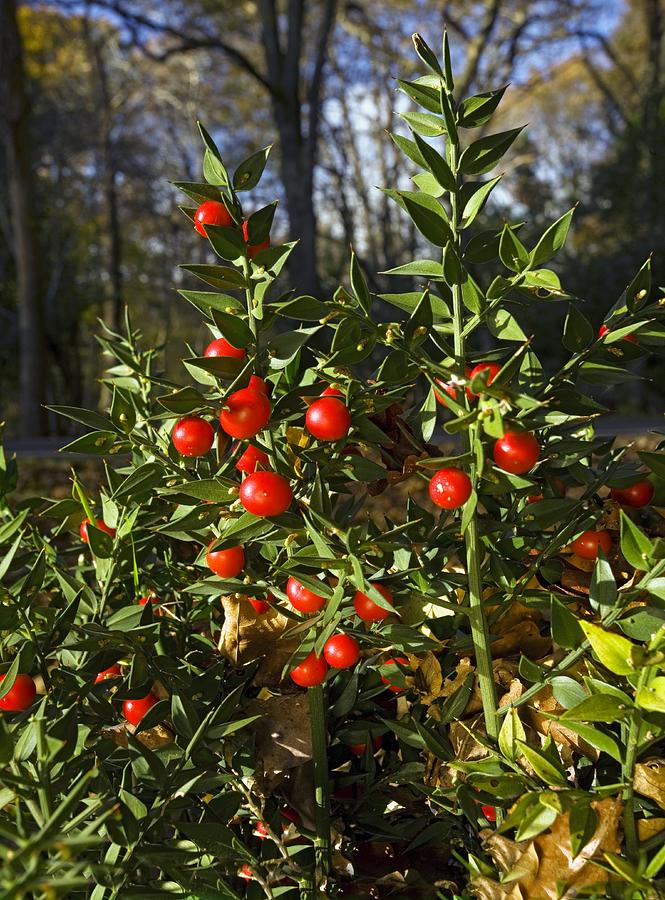
Butchers Broom Ruscus Aculeatus
Butcher’s broom is recognised as an ‘ancient woodland indicator’ because it does not readily colonise new habitats or spread quickly to new areas; when it grows, it typically indicates that the woodland has existed for a long time.
The New Forest has many ancient woodlands and numerous butcher’s broom plants. These plants grow beneath deciduous trees, even in the more shaded areas.
It is still relatively scarce, even in the south of England so it was exciting to find it here today.
Butcher’s broom (Ruscus aculeatus) is unlike any other British plant. It is a short, evergreen shrub that can grow about two feet high. All its leaves end in a pointed spike, which is why one of its old English names is ‘knee holly.’
In early spring, tiny, pale green flowers with six petals bloom in the centre of the leaves, revealing that these leaves are flattened stems.
Historically, butcher’s brooms were used to scrub butcher’s blocks until the nineteenth century. Their spiky leaves were ideal for cleaning cuts in old wooden blocks.
Butcher’s broom is a curious evergreen shrub related to asparagus and lilies. It is steeped in historical significance and adds colour and vibrancy to the shady corners of the countryside in winter.
Butcher’s broom prefers well-drained, poor soils. Its sturdy, water-retentive structure allows it to withstand drought, which is likely why it thrives in the dry plains of southern Europe.
The plant grows in stiff clumps of glossy, prickly foliage, forming impenetrable and sometimes expansive stands on the woodland floor. It rarely exceeds thigh height (hence the old name: knee holly). Interestingly, leaves appear to be ‘cladodes’—flattened branches with sharp spines on the ends.
True leaves are tiny and grow at the base of these cladodes. After two or three years, some stems die and turn brown, and this desiccated foliage can remain entangled in the plant for a long time, with the spines still formidable!
Butcher’s broom is dioecious, meaning it has separate male and female plants. Both types produce delicate green and purple flowers in the middle of the cladodes, but only the female flowers develop into fruit. The fruit starts as a tiny green bead that swells and turns into a succulent red berry, giving the plant a festive appearance.
Due to their attractive appearance, butcher’s brooms were often picked and arranged indoors for Christmas. Additionally, their sturdy foliage was once used to scrub butcher’s blocks long before the advent of plastic bristles and disinfectants.
The plant contains antibacterial oils that may have improved butchery hygiene practices, potentially leading to fewer cases of food poisoning and increased business.
A concoction from the roots has been used to treat various ailments, including gangrene, circulatory issues, and tissue swelling. The ancient Greeks used butcher’s broom mixed with wine as a laxative and diuretic for treating kidney stones.
Furthermore, some sources claim that it contains anthocyanins, which may have potential uses in cancer treatment.
Few animals eat this plant despite its medicinal properties due to its spiny defences. Butcher’s broom has two methods of reproduction: underground rhizomes and berry dispersal by birds. The rhizomes are believed to be responsible for most of its spread, but deliberate planting—due to its popularity as a shade garden filler—also contributes to its range expansion.
Alongside the wild variety, several cultivars have emerged and escaped into the wild, a familiar story for many plants with desirable features favoured by gardeners.
Like its cousin asparagus, new shoots of butcher’s broom can be eaten, and the seeds inside the berries can be crushed to make coffee.
Overall, it is a beneficial shrub. If you ever need to cultivate a single plant during an impending apocalypse, butcher’s broom might be a great choice—it provides sautéed shoots, tinctures made from its roots, and a way to clean your space!
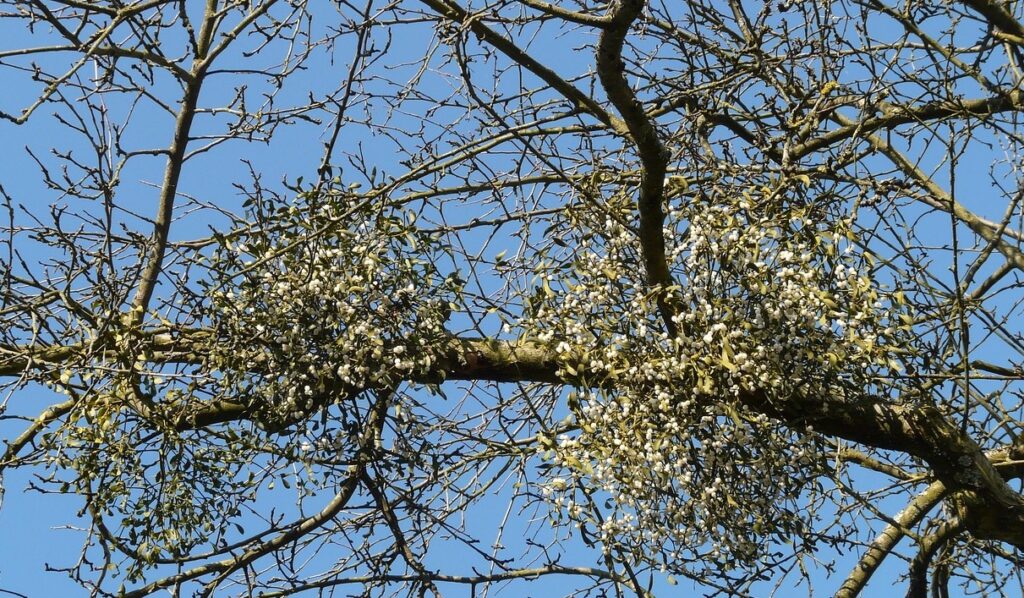
Mistletoe Viscum Alba
Mistletoe is characterised by its white berries and oval, evergreen leaves. It predominantly grows in the southern and western parts of the UK, often found along wood edges and in orchards.
The scientific name of this white berry translates to “white goo.” It is commonly known by various local names, including Churchman’s Greeting, Kiss-and-Go, Masslin, Misle, and Mislin-Bush.
Mistletoe is said to have properties that can help alleviate epilepsy, which is not entirely unfounded. It contains an antispasmodic active principle that can lower blood pressure.
The plant is often associated with ancient Druids, who revered it during the winter solstice, as documented by historical figures like Pliny and Caesar. Its striking pearly white berries thrive even in the starkness of winter, much like holly and ivy, which are respected plants that flourish when fewer wildflowers bloom.
Mistletoe is dioecious, with male and female flowers on separate plants. The sticky white berries appear between November and December and can only be found on female plants.
These berries are a food source for the Mistle Thrush (Turdus viscivorus) and other birds. Due to their sticky nature, they often cling to the birds’ beaks, allowing them to be transported to new high branches where they can germinate.
Mistletoe typically grows near the tops of trees, as birds prefer to be elevated. However, it only establishes itself on first or second-year tree growth, and it may take a full year to root and connect with the host tree to extract nutrients and fluids. During that first year, it relies entirely on its resources.
As a hemiparasitic plant, mistletoe obtains some nutrients from deciduous trees, preferring apple trees (Malus), which account for 40% of mistletoe occurrences. Other trees it commonly grows on include lime (Tilia), hawthorn (Crataegus), black poplar (Populus), willow (Salix), false acacia, and occasionally oak (Quercus).
While it can grow on nearly any tree, this is much less likely. Mistletoe is commercially cultivated primarily on apple trees for the Christmas market, where it is traditionally used for kissing under.
Mistletoe grows when its seeds stick to a tree’s bark, thanks to a sticky, viscous liquid they contain. The mistletoe typically produces four leaves in the first year on one branch. Each subsequent year, it branches once, doubling the number of branches annually until it forms a globular mass that expands over time.
In the past 15 years, mistletoe has spread more rapidly than usual. This increase is attributed to another bird, the Blackcap, now assisting with its dispersal. The Blackcap is particularly effective at placing seeds in more secure spots on tree bark, thus enhancing the chances of successful germination compared to Mistle Thrushes.
Mistletoe can conduct photosynthesis but primarily relies on its host for water and minerals through distinct swellings, known as galls, where it connects with the host tree. Although it may appear embedded in the bark, it grows on the surface, causing the tree to produce bark over and around it, resulting in a structure known as a haustorium.
After attaching itself to the bark, the mistletoe seedling sends tentacle-like structures into the tree, enabling it to absorb nutrients, especially water. These tentacles penetrate only a short distance into the host tree. In response to this intrusion, some trees, like maple, produce toxins in specific cells to prevent further invasion, and other species may respond similarly.
Several subspecies are found worldwide, but only the ‘parent’ species, Viscum album, grows in the UK. This species contains a toxic protein and lectin known as “Viscumin,” which has a high molecular weight. Other sources also mention viscotoxin as one of the plant’s poisonous components. Like ricin, it is a ribosome-inactivating protein, although the two substances target different sites on the ribosome.
While mistletoe is toxic, fatalities are rare. The toxin is concentrated in the white berries but is present throughout the entire plant. In addition to viscotoxins, mistletoe contains various other chemical compounds. 0Recently, a new acyclic monoterpene glycoside was discovered in mistletoe. It has no common name and a lengthy chemical name.
Mistletoe has its highest density in the UK in Somerset and Devon, with a broad distribution across the home counties and minor occurrences along the Mid-Wales border. It is virtually absent north of South Yorkshire, except for a few rare hectares, and primarily thrives in gardens and orchards where conditions are favourable.
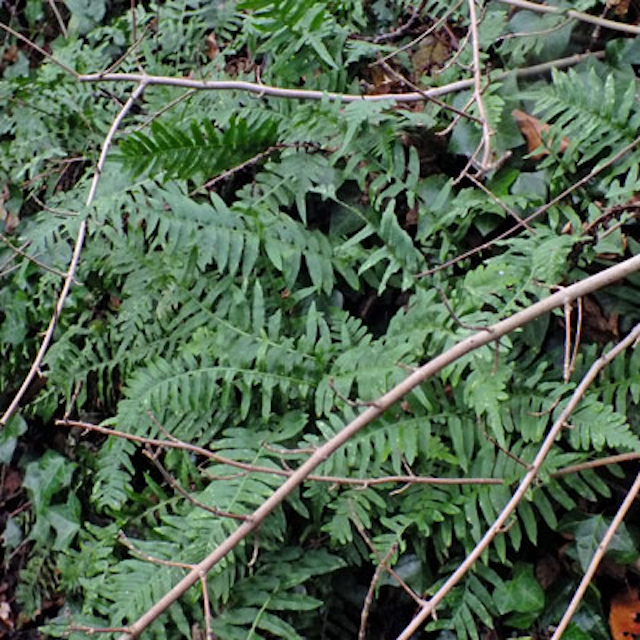
Common polypody (Polypodium vulgare)
The common polypody (Polypodium vulgare) is a striking and resilient fern that thrives in shady woodlands’ cool, damp underlayers.
This medium-sized fern is easily recognisable because of its unique, ladder-like fronds, composed of simple, finger-like leaflets radiating from a central stem. The fronds exude a leathery texture and offer a robust appearance that adds an enchanting touch to their environment.
One of the most notable features of common polypody is its distinctive, pimply undersides, which house clusters of small, round spore-bearing organs.
These spores display vibrant colours, shifting between bright yellow and rich orange, creating a stunning contrast against the green foliage. This visual charm is particularly pronounced when viewed from below.
Common polypody prefers the humid and shady microhabitats found in gorges and along woodland banks.
Common polypody often occurs in rocky crevices, mossy branches, or old walls. Its ability to cling and adapt allows it to flourish in challenging environments. Although it thrives in moist conditions, common polypody is also quite versatile. It can withstand relatively dry spells, making it an excellent garden choice.
The common polypody can exhibit epiphytic behaviour in particularly humid woods. Here, it derives its moisture and essential nutrients from the air and rain, growing harmoniously alongside other plants without competing directly for soil resources.
The common polypody is a resilient inhabitant of damp woodlands and a captivating fern that adds life and texture to its surroundings, whether in its natural habitat or cultivated gardens.
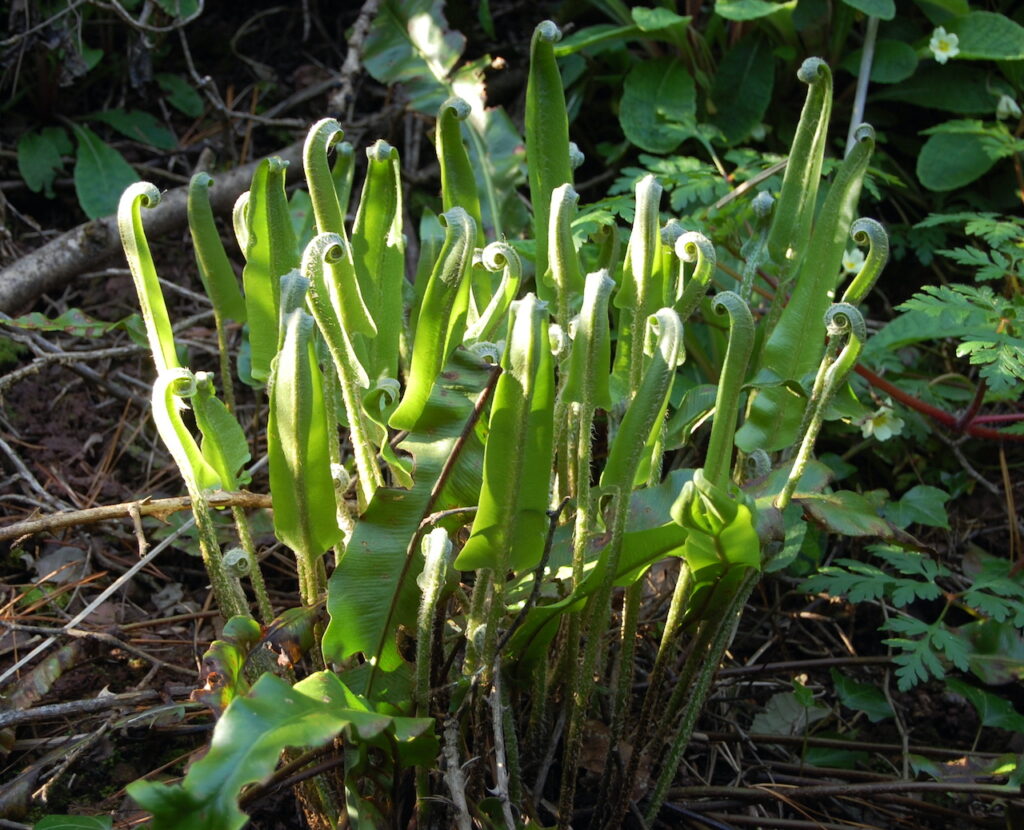
Hart’s tongue fern (Phyllitis scolopendrium)
The hart’s tongue fern is a member of the Asplenium family, also known as the spleenwort family, which consists of over 700 – mainly tropical species.
This fern is unique to the UK due to its long, strap-like leaves that develop wavy edges as the plant matures. The name “Hart’s tongue” comes from the resemblance of the leaves to the tongue of a young red deer stag.
Hart’s tongue fern thrives in shallow soil and is often found growing among the roots of trees and bushes or in cracks within walls. It is a native northern hemisphere plant common in the UK, particularly in southwest England. However, it is rare in the United States, where it exists in isolated populations and is classified as Endangered.
Unlike flowering plants, ferns do not produce seeds or flowers but reproduce via spores. The hart’s tongue fern produces distinctive chocolate-coloured spores on the underside of its leaves, which are shed between August and March. The shape of its sporangia reminded medieval people of the spleen, leading them to believe the plant could help treat ailments related to this organ, based on the Doctrine of Signatures. The dark brown lines on the leaves also inspired the Latin name “scolopendrium,” which refers to a centipede.
According to “A Modern Herbal,” Hart’s tongue fern can help relieve liver disorders, spleen hardiness, and stoppages. The herbalist Culpepper noted that “distilled water is perfect against the heart’s passion, can relieve hiccups, support the palate, and help stop bleeding of the gums when used as a gargle.” Long before Culpepper, Galen recommended an infusion of this fern for dysentery and diarrhoea. In rural areas of the UK, it was used as an ointment for burns and scalds.
Britain’s only native fern features tufts of strap-shaped, often wavy, evergreen leaves 4 to 20 inches long. The spore cases are located on the underside of the leaves in slightly curved rows, and the spores ripen between August and March.
The Hart’s tongue fern prefers to grow on walls, rocks, in woods, and along hedge banks, favouring the western regions of Britain. While it can be found throughout the UK, it is generally absent from the Scottish Highlands.
Flatropers Wood showcases a variety of geological features, with multiple soil types found within just a few kilometres. Limestone is a key component in the underlying structure, and the soils above it provide an excellent growing environment for this distinctive fern.
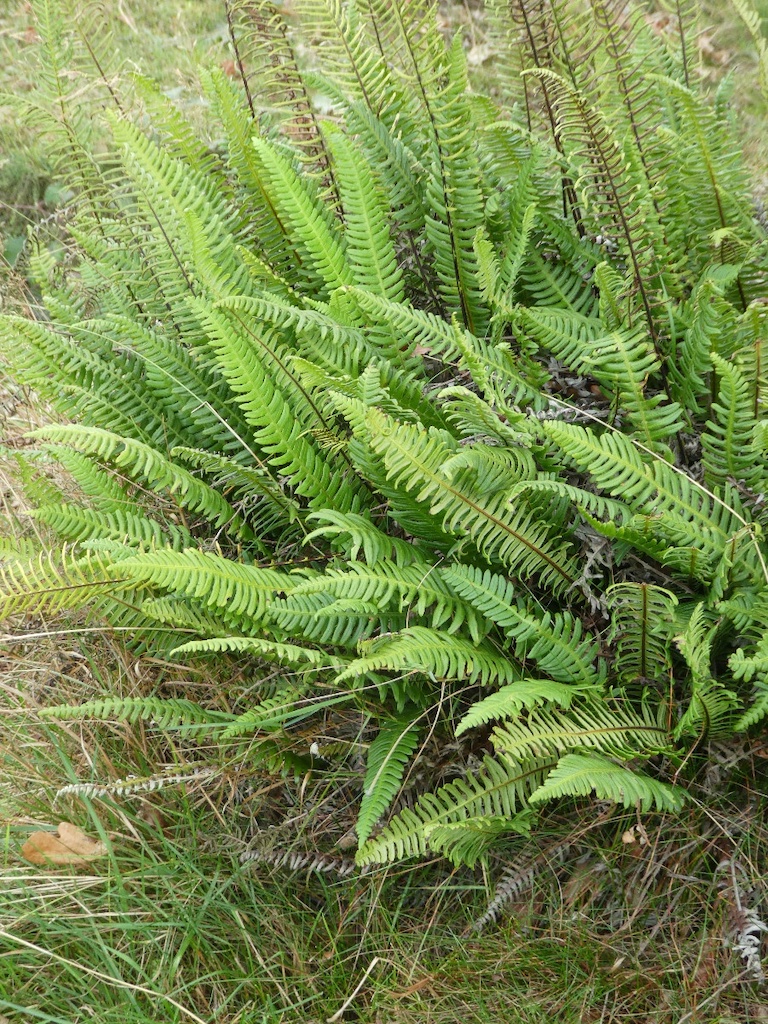
Hard fern (Blechnum spicant)
Hard fern is an evergreen in woodlands, dry stone walls, and rocky banks. It is native to Britain and is commonly referred to as deer fern. This species has two types of fronds: the sterile fronds are broad and lobed, while the spore-bearing fronds are narrow and comb-like. It primarily grows in acidic soils.
This fern forms dense clumps of evergreen fronds that typically measure 30-50 cm in length and 5-15 cm in width. The fronds are finely divided, leathery, and dark green, arranged in a rosette shape. Unlike other ferns, thorny fern fronds do not have leaflets but consist of small spiky segments resembling deer antlers, contributing to their common name.
Blechnum spicant is a popular ornamental plant often used as a ground cover in rock or woodland gardens. It thrives in moist, shady sites and adapts well to different soil types. The plant can be propagated from spores or by dividing its rhizomes.
Hard ferns are hardy and adaptable, thriving in woodlands, moors, and upland areas. For centuries, they have been used for their medicinal properties. Historically, hard ferns have been valued for their medicinal properties. The plant contains tannin, known for its astringent qualities, which can help treat diarrhoea and dysentery. Additionally, its leaves have been used as a poultice for wounds and sores due to their anti-inflammatory properties.
In folk remedies, hard ferns have been used to treat various ailments, including coughs and colds. They are also believed to have diuretic effects that help with urinary tract infections.
Hard ferns are easy to grow and require minimal maintenance. They thrive in damp or shady areas but can adapt to various conditions. They should be planted in spring or early autumn, ensuring they are placed in well-drained soil enriched with organic matter.
As a vital component of forest ecosystems, hard ferns provide habitat and food for numerous animals. Their fronds can be used as bird nesting material and food sources for caterpillars, slugs, and insects. Moreover, hard ferns help stabilise the environment by reducing soil erosion and mitigating the effects of heavy rainfall.
Although hard ferns are not considered endangered, they face habitat loss and degradation threats. Clear-cutting forests for agriculture or development destroys their natural habitats. Additionally, over-harvesting for medicinal or ornamental purposes can further jeopardise their populations. Therefore, preserving their natural habitat and promoting responsible cultivation and harvesting practices is crucial for survival.
Hard ferns have been important in traditional medicine and folklore across many cultures. In European folklore, the plant was believed to protect against evil spirits and was used as a charm against witchcraft. In Welsh mythology, the hard fern was associated with the fairy kingdom and was thought to possess magical powers. It continues to serve as a traditional remedy for numerous ailments in various regions.
This is my first visit to Flatropers Wood, and there is so much to see and enjoy in this beautiful woodland. We have discovered many stunning wild plants—so many that we will cover the rest in part two. As I stand in this beautiful glade filled with birdsong, which I have featured in the first picture, I am excited to share my experiences. This is Wildlife Matters looking forward to completing our adventure at Flatropers Wood next time.
Recommended Additional Reading