
Over the past three years, Wildlife Matters has gained recognition for our storytelling walks during the equinoxes and solstices, as well as for our articles and podcasts on wildlife and nature. Join us today for our Waterfall Walk to celebrate the Spring Equinox.
It’s 5.30 am on a beautiful sunny morning, and the air is sharp and crisp after a deep frost. Today is Spring Equinox also known as the vernal equinox. It signifies the astronomical start of spring in the Northern Hemisphere and the beginning of autumn in the Southern Hemisphere.
Today, the Sun crosses the celestial equator, making day and night roughly equal in length. This natural event occurs twice a year: in spring and autumn. For those who prefer the Gregorian calendar, it is the 20th of March.
I’m looking forward to sharing a mystical adventure with you today as we explore some of the hidden waterfalls of a very well-known 500-acre wood that is home to one of the best-loved fictional characters that was part of so many of our childhoods, and for many has continued into their adult lives.
I have parked Raven, the campervan, in one of the many car parks, all of which charge. Despite being dry for the last couple of weeks, most are bumpy and full of puddles.
As I set off on the rough path, the signs of spring are barely noticeable as the path enters a small copse; the only indication of a change from winter is the clusters of hazel catkins.
There are no flowers on the forest floor and no green shoots. The leaf buds remain tight and brown, but with all the early spring warmth and sunshine, this will all change soon.
Although I am exploring the 500-acre wood, which is known as a forest in the real world, it is primarily heathland that covers the area.
This was a royal hunting forest in Tudor times, and while the hunting has thankfully ended, many deer still call this forest home.
The native Roe deer population is said to be stable, but the introduced Fallow deer herd is growing, and in recent years, Muntjac deer have been seen in the more densely vegetated areas.
As I leave the small wooded area, a sea of yellow washes over the area, and the path begins to climb. The Gorse provides a stunning yellow wash of colour, stretching almost as far as the eye can see.
Despite the chilly east wind, the sun felt warm on my face. The sun’s light and warmth return just a little more each day. This thought made me smile, which grew wider when I heard the curlew call. Wildlife has to adapt quickly to the seasonal changes, and spring is the time to mate and raise their young.
During previous Spring Equinox walks, we visited Stonehenge, Amesbury Ring, and walked to Glastonbury Tor. Still, as some may have guessed from my teasing this year, we are exploring the beautiful in Ashdown Forest.
I promised waterfalls on today’s walk, and you may be thinking waterfalls in Sussex? Which would be fair, but stick with me because you are in for a pleasant surprise.
These waterfalls are mystical and hidden; you might say they lie off the main tracks of Ashdown Forest, but that adds to their allure and magic for me.
Although our adventure today is audio, you won’t miss anything. Pictures are on our website and social media platforms.
You may decide to experience this walk yourself, but I suggest you wear waterproof boots as the tracks are muddy and rough. The walk is around 5km and will take one to two hours, depending on how long you stay at each attraction.
This walk is medium to difficult in places, and the waterfalls are especially hard to find as there are no footpaths or signage. I recommend you get the Ordnance Survey Explorer Map 135 before heading into the forest.
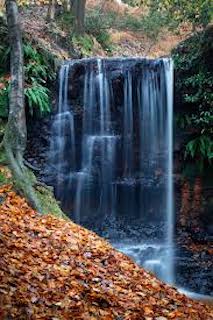
We are starting our journey to Mungo’s Waterfall, which many consider the most spectacular waterfall in Ashdown Forest.
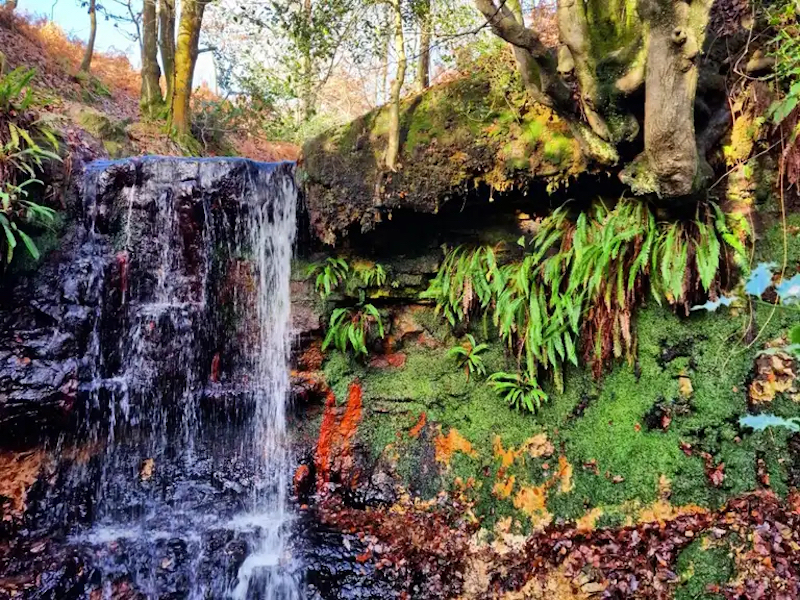
Although the waterfall is about 1 km from Hollies Car Park, no signposts guide you to it. To reach it, head to the right of the information boards at the car park and walk south-southwest. Follow the rough track downhill, disappearing into the surrounding vegetation and scrub. As you walk, listen for the sound of running water in the distance.
Follow the sound, and you will discover a stream. Follow this stream until you come upon one of two waterfalls cascading into a clear pool below. Some may choose to stop here, but for the most magical experience, I recommend taking a short but steep climb down to the pool.
The view is truly rewarding as you gaze back at the crystal-clear water tumbling over the stepped layers of rock shaped by millennia of erosion. If you haven’t already, look at the pictures on our website – you will think you are in Wales or Scotland.
I look up at the cornucopia of fern species covering the rocks. Lady Fern and lemon-scented fern are prominent, but I can see triangular fronds of the Broad Buckler fern.
Mosses and lichens are abundant, and I am currently working to improve my knowledge of them, but I can see oak, beech and holly trees with exposed root systems around the upper edge of the waterfall.
I need to move along, as we have two more waterfalls I would like to share with you today. There are many more within Ashdown Forest, but these three are the most magical and mystical, and that is the essence of a spring equinox walk.
We are now at the car park for Ellison’s Pond, one of the 126 ponds within Ashdown Forest. The headline resident is the Great Crested Newt, which can be found in many ponds and not just isolated populations.
Other claimed pond inhabitants include the great Diving Beetle, and I am told that 46 of the 57 Dragon and Damsel fly species recorded in the UK have been recorded here, so a return later in the year to see some of them sounds good.
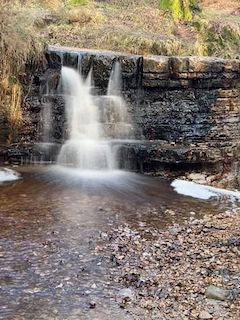
The Garden of Eden waterfall is approached via muddy and unmade tracks, but can be found by taking a circular route on AllTrails. I recommend following this or using GIS, as there are no signs, and it would be easy to get lost.
When you leave the car park, walk between the two parts of Ellison’s Ponds—they look like two separate ponds—and turn left.
In mid-March, I am walking through waist-high Gorse – a prickly experience at best. However, Gorse flowers with that familiar strong scent of coconut have been used in herbal remedies to lift spirits and counter feelings of hopelessness for centuries, so with my spirits lifted, I press on.
Gorse is also used in homoeopathy and Bach flower remedies for emotional balance. Additionally, gorse flowers have been traditionally used for various health conditions, such as jaundice, scarlet fever, and as a flea repellent.
After a few minutes, we begin to leave the Gorse behind, and now the path heads through grazed grassland. Although no cattle are present today, this meadow would have traditionally been flooded over winter to keep the land warm and raise grass for feeding livestock much earlier than if it had not spent the winter under water.
I’m not sure that happens today, but the muddy paths indicate this is a wetland meadow.
As you cross the open meadow, the clump of trees in the distance to the left is called the Friends’ Clump.
Although we won’t be visiting today, the Friends Clump is a stand of Scots pines planted in the Ashdown Forest in 1825 for Elizabeth, Countess de la Warr, whose family owned much of this land until 1988. At the time, the locals were unhappy about introducing Scots Pine, cutting down many trees to make their point clear.
The current clump was planted in 1973 by The Friends of Ashdown Forest for an initiative called ‘Plant and Tree in 73′, which I don’t remember, but the excellent Chris Skinner mentions it on his Countryside Podcast and adds it ran again as ‘and plant some more in 74”
The path takes a turn and begins a fairly steep uphill climb here. It is lined with heather, one of the many ways commons are so diverse in species.
The path is muddy and crossed by ghyll streams, abundant throughout the Ashdown Forest due to its altitude, around 200 metres above sea level. This altitude is high for Sussex, so the forest experiences high annual rainfall.
The path continues to rise when a bridge comes into view. A little unusual as it appears to be in the middle of nowhere. It’s called ‘Nobby’s Bridge”
A plaque at the bridge is dedicated to Albert “Nobby” Clarke and Mary Ellen Clarke. After the bridge, you will see two paths, both of which take you to the Garden of Eden waterfall.
Whichever path you arrive on—I came via the Ghyll side path—you will see a clearing in the earth bank that runs alongside the path.
This may have been a cart track a century or so ago, but it leads straight through the shallow ghyll waters. On my right, you can see the Garden of Eden waterfall.
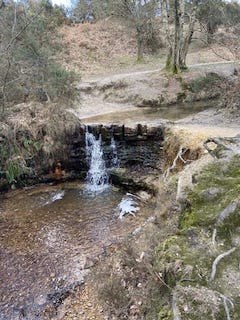
I have to be fair and say it isn’t the tallest or fastest waterfall I’ve seen, but it would be an excellent place for a puddle on a warmer day.
I don’t know how this charming waterfall found its name because its setting is more like a cart wash than what I imagine to be the abundance of the Garden of Eden.
It didn’t hold the magic and mystery you could feel at Mungo’s waterfall, but with all that said, I am pleased to have found it and am now looking forward to finding the third, and I am told the most mystical waterfall on our adventure.
There are several options to start this part of the adventure, including from near Chelwood Vachary, on the A22.
I’ve parked Raven, my campervan, at Streeters Rough, which possibly tells you more about us than if we had parked opposite at the larger and more accessible Chelwood Gate.
The path will take you towards Chelwood Vachary and the gardens.
The house and formal gardens are now private, but the woodland has open public access and is maintained by the Conservators of Ashdown Forest.
The term “vachery” comes from a Norman word meaning cow, dairy, or cattle shelter. It is believed that cattle have been kept on this site since Medieval times.
Chelwood Vachery was constructed in 1906 by Sir Stuart Samuel, a Member of Parliament.
In 1910, he created a Forest Garden that featured four lakes and ponds, each equipped with a weir and sluice.
In 1925, the house was sold to F.J. Nettlefold, who hired the renowned landscape designer Gavin Jones to create a “Gorge” using limestone boulders from Cheddar Gorge.
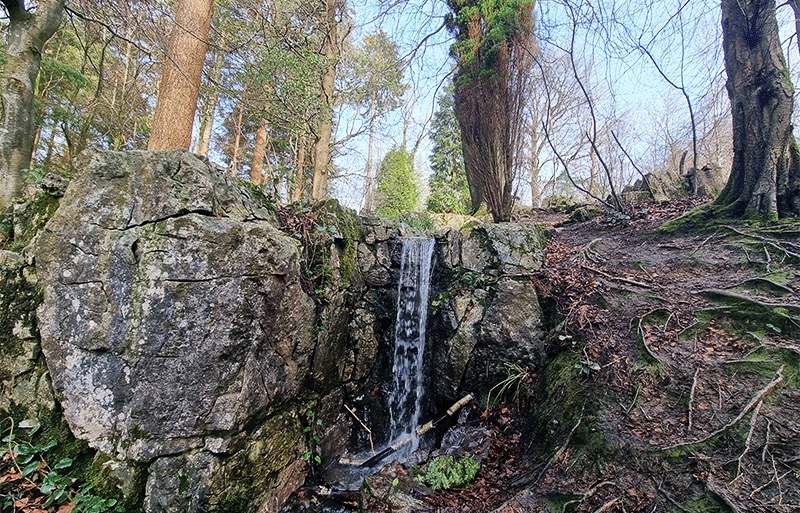
As I walked along the woodland edge path, I could see some water, which turned out to be one of the ponds and an infinity pool, which was doing its best to reflect the early spring sunlight.
There is a definite feel of nature reclaiming the man-made elements of the woodland garden, and I like the wild and slightly unkept look.
The woodlands are mixed broadleaf, but not of any significant age. There is precise plantation planting still standing in regimented straight lines that scream’ manmade.’ In contrast, the natural part of the woodland has the magic of nature that nurtures us and the wildlife that call it home.
Although it is early spring, the birds are quiet here, and I have to think hard to recall seeing grey squirrels, wood pigeons, and Jackdaws.
I don’t know, but my instinct tells me this woodland is popular with dog walkers and the wildlife lives somewhere else.
As I approach the top of the waterfalls, the sound of water tumbling and splashing reaches my ears.
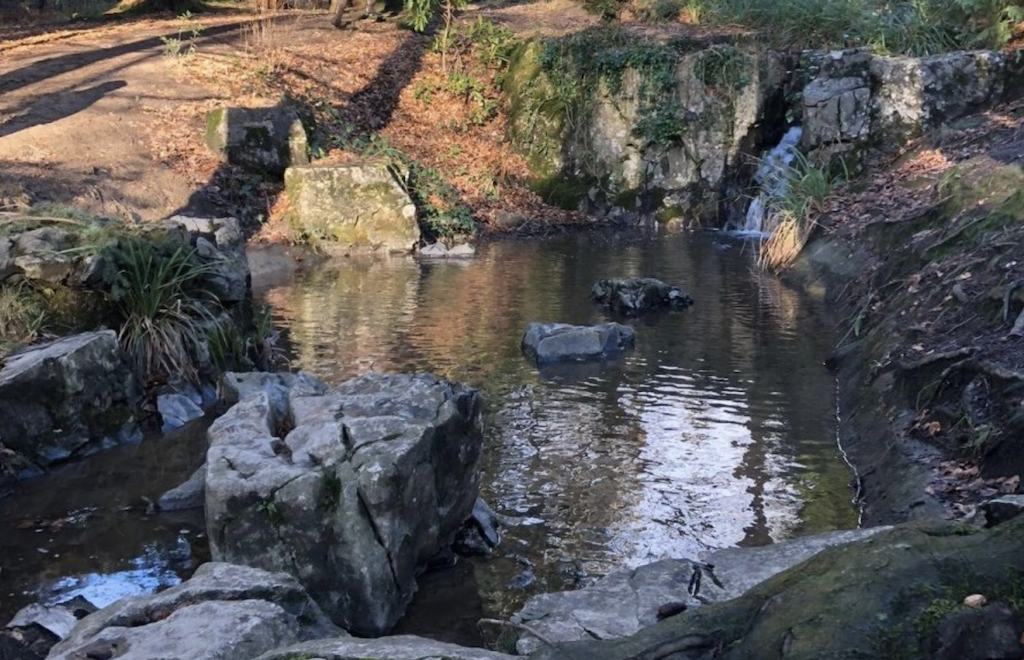
I can see the waterfall gently tumbling down the rocks through a series of pools before gently cascading to the valley below.
The boulders from Cheddar Gorge stand in the valley’s pool, giving the sense that you could be in Derbyshire or Wales, but strangely, not Somerset. I do like their sense of wild ruggedness.
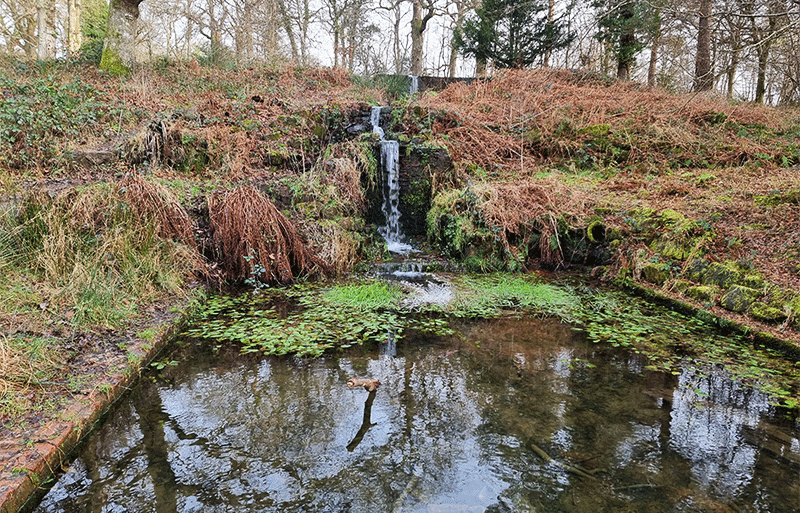
The Chelwood Vachary falls should be an oasis for wildlife. On a sunny equinox afternoon, I would expect to see birds bathing in the clear, shallow waters that ripple gently and reflect light with stunning intensity.
It is early afternoon, so it’s not ideal for wildlife watching, and I hope this magical place comes alive after dusk. It would be good to see badgers, foxes and deer drinking from the shallow pool as the bats sweep over it, harvesting the insects they need to fuel their forage flights.
At this time of seasonal change, the burnt oranges of bracken and russet brown leaves that lie where they fell last autumn are joined by a kaleidoscope of greens of every shade and shape as spring begins to break through.
The wild daffodils are joined by the buds of magnolia and Ransomes, or wild garlic, which loves to grow beside a stream or pond.
There are also rhododendrons here, their pinky-purple flowers peeking out of the foliage. I’m not a fan and hope the Conservators are actively managing them out of this habitat where they don’t belong. They are a wooded mountain plant that shouldn’t be making a home in Sussex.
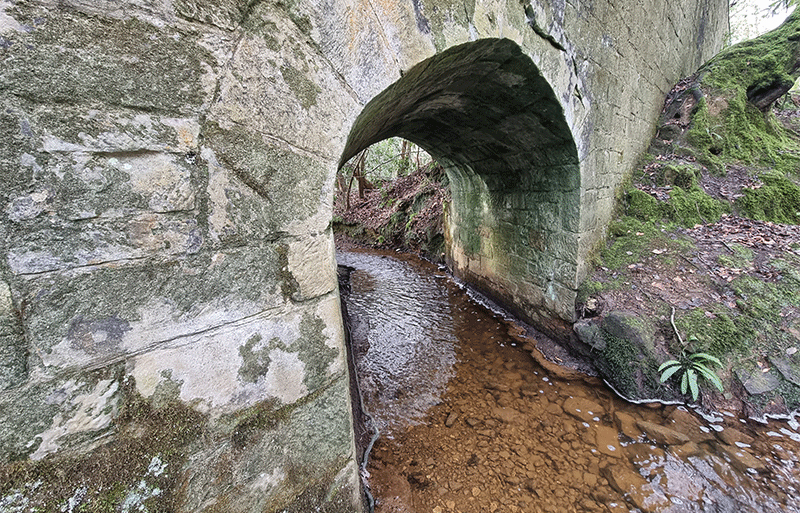
Moving along from the pool at the foot of the waterfalls, follow the stream, and you will arrive at a folly bridge with steps on one side and a slope on the other. It’s ‘reclaimed by nature look’ with ivy climbing the steps and walls to join the mosses and lichens that call the bridge home.
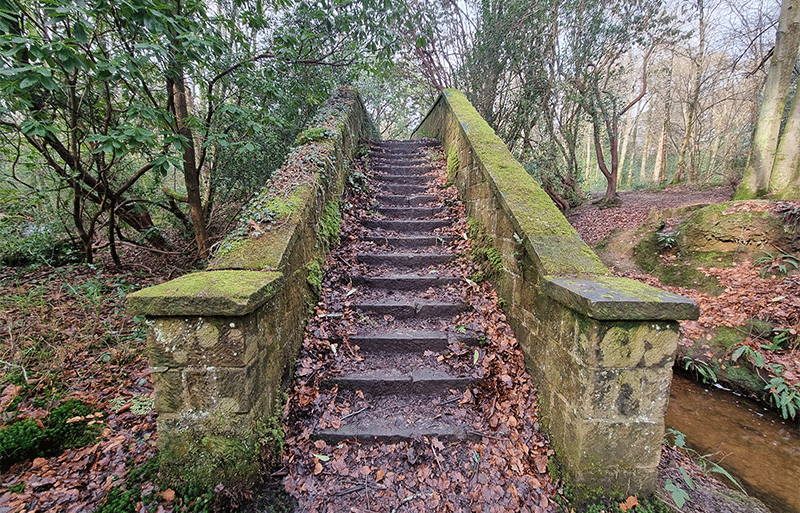
Take a peek over the edge, and you will see the stepping stones that give you another way to cross the Millbrook stream.
Continue along the path for a short distance, and you will be back at Chelwood House.
This would be a good place to end part one of our Spring equinox special, where we have been searching for the waterfalls of the historic Sussex forest.
But please join us for part two, where we will remain in the Ashdown Forest as we explore the fictional 100-acre wood and the characters from A. A. Milne’s works who call it home.
If you want to support our work
Please click on the Wildlife Matters Patreon Community.
Please click to join the Wildlife Matters Substack Community.
You can donate here.
Further Reading
This both looks and sounds AMAZING. It is so descriptive and beautifully written, I actually felt as though I was on the walk myself …. Thank you 💖