Thank you for joining me for Part Two of this spring walk in the Ashdown Forest, or perhaps I should say to explore Winnie the Pooh’s 100-acre wood.
We are in Gill’s Lap Car Park and will take the long walk, which is approximately 3.5 km. However, a shorter route is available that allows you to see most of the highlights of the Pooh Trail.
There is so much wildlife and nature to see in the Ashdown Forest, especially in early spring, that we hope to share it with you.
An initial look around from the car park as I lace up my walking boots on this sunny but slightly chilly spring morning confirms much of the Ashdown Forest is heathland, although there is a large and thick copse of Scots pine trees we will pass as we begin the trail.
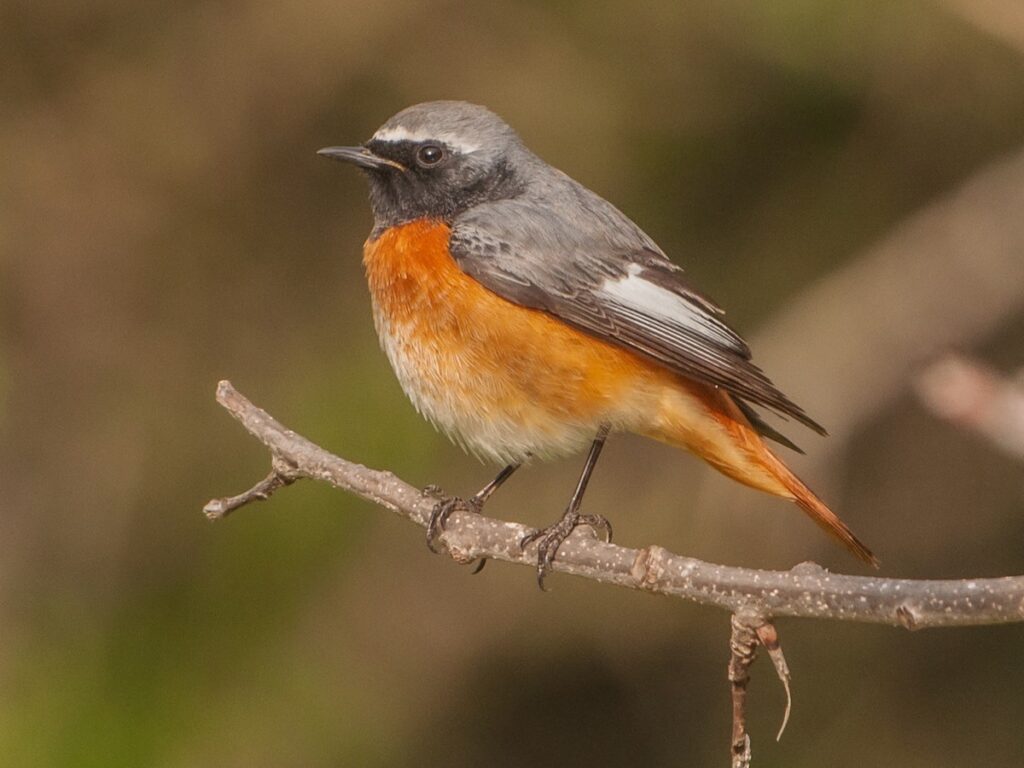
A melodic song emerges from the pine copse as I walk by, barely a couple hundred metres from the car park. I stopped to listen and could see, perched on the branch of a pine tree, a pinky-red bird with a black face, silvery-white forehead, grey back with a vibrant red tail. It was a male Redstart who was perhaps a little early to be singing in late March, as the females tend to arrive from their long flight from sub-Saharan Africa in April, but I was incredibly pleased to hear his wonderful song.
Now, in the magical world of Winnie the Pooh, this place is called Galleon’s Lap, a dense clump of Scots Pine trees.
Nobody, not even Christopher Robin, has been able to count the number of trees as Milne wrote:
Christopher Robin knew that it was enchanted because nobody had ever been able to count whether it was sixty-three or sixty-four, not even when he tied a piece of string round each tree after he had counted it”
We continue across the scrubby heathland, where gorse and bracken are the dominant species, to rejoin the main path from the car park. The heather is low and dense, with just a hint of the flowers that will later this year turn this area a stunning hue of light purple and blue.
There on the heather is a stunning blue butterfly which I stop to watch as it settles and unfolds its wings, flicking them open and closed.
There are only a few Butterflies I can confidently identify in the field, but this one is, I think, the Common Blue. I’m sure it could feel the early warmth from the sun as it began its climb towards the midday point and was soaking up the energy like a little blue solar panel. As I stood still and took some pictures, I could see on the hind wings a metallic-like reflection and some small green-blue circles in a line.
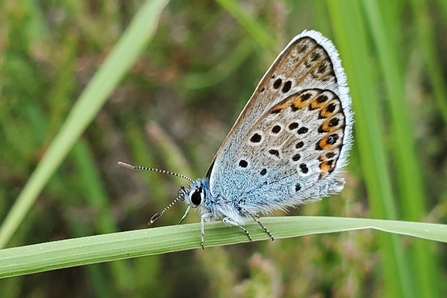
It’s time to take a look at my app, as I now don’t think this is the Common Blue. With a bit of help from my app, I now know I am looking at the very beautiful and relatively rare Silver Studded Blue, which is only found in the south east of England and a few places in Wales. Whenever I see a new species, it’s a good day for me and a great chance to share my picture.
This walk is flat and can be completed in about an hour. However, I know it will take me much longer because of all the stops I tend to make. I’m starting to think that my four hours in the car park might not be enough time, so I decide to keep moving.
The path is straight and sandy. It’s dry today, but you can see that it washes out during the winter. I suppose it would be different if we had a typical spring with showers, which we haven’t had this year.
Sometimes, if you stand on the bottom rail of a bridge and lean over, the river slipping slowly underneath…”.
That is a massive clue that we are heading for the first of Winnie the Pooh’s special places on today’s walk – the famous Poohsticks Bridge.
The path heads gently downhill towards the stream until you arrive at a bench and a clearing. If you, like me, will be reliving your childhood throughout this walk, this is where to gather your Poohsticks.
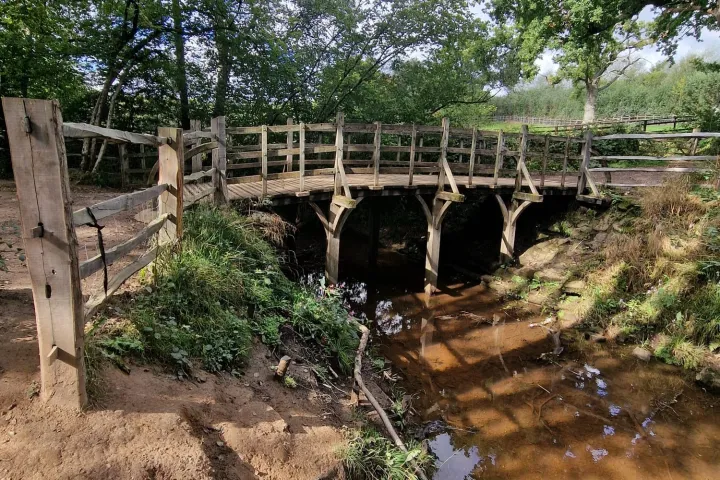
I must add here that you should only gather fallen sticks from the trees and certainly NEVER break your poohsticks off the branches of the trees here. Today, plenty of sticks are on the ground, and I have eagerly gathered a small handful.
The clearing, or glade, is filled with spring flowers such as bluebells, wood anemones, and dog violets, accompanied by the pungent scent of wild garlic.
After gathering my sticks, I walked another 200 meters along a flat gravel track to reach the bridge that leads to Poohsticks Bridge. As I stepped onto the bridge, a huge smile broke out on my face. I stood there, looking in anticipation. There were five adults on the bridge and no children; I suspected this was the norm, except perhaps during school holidays.
Two couples were playing nearby, and I asked a lady with her dog if she wanted to join me for a game of Poohsticks. She smiled and replied, “Of course.” I shared my bundle of twigs with her, and we stood looking upstream when she said, “Let the games commence. “nd there we were, complete strangers engaged in a friendly yet competitive game of Poohsticks. That is the magic of Winnie and his friends.
As we launched our first sticks into the water, we hurried to the opposite side of the bridge to see whose stick would emerge first. Everything else in the outside world faded away as I focused on the sticks as they made their way down the stream. My new friend won the first race, but by the end of our five-race series, I emerged victorious with an impressive three wins to two.
We watched as our poohsticks floated down and joined the many others that had collected just downstream of the bridge. I’m sure one of the Rangers has the daily task of entering the stream to retrieve the sticks and return them to the glade for the next day’s competitors.
I turned to my new friend and thanked her for the game as she, Kathryn, and her Springer Spaniel, Luna, headed in the opposite direction at the end of their walk for the day. Playing Poohsticks on the bridge was great fun, and it was heartwarming to see people of all ages recreating their childhood memories.
The Poohsticks Bridge is situated at the original location where Christopher Robin and A.A. Milne played together. This bridge was built in 1979 due to wear and tear from its increased popularity following the fame of Winnie the Pooh.
After visiting the bridge, I went to look for Winnie the Pooh’s house. I can’t believe how excited I felt. It seemed as though I’d effortlessly stepped into a childhood storybook, captivated once again by the characters from A.A. Milne’s stories.
In reality, Pooh’s House is only about 50 meters along the footpath, but you need to take the small path to the left, which leads to it.
“Once upon a time, a very long time ago now, about last Friday, Winnie-the-Pooh lived in a forest all by himself under the name of Sanders, begins one of the stories.
“What does ‘under the name ’ mean? asked Christopher Robin. “It means he had the name over the door in gold letters and lived under it.”
Story lovers know that Mr. Sanders lived in Pooh’s house before Pooh arrived, but the silly old bear never bothered to take down the sign! Who Mr. Sanders was remains a mystery.
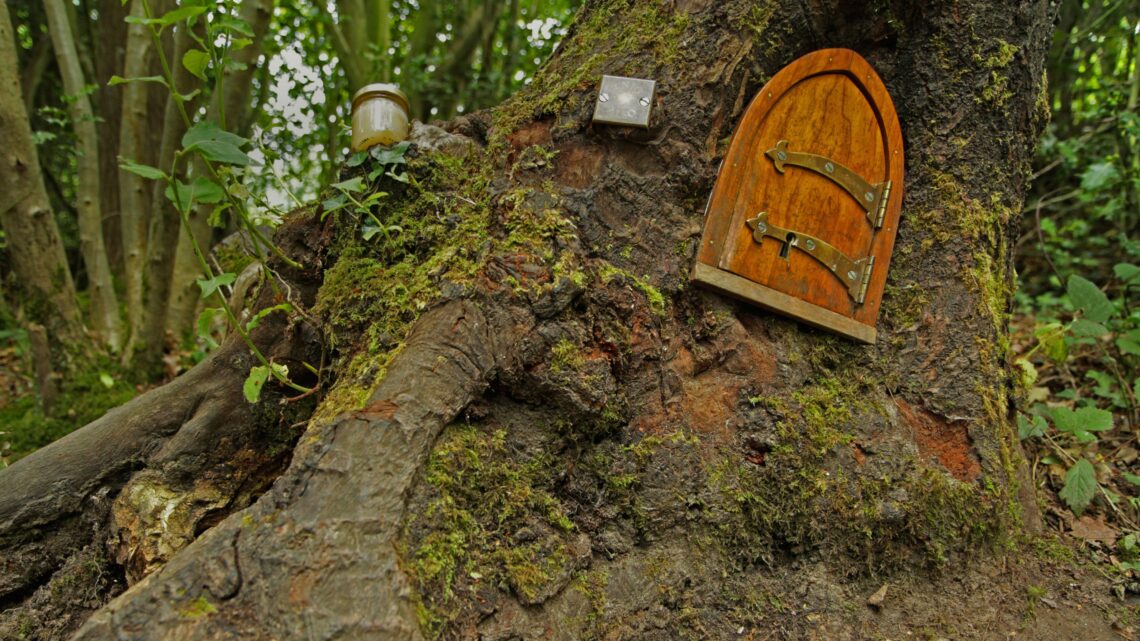
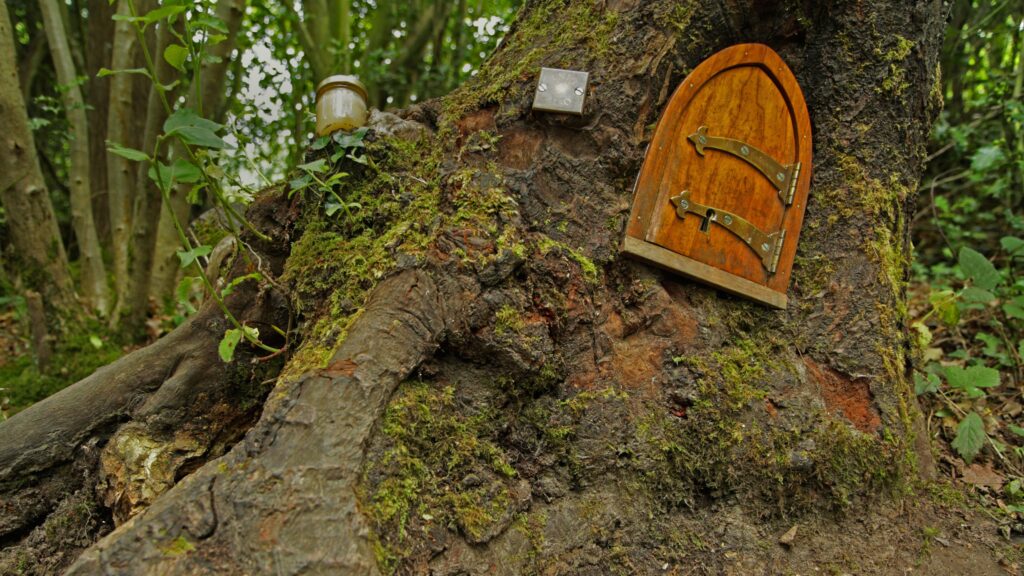
Winnie’s house is well designed to perfectly recreate the vision of Pooh’s home from the books. At the base of a magnificent old oak tree, with its exposed roots, is a tiny wooden door, arched at the top like a church door with two thick brass hinges and a lock that needs a rather large key for Pooh to carry around. Perhaps he hides it somewhere around the tree?
On a ledge to the left, there is a glass jar of honey with a screw top that doesn’t seem entirely authentic; it may have been left by an adoring fan. Pooh’s mailbox is located just to the right of the tree.
Behind the door sits a dry and happy Pooh Bear. It may have been placed there by a ranger each day or left by fans; I can’t tell. Regardless, it’s a lovely touch, and I immediately take some pictures, finding myself wishing I could live in a little tree house in the woods.
Returning to the main path, follow it for a short while, and you will arrive at another path that leads a little deeper into the woods, where you will find Piglet’s house.
You can also access this location by parking at Piglet’s Car Park, which is nearby—how amazing is that!
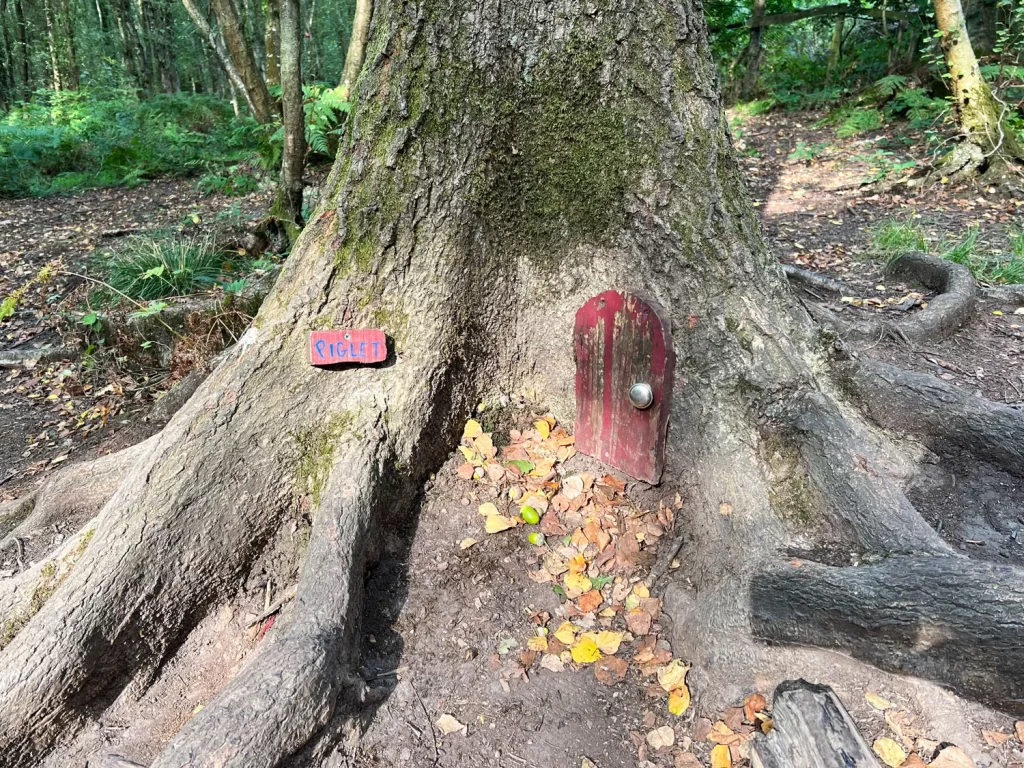
There’s no mistaking that you have arrived at Piglet’s house, as a red wooden sign with blue writing proudly displays “inlet.”Deep within the roots of the tree, you’ll find the rosehip red door with its large brass doorknob.
I lay prone on my front, bending my leg in the air, just like Christopher Robin did when he spoke to Piglet, pretending it was so I could take this picture!
Don’t forget to look high up in the tree. Piglet has a small balcony from which he enjoys looking out over the Hundred Acre Wood. If you’re lucky, you might see Piglet on his balcony, waving to everyone visiting him.
After leaving Piglet’s house, it’s only a short walk until you reach the tree where another favourite character lives. We are now heading towards Owl’s house.
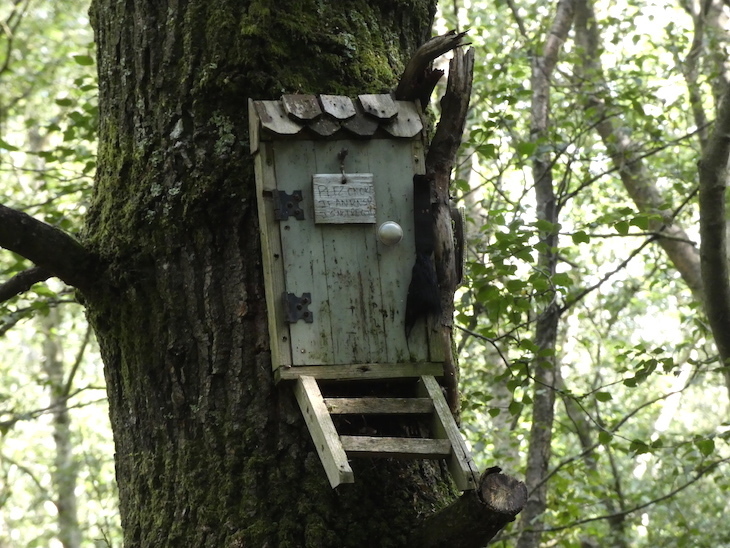
Remember that Owl lives high up in a tree, and I love the details that went into recreating all of these characters ‘ homes. Owl’s home features short landing steps and wooden shingles above the green door, which has a sign that reads:
“PLEZ RING IF AN RNSR IS NOT REQUIRED.”
In the story, Owl is out in the forest when he stumbles upon what he thinks is a marvellous rope doorbell. Owl recalls,
“I just came across it in the forest. It was hanging over a bush, and I thought at first that somebody lived there, so I rang it, and nothing happened”
“Then I rang it again, very loudly, and it came off in my hand. Since nobody seemed to want it, I took it home”
Owl then installs his new doorbell, but when Pooh comes along to visit, he recognises the rope doorbell as EEeyore’s lost tail, and that’s why you can see EEeyore’s tail hanging outside Owl’s house. Love it!
As I’m sure you can hear, I am enjoying this walk. It is also a trip down memory lane as I recall Winnie the Pooh’s Stories, most of which I haven’t read for many years. I already have the urge to scour the charity shops for the books and relive the stories once again.
The path leads us away from our characters ‘ homes and towards a very special place at the highest point in the Ashdown Forest. This place has a beautiful plaque dedicated to A.A. Milne, the author and creator of the wonderful Pooh stories, and E.H. Shepard, who brought the wonderful characters to life as the illustrator of the books.
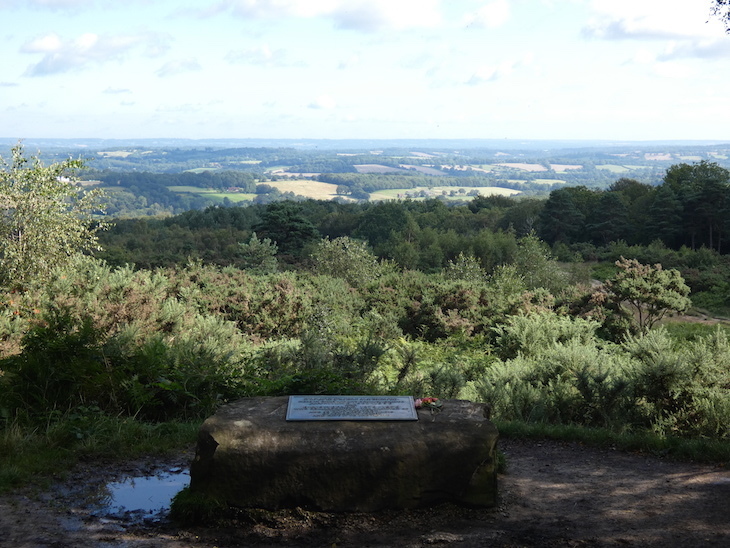
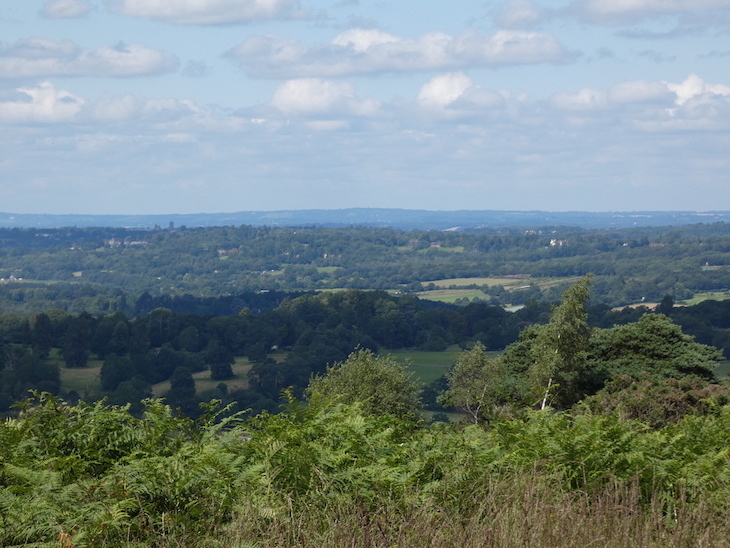
Stood at the memorial, which looks over the Ashdown Forest with its beautiful views towards Hartfield and downhill to Cotchford Farm, where the Milne family lived.
Of course, to Pooh fans, this is the Enchanted Place where Christopher Robin and Pooh sat at the end of “The House at Pooh Corner,” and Christopher explained to Pooh that he was going off to boarding school.
“Wherever they go, and whatever happens to them on the way, in that enchanted place on the top of the forest, a little boy and his Bear will always be playing.”– A.A. Milne, The House at Pooh Corner, 1928
This is a great spot to observe the resident Exmoor ponies. Seeing them gallop across the heath was breathtaking, and you can also spot sheep with their lambs and Belted Galloway cows grazing in the heathland.
As I set off along the path, I noticed a wooden sign featuring a classic quote from Pooh:
“I’m rumbly in my tumbly. Time for something sweet.”
This walk offers a wonderful way to spend a couple of hours or more outdoors in a beautiful natural landscape. It’s rich in wildlife and home to many wild deer. However, to truly appreciate the magic of storytelling, your familiarity with the stories will transform this into a magical experience for individuals, couples, and families of all ages.
As I left the Enchanted Place, I began to enter a wilder part of the heathland. I was thrilled to see a skylark soaring high in the air, accompanied by its distinctive call. Nearby, a buzzard rode the thermals, with a pair of crows hot on its tail, which is a sure sign that the Crows have youngsters in their nest.
Unexpectedly, this path led me toward some wooden fort, which my imagination whimsically suggested could be Eeyore’s house. Strangely, I also came across a bridge that stands in the field without a stream or river in sight.
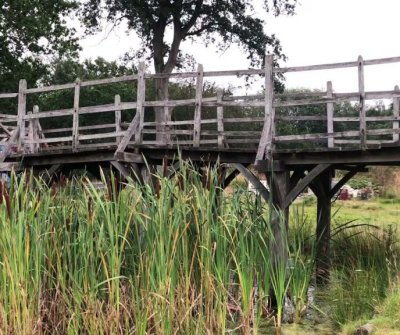
This is the Posingford Bridge, originally built in 1907. This timber-frame bridge is currently being restored before it will be returned to its original position across the stream in Posingford Wood. Yes, this is the original Poohsticks Bridge that A.A. Milne would have known and that has played such a big part in so many childhood memories all around the world.
Ahead, I spotted a solitary Scots Pine standing tall and proud. This tree is believed to be the last of six pines where, in the stories, Pooh looked around to ensure that nobody else was listening and said in a very solemn voice:
“Piglet, I have decided something.”
“What have you decided, Pooh?“
“I have decided to catch a Heffalump.”
It’s interesting to note that this area is referred to as a forest despite being about two-thirds heathland with small woodland areas.
The heathland in Ashdown Forest is home to the Green Huntsman Spider, a rare species found throughout the UK, particularly in the southern regions of England.
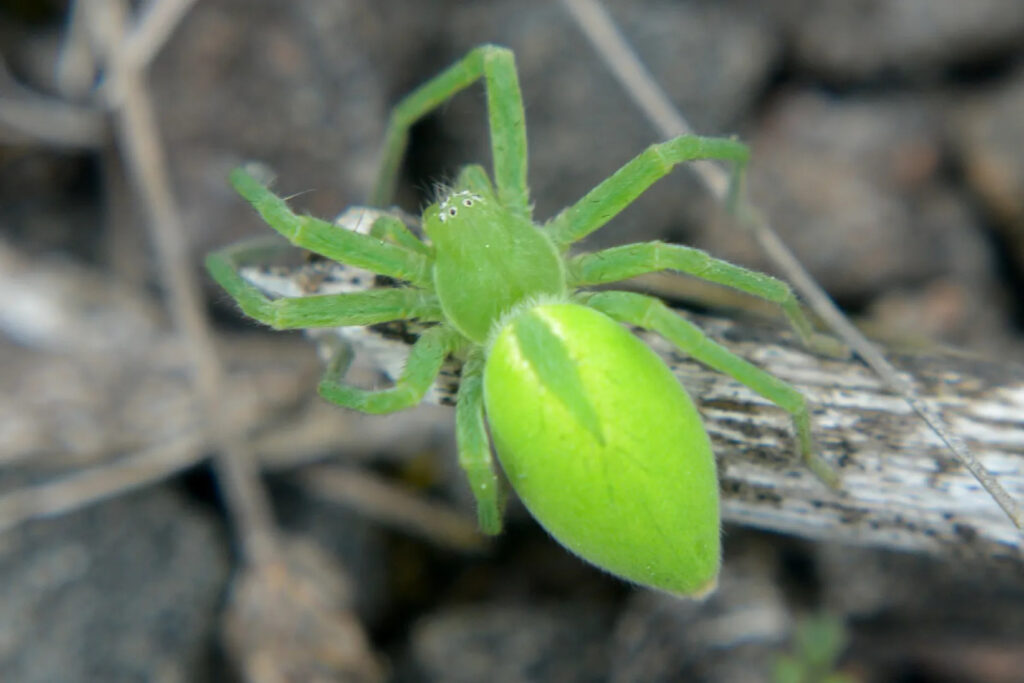
Green Huntsman spiders feature a bright green carapace and legs. Males have a yellow abdomen with scarlet-coloured stripes, while females possess a bright green abdomen that has a darker green stripe along the top, bordered in yellow. Both sexes are distinguished by the presence of white circles surrounding their six eyes.
These spiders get their name because they do not build webs to catch flies and other invertebrates; instead, they lie in wait and pounce on their prey.
Like many heathland habitats, Ashdown Forest is abundant in fast-growing silver birch saplings, which are a colonising species for woodland. Without careful management, much of the heathland in the UK would eventually revert to woodland.
England’s lowland heathland is a unique and valuable habitat characterised by open spaces filled with low-growing shrubs like heather and gorse, often found on sandy, acidic soils. This habitat is scarce both globally and within the UK, making its conservation a priority.
The soils in Ashdown Forest are primarily sandy and podzolic, influenced by the underlying sandstone geology and the forest’s climate. This geology contributes to well-drained heathland habitats, while areas with clay deposits can create wetland environments. Podzolic soils are characterised by their low nutrient content and acidic nature.
The path through the heathland takes us to another area of interest for geologists, which also features in the stories of Winnie the Pooh. Fans of the stories will remember that Roo used to play in a sandy pit that was the site of an old quarry. Ashdown Forest’s geology is primarily sandstone, a popular building material, which means there are many quarries throughout the area.
In the stories, Rabbit introduced the readers to Kanga and Roo with the following words:
“Suddenly, we wake up one morning, and what do we find? We find a Strange Animal among us, an animal we have never heard of before! An animal who carries her family about with her in her pocket! Suppose I carried my family about with me in my pocket, how many pockets would I need?”
Can you recall the scene when Pooh, Piglet, and Rabbit first saw Kanga and Roo spending a quiet afternoon in a sandy area of the Forest?
Baby Roo was practising tiny jumps in the sand, falling into mouse holes and climbing out of them, while Kanga fidgeted and said, “Just one more jump, dear, and then we must go home.“
In a funny turn of events, Kanga accidentally took Piglet back home with her in her pouch instead of little Roo.
The path now takes us past the quarry, and beyond that is the quarry car park. As you walk through the car park, you will need to cross the road. You’ll notice a grassy path leading downhill, and we are about to embark on the next part of our adventure. Perhaps we should call it an expedition!
A few minutes along the path, I entered a broadleaved woodland known as “100 Aker Wood’ There, I was greeted by the sight of two young roe deer, a buck and a doe, siblings who were sticking together and feeding.
It’s the doe who senses me first. Their sense and ability to smell danger are their primary security alarms, along with their ability to outrun most predators with ease.
She freezes initially, confident that I haven’t seen her and her brother. I have also frozen and stood, watching as any movement to position my camera will send them running. After around 45 seconds, she decides to leave, closely followed by her brother; their distinctive rear ends, with white patches visible as they go.
A little further into the woodland, I am beguiled by the array of ferns that are all along the path as it drops towards a stream at the bottom of the valley.
This is the ideal habitat to spot a very rare and special fern that I have been fortunate enough to see once before. This fern loves steep banks on acidic soils in dense woodland and wet atmospheres, and all are present here.
I stepped away from the path and studied the dense green undergrowth bursting into life in early spring. It was then that I saw it, a clump forming up across a large sandstone rock that must have been in the woodland for decades, if not centuries.
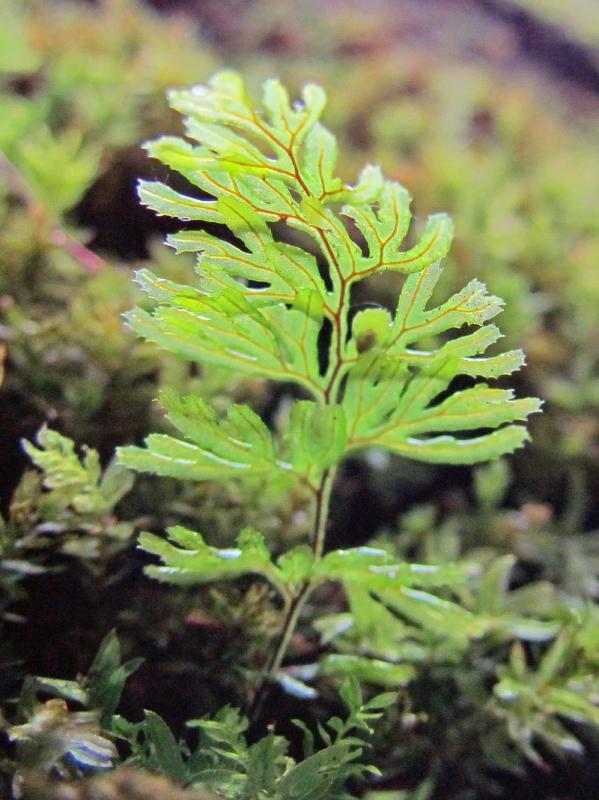
The Tunbridge Filmy Fern, scientifically known as Hymenophyllum tunbrigense, is a small, perennial plant that forms large, dense colonies of overlapping leaves from creeping rhizomes. Its common name comes from the delicate, translucent leaves, which are only a single cell thick, giving them the appearance of being coated in a wet film.
What a find that was! I’m delighted to return to the footpath and continue my descent toward the ghyll at the bottom.
Story lovers will remember how Christopher Robin led his friends on an expedition to the North Pole. During their adventure, Roo fell into a stream. Well, this is that stream! Fortunately, in the story, Pooh found a pole that was used to fish Roo out. Phew, that was a close one, Roo!
In the story, Christopher Robin asked Pooh where he got the pole, and Pooh replied that he found it. This is when Christopher Robin declared that it was not just a pole; it was the North Pole! The significant pole was then planted in the ground and shall forever be known as the North Pole, discovered by Pooh.
Today, when you visit the “North Pole,” you won’t find that pole, so you’ll need to use your imagination. However, you will know you are in the right spot because the stream where Roo fell in is still here. There’s even a little bridge to help modern-day explorers cross the stream without falling in, just like Roo did.
After successfully crossing the stream, I started climbing the opposite bank. While it’s not very steep, my calves notice that we are going uphill. Once I reach the top, I take a moment to catch my breath and appreciate the lush woodland canopy behind me, along with the open grassland at the edge of the woods, which leads out toward the heathland ahead. A fast-moving bird in flight catches my eye.
These small raptors are among the most agile and acrobatic birds of prey. They can catch fast-flying birds like swallows and swifts in mid-air. In addition to being their primary food source, they sometimes eat dragonflies, damselflies, and other flying insects and invertebrates while in flight.
Although they are small, about the size of a kestrel, these spring and summer visitors arrive around this time to breed. They don’t build their nests; instead, they lay 2-3 eggs in the nests of corvids between late May and early June. The young birds fledge by the end of summer, in time to return to Africa.
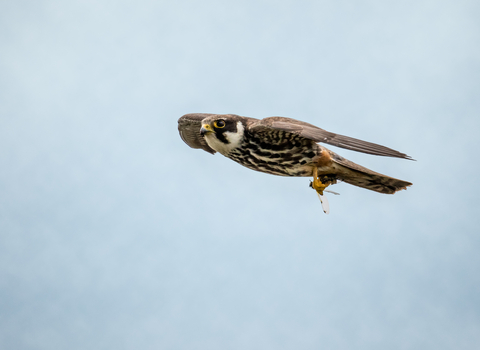
For those who haven’t guessed, I am referring to the Hobby. The distinctive red trousers caught my attention as I flew by in pursuit of a winged meal. After catching and eating it in flight, I noticed the Hobby circling the top of the hill with its long, pointed wings and dark-streaked white breast. This confirmed for me that I had seen a Hobby.
Following that unexpected excitement, I continued toward the open grassland of Wwren’s Warren, which is more commonly known to story lovers as Eeeyore’s sad place.
In the Winnie-the-Pooh stories, Eeyore is often depicted as a sad and gloomy donkey, so it makes sense that he would have a ‘‘ad and gloomy’’place. Wren’s Warren, however, is not a sad place; in reality, it is a beautiful open grassland that leads to heathland habitat. It is a place of solitude where one can find silence and peace within their thoughts. Perhaps this is what Eeyore experienced when he visited this tranquil spot.
Eeyore, the old grey Donkey, stood by the side of the stream, and looked at himself in the water. “Pathetic, ”he said. “That’s what it is. Pathetic.” He turned and walked slowly down the stream for twenty yards, splashed across it, and walked slowly back on the other side. Then he looked at himself in the water again. “As I thought,” he said. “No better from THIS side. But nobody minds. Nobody cares. Pathetic, that’s what it is.”
Eeyore is often viewed as a character who struggles with depression and a low mood. His consistent negativity, lack of enthusiasm, and overall melancholic demeanour reflect these traits. Some interpretations even suggest that he may exhibit symptoms of dysthymia, a persistent form of depression.
From this point, I headed back to my campervan, Raven, but the day’s adventure was far from over, as we were off to enjoy afternoon tea at Pooh Corner, a Winnie the Pooh-themed café in Hartfield.
Story lovers will remember that Christopher Robin frequently visited Sackville Cottage, which used to be a sweet shop and bakery. Well, here it is in real life, this charming cottage, built in 1703, provides both indoor and outdoor seating. I visited on a Friday in late March, and despite the time of year, it was quite busy.
The café offers a variety of treats, but afternoon tea is especially popular. It is served in a yellow teapot featuring Winnie the Pooh’s face. They also have vegan cream tea options and oat milk, which was perfect for me.

I couldn’t resist ordering some toast when I saw that it was shaped like Winnie the Pooh’s face and served with locally made dandelion honey. After finishing, I felt full and decided to take a walk to the Winnie-the-Pooh Museum next door.
The museum is free to enter. It features a collection of toys, games, books, and teddy bears from 100 years of Winnie the Pooh. Although small, it is worth a visit.
Winnie the Pooh and his friends continue to hold a special place in our hearts, even after the passing of their creator, A. A. Milne, who died at his farm in Hartfield in 1956. Milne’s writing is characterised by humour and wordplay, blending whimsical subjects with a deeper emotional reality.
After his only child, Christopher Robin, was born, A.A. Milne began writing the Pooh stories for which he is best known. The books, including “When We Were Very Young,” “Winnie-the-Pooh,” “Now We Are Six,” and “The House at Pooh Corner,” were published between 1924 and 1928.
Milne collaborated with the illustrator E.H. (Ernest Howard) Shepard, who brought Milne’s wonderful characters to life with his stunning illustrations, starting from simple pencil outlines that evolved into colourful characters recognised around the world.
While we have mentioned Pooh and many of his friends, there is one hugely popular character we have not yet talked about today. He did not appear until the last book of the series and does not have a special place on the Forest Walk, but he holds a special place in my heart, and I’m sure in yours as well. Of course, we are talking about Tigger.
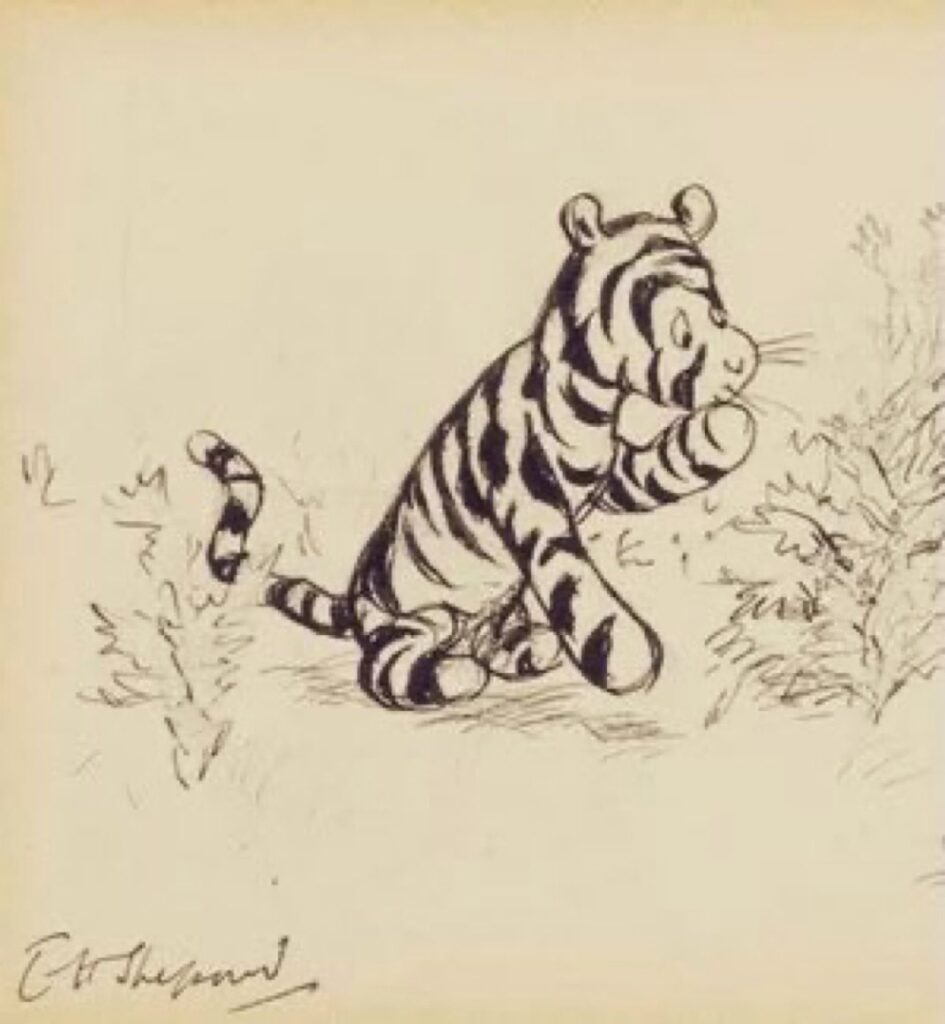
Tigger, the exuberant tiger from Winnie the Pooh, is celebrated for his boundless energy and infectious enthusiasm. With his vibrant personality, he embodies a spirit of joy and adventure. One of his most memorable quotes, Bouncing is what Tiggers do best,” perfectly captures his love for playful leaps and boundless fun. He often brings smiles to his friends ‘ faces with his whimsical nicknames, affectionately calling Pooh “Buddy Boy” and teasing Rabbit with the moniker “Long Ears.”
How else could we finish our expedition to explore the Hundred Acre Wood than with Tigger’s classic line: “The wonderful thing about Tiggers is Tiggers are wonderful things!”
Thank you for joining us! Please follow, like, and subscribe to never miss a new story from Wildlife Matters.
Nigel Palmer1 Commenton 115 Waterfall Walk for Spring Equinox
It’s 5.30 am on a beautiful sunny morning, and the air is sharp and crisp after a deep frost.
Over the last three years, Wildlife Matters has become well known for our equinox and solstice storytelling walks, as well as our wildlife and nature articles and podcasts.
Today is Spring Equinox also known as the vernal equinox. It signifies the astronomical start of spring in the Northern Hemisphere and the beginning of autumn in the Southern Hemisphere.
Today, the Sun crosses the celestial equator, making day and night roughly equal in length. This natural event occurs twice a year: in spring and autumn. For those who prefer the Gregorian calendar, it is the 20th of March.
I’m looking forward to sharing a mystical adventure with you today as we explore some of the hidden waterfalls of a very well-known 500-acre wood that is home to one of the best-loved fictional characters that was part of so many of our childhoods, and for many has continued into their adult lives.
I have parked Raven, the campervan, in one of the many car parks, all of which charge. Despite being dry for the last couple of weeks, most are bumpy and full of puddles.
As I set off on the rough path, the signs of spring are barely noticeable as the path enters a small copse; the only indication of a change from winter is the clusters of hazel catkins.
There are no flowers on the forest floor and no green shoots. The leaf buds remain tight and brown, but with all the early spring warmth and sunshine, this will all change soon.
Although I am exploring the 500-acre wood, which is known as a forest in the real world, it is primarily heathland that covers the area.
This was a royal hunting forest in Tudor times, and while the hunting has thankfully ended, many deer still call this forest home.
The native Roe deer population is said to be stable, but the introduced Fallow deer herd is growing, and in recent years, Muntjac deer have been seen in the more densely vegetated areas.
As I leave the small wooded area, a sea of yellow washes over the area, and the path begins to climb. The Gorse provides a stunning yellow wash of colour, stretching almost as far as the eye can see.
Despite the chilly east wind, the sun felt warm on my face. The sun’s light and warmth return just a little more each day. This thought made me smile, which grew wider when I heard the curlew call. Wildlife has to adapt quickly to the seasonal changes, and spring is the time to mate and raise their young.
During previous Spring Equinox walks, we visited Stonehenge, Amesbury Ring, and walked to Glastonbury Tor. Still, as some may have guessed from my teasing this year, we are exploring the beautiful in Ashdown Forest.
I promised waterfalls on today’s walk, and you may be thinking waterfalls in Sussex? Which would be fair, but stick with me because you are in for a pleasant surprise.
These waterfalls are mystical and hidden; you might say they lie off the main tracks of Ashdown Forest, but that adds to their allure and magic for me.
Although our adventure today is audio, you won’t miss anything. Pictures are on our website and social media platforms.
You may decide to experience this walk yourself, but I suggest you wear waterproof boots as the tracks are muddy and rough. The walk is around 5km and will take one to two hours, depending on how long you stay at each attraction.
This walk is medium to difficult in places, and the waterfalls are especially hard to find as there are no footpaths or signage. I recommend you get the Ordnance Survey Explorer Map 135 before heading into the forest.
We are starting our journey to Mungo’s Waterfall, which many consider the most spectacular waterfall in Ashdown Forest.
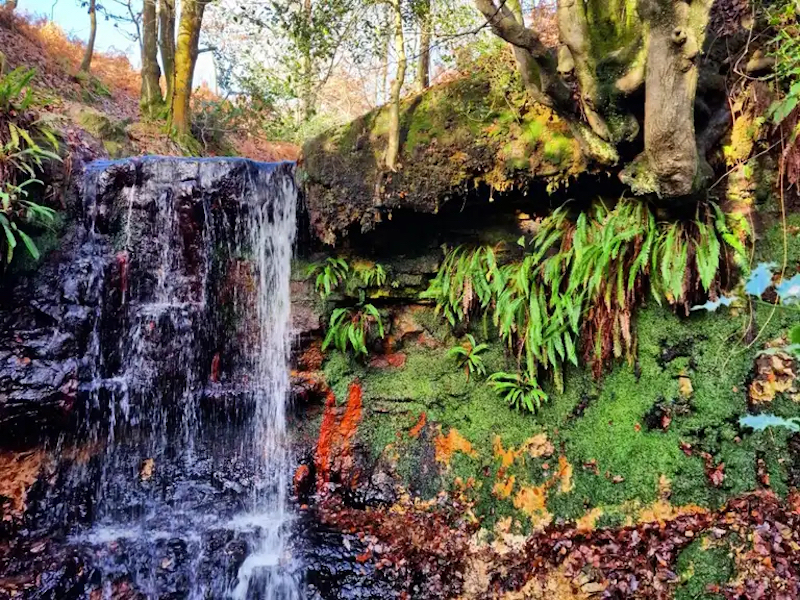
Although the waterfall is about 1 km from Hollies Car Park, no signposts guide you to it. To reach it, head to the right of the information boards at the car park and walk south-southwest. Follow the rough track downhill, disappearing into the surrounding vegetation and scrub. As you walk, listen for the sound of running water in the distance.
Follow the sound, and you will discover a stream. Follow this stream until you come upon one of two waterfalls cascading into a clear pool below. Some may choose to stop here, but for the most magical experience, I recommend taking a short but steep climb down to the pool.
The view is truly rewarding as you gaze back at the crystal-clear water tumbling over the stepped layers of rock shaped by millennia of erosion. If you haven’t already, look at the pictures on our website – you will think you are in Wales or Scotland.
I look up at the cornucopia of fern species covering the rocks. Lady Fern and lemon-scented fern are prominent, but I can see triangular fronds of the Broad Buckler fern.
Mosses and lichens are abundant, and I am currently working to improve my knowledge of them, but I can see oak, beech and holly trees with exposed root systems around the upper edge of the waterfall.
I need to move along, as we have two more waterfalls I would like to share with you today. There are many more within Ashdown Forest, but these three are the most magical and mystical, and that is the essence of a spring equinox walk.
We are now at the car park for Ellison’s Pond, one of the 126 ponds within Ashdown Forest. The headline resident is the Great Crested Newt, which can be found in many ponds and not just isolated populations.
Other claimed pond inhabitants include the great Diving Beetle, and I am told that 46 of the 57 Dragon and Damsel fly species recorded in the UK have been recorded here, so a return later in the year to see some of them sounds good.
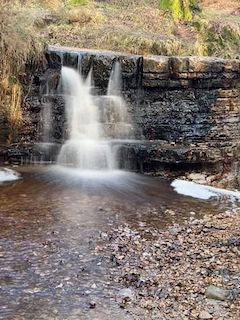
The Garden of Eden waterfall is approached via muddy and unmade tracks, but can be found by taking a circular route on AllTrails. I recommend following this or using GIS, as there are no signs, and it would be easy to get lost.
When you leave the car park, walk between the two parts of Ellison’s Ponds—they look like two separate ponds—and turn left.
In mid-March, I am walking through waist-high Gorse – a prickly experience at best. However, Gorse flowers with that familiar strong scent of coconut have been used in herbal remedies to lift spirits and counter feelings of hopelessness for centuries, so with my spirits lifted, I press on.
Gorse is also used in homoeopathy and Bach flower remedies for emotional balance. Additionally, gorse flowers have been traditionally used for various health conditions, such as jaundice, scarlet fever, and as a flea repellent.
After a few minutes, we begin to leave the Gorse behind, and now the path heads through grazed grassland. Although no cattle are present today, this meadow would have traditionally been flooded over winter to keep the land warm and raise grass for feeding livestock much earlier than if it had not spent the winter under water.
I’m not sure that happens today, but the muddy paths indicate this is a wetland meadow.
As you cross the open meadow, the clump of trees in the distance to the left is called the Friends’ Clump.
Although we won’t be visiting today, the Friends Clump is a stand of Scots pines planted in the Ashdown Forest in 1825 for Elizabeth, Countess de la Warr, whose family owned much of this land until 1988. At the time, the locals were unhappy about introducing Scots Pine, cutting down many trees to make their point clear.
The current clump was planted in 1973 by The Friends of Ashdown Forest for an initiative called ‘Plant and Tree in 73′, which I don’t remember, but the excellent Chris Skinner mentions it on his Countryside Podcast and adds it ran again as ‘and plant some more in 74”
The path takes a turn and begins a fairly steep uphill climb here. It is lined with heather, one of the many ways commons are so diverse in species.
The path is muddy and crossed by ghyll streams, abundant throughout the Ashdown Forest due to its altitude, around 200 metres above sea level. This altitude is high for Sussex, so the forest experiences high annual rainfall.
The path continues to rise when a bridge comes into view. A little unusual as it appears to be in the middle of nowhere. It’s called ‘Nobby’s Bridge”
A plaque at the bridge is dedicated to Albert “Nobby” Clarke and Mary Ellen Clarke. After the bridge, you will see two paths, both of which take you to the Garden of Eden waterfall.
Whichever path you arrive on—I came via the Ghyll side path—you will see a clearing in the earth bank that runs alongside the path.
This may have been a cart track a century or so ago, but it leads straight through the shallow ghyll waters. On my right, you can see the Garden of Eden waterfall.
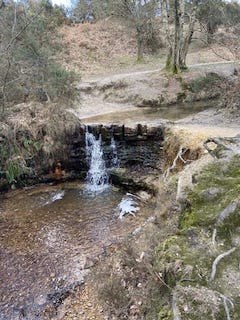
I have to be fair and say it isn’t the tallest or fastest waterfall I’ve seen, but it would be an excellent place for a puddle on a warmer day.
I don’t know how this charming waterfall found its name because its setting is more like a cart wash than what I imagine to be the abundance of the Garden of Eden.
It didn’t hold the magic and mystery you could feel at Mungo’s waterfall, but with all that said, I am pleased to have found it and am now looking forward to finding the third, and I am told the most mystical waterfall on our adventure.
There are several options to start this part of the adventure, including from near Chelwood Vachary, on the A22.
I’ve parked Raven, my campervan, at Streeters Rough, which possibly tells you more about us than if we had parked opposite at the larger and more accessible Chelwood Gate.
The path will take you towards Chelwood Vachary and the gardens.
The house and formal gardens are now private, but the woodland has open public access and is maintained by the Conservators of Ashdown Forest.
The term “vachery” comes from a Norman word meaning cow, dairy, or cattle shelter. It is believed that cattle have been kept on this site since Medieval times.
Chelwood Vachery was constructed in 1906 by Sir Stuart Samuel, a Member of Parliament.
In 1910, he created a Forest Garden that featured four lakes and ponds, each equipped with a weir and sluice.
In 1925, the house was sold to F.J. Nettlefold, who hired the renowned landscape designer Gavin Jones to create a “Gorge” using limestone boulders from Cheddar Gorge.
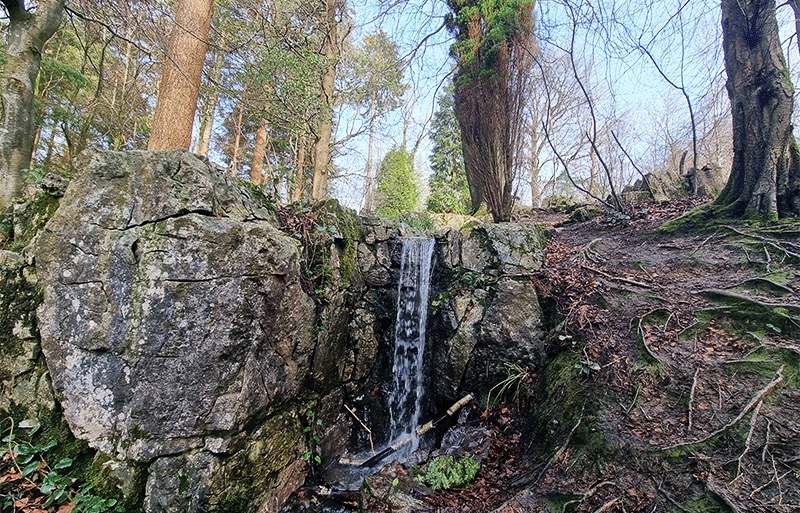
As I walked along the woodland edge path, I could see some water, which turned out to be one of the ponds and an infinity pool, which was doing its best to reflect the early spring sunlight.
There is a definite feel of nature reclaiming the man-made elements of the woodland garden, and I like the wild and slightly unkept look.
The woodlands are mixed broadleaf, but not of any significant age. There is precise plantation planting still standing in regimented straight lines that scream’ manmade.’ In contrast, the natural part of the woodland has the magic of nature that nurtures us and the wildlife that call it home.
Although it is early spring, the birds are quiet here, and I have to think hard to recall seeing grey squirrels, wood pigeons, and Jackdaws.
I don’t know, but my instinct tells me this woodland is popular with dog walkers and the wildlife lives somewhere else.
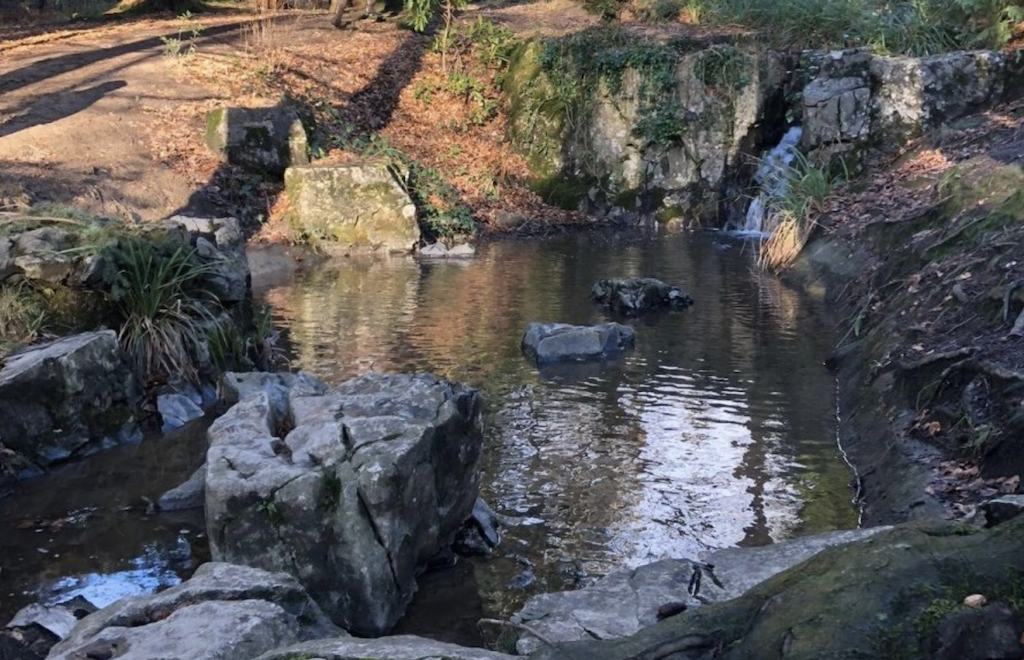
As I approach the top of the waterfalls, the sound of water tumbling and splashing reaches my ears.
I can see the waterfall gently tumbling down the rocks through a series of pools before gently cascading to the valley below.
The boulders from Cheddar Gorge stand in the valley’s pool, giving the sense that you could be in Derbyshire or Wales, but strangely, not Somerset. I do like their sense of wild ruggedness.
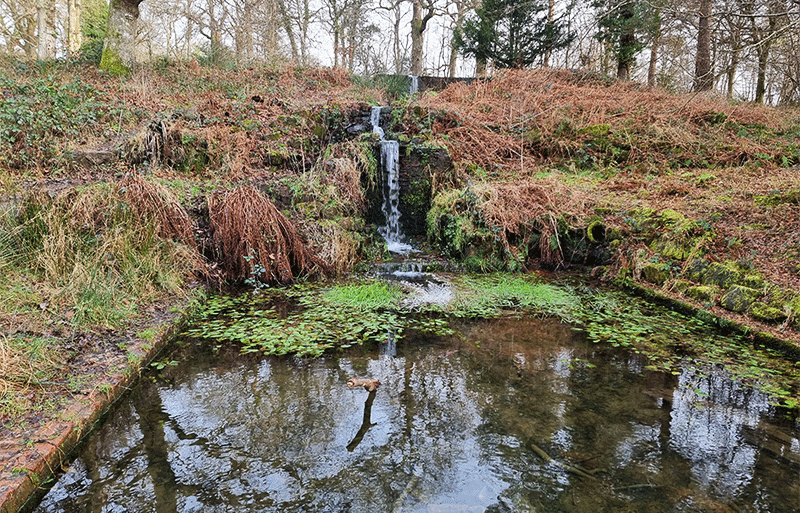
The Chelwood Vachary falls should be an oasis for wildlife. On a sunny equinox afternoon, I would expect to see birds bathing in the clear, shallow waters that ripple gently and reflect light with stunning intensity.
It is early afternoon, so it’s not ideal for wildlife watching, and I hope this magical place comes alive after dusk. It would be good to see badgers, foxes and deer drinking from the shallow pool as the bats sweep over it, harvesting the insects they need to fuel their forage flights.
At this time of seasonal change, the burnt oranges of bracken and russet brown leaves that lie where they fell last autumn are joined by a kaleidoscope of greens of every shade and shape as spring begins to break through.
The wild daffodils are joined by the buds of magnolia and Ransomes, or wild garlic, which loves to grow beside a stream or pond.
There are also rhododendrons here, their pinky-purple flowers peeking out of the foliage. I’m not a fan and hope the Conservators are actively managing them out of this habitat where they don’t belong. They are a wooded mountain plant that shouldn’t be making a home in Sussex.
Moving along from the pool at the foot of the waterfalls, follow the stream, and you will arrive at a folly bridge with steps on one side and a slope on the other. It’s ‘reclaimed by nature look’ with ivy climbing the steps and walls to join the mosses and lichens that call the bridge home.
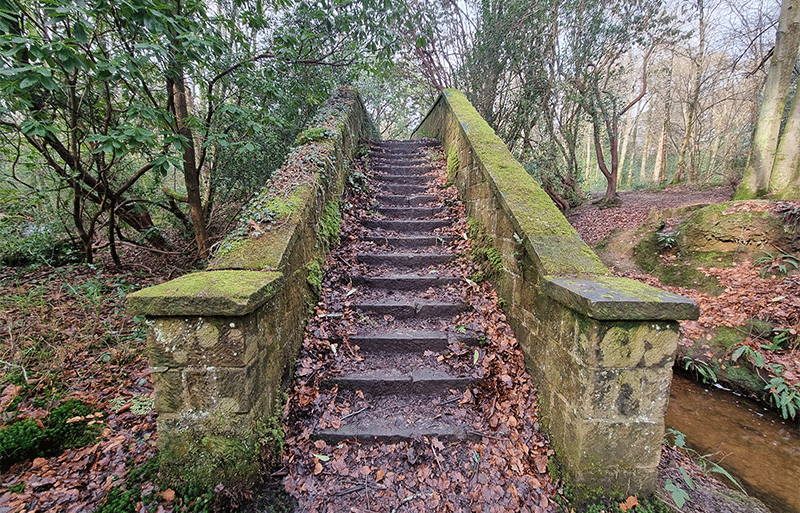
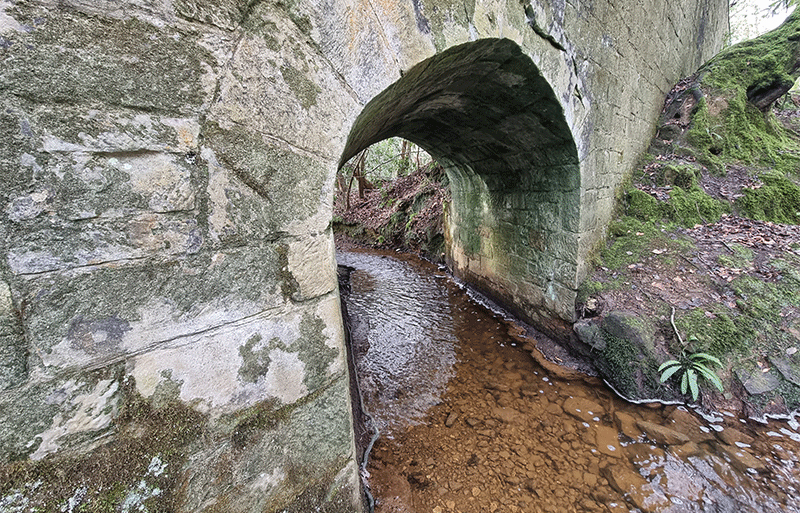
Take a peek over the edge, and you will see the stepping stones that give you another way to cross the Millbrook stream.
Continue along the path for a short distance, and you will be back at Chelwood House.
This would be a good place to end part one of our Spring equinox special, where we have been searching for the waterfalls of the historic Sussex forest.
But please join us for part two, where we will remain in the Ashdown Forest as we explore the fictional 100-acre wood and the characters from A. A. Milne’s works who call it home.
If you want to support our work
Please click on the Wildlife Matters Patreon Community.
Please click to join the Wildlife Matters Substack Community.
You can donate here.
Further Reading
Pooh Corner Cafe and Museum Hartfield