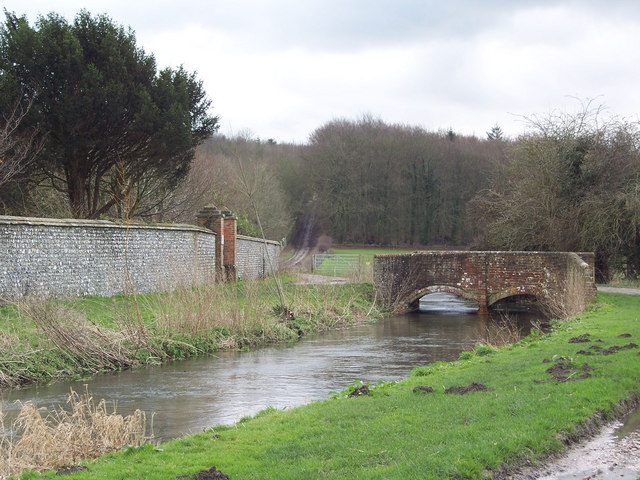
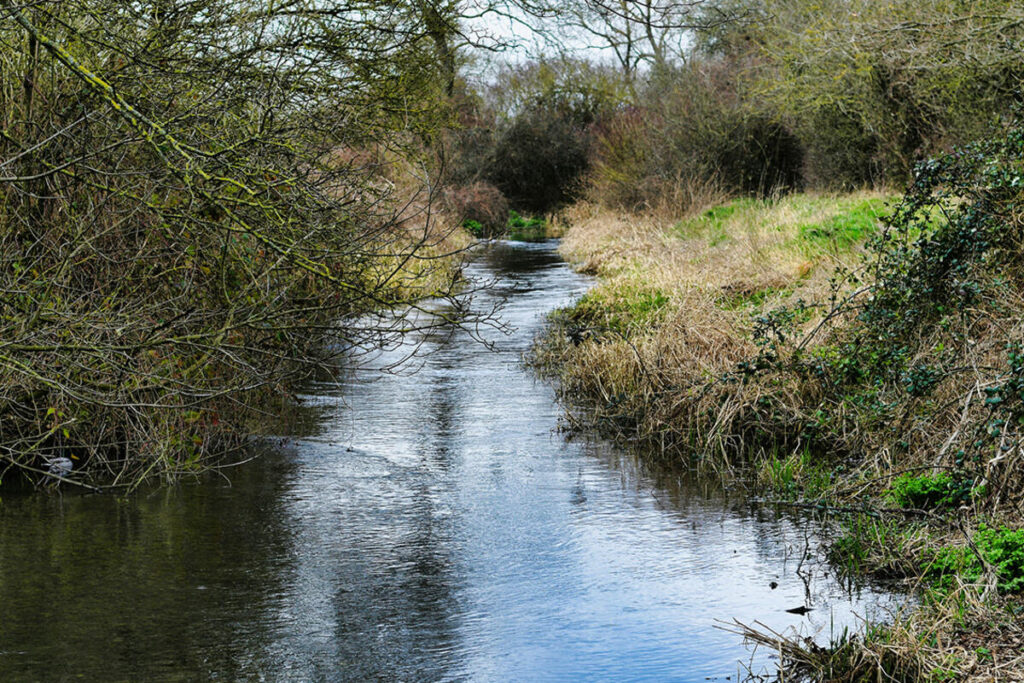
Today, we are walking along one of the local chalk streams, the River Lavant, but for those of you not in the south of England, let me tell you about chalk streams.
If you have listened to the Wildlife Matters podcast before, you will already know that we are passionate about our waterways, rivers, lakes, and, of course, the ocean.
Still, there is a watercourse common around my home area, but globally rare, with over 80% of this special watercourse found here in the south of England.
A chalk river or stream is a watercourse which flows across or is influenced by chalk bedrock. They are usually fed by underground or seasonal springs and often have ‘winterbourne’ stretches in their headwaters, which run dry in late summer.
England has the most chalk rivers in Europe. There are only around 35 chalk rivers between 20 and 90 km long in the whole of the UK. Chalk geology is rare worldwide.
So chalk rivers and streams are therefore of global importance.
All chalk rivers are fed from groundwater aquifers, which means they have clean, clear water at relatively stable water temperatures.
These unique conditions, along with the chalk bedrock, support an unusual diversity of wildlife, including fish populations and many specialist insect species.
What is the difference between a chalk river and a chalk stream?
Well, watercourses are considered to be streams when they are no further than 5 km from their spring source, and no greater than 5 metres wide unless they have been artificially widened.
If the watercourse is longer or wider, it would be classified as a chalk river.
The South Downs chalk streams are different from classic chalk rivers found just a bit further west, such as Hampshire’s River Itchen.
Each of the Sussex chalk streams we are examining today has its source high in the hills, resulting in a much steeper gradient. This sets the South Downs chalk streams apart from other chalk streams in England.
Sussex chalk streams often occur in small, natural gulleys, which are more wooded than most other UK chalk rivers or streams.
This results in unusual features which you don’t see away from the Sussex chalk streams, like mini chalk waterfalls which form when chalk water upwellings ‘calcify’ in the air, and they have large areas of dense shade, which means that there is naturally less wetland plant cover.
More natural stream channels create natural flow restrictions, such as those caused by tree roots. Woody debris is common in the channel and has a positive influence on the stream’s flow.
The substrate or stream bed isn’t always made up of flints and mobile gravels, and you won’t find some chalk stream indicator plants like Water Crowfoot.
Here in Sussex, we have three designated chalk rivers. They are the River Lewes Winterbourne in East Sussex, and in West Sussex, we have the River Ems and the River we will be walking today, the River Lavant.
We also have over 140 km of chalk streams spread throughout the South Downs National Park and Chichester Coastal Plain.
Chalk streams are known as winterbournes, meaning they flow seasonally or are perennial, depending on seasonal changes in their groundwater sources.
Today, we are walking six miles along the River Lavant, starting from Sheepwash Lane on the north side of the village green in East Lavant.
Having risen at East Dean, the chalk-filtered waters of the River Lavant serenely carve a route from the peaceful village of East Dean, through Singleton, West Dean and Lavant, before winding their way around the city walls of historic Chichester and out to sea.
Providing a vital source of freshwater, the Lavant has played a crucial part in establishing the settlements around this rolling downland valley.
Evidence suggests that humans have lived along the riverbank for approximately 5,000 years, utilising the water for daily life and farming.
Over the years, the river has also been used to transport goods, mainly wool and grain, to various villages and, of course, to the market in Chichester.
As one of only 200 chalk streams left in the UK, this precious river should offer a haven for an abundance of wildlife.
However, in recent years, the quality of this habitat has been compromised due to pollution washing into the water from adjacent farmland and roads.
Back in 2024, signs were posted along the river course, instructing people to stay away and wash their hands before eating and drinking. So what’s going on?
When there is heavy rainfall across the Lavant Valley, especially in winter, the amount of water naturally stored in the ground rises to high levels and can then enter the underground sewer pipes.
This means the local sewage treatment plant can be overwhelmed by the high volumes of water and sewage which it receives.
The local water company, Southern Water, decided to pump excess water out of the sewers and then discharge it into the river.
Whilst this might help the water company and its overloaded sewage treatment plant, it is obviously terrible for our river’s health!
The best way to assess a river’s health is to test its water quality.
By regularly checking for various physical and chemical factors, we can build up a picture of our river’s health.
The aspects of water quality we are testing are
Temperature: a vital indicator of river health, temperature controls the life cycles of animals and plants living in the river.
Total Dissolved Solids: these include metals, minerals, and salts dissolved in water and are a sign of pollution from farm slurry, sewage, and industry.
Phosphates can come from a variety of sources, including agricultural runoff and wastewater discharges; they are an essential component of many detergents.
In small quantities, phosphate is an essential nutrient, but high concentrations can harm river wildlife.
Nitrates: these chemicals come from fertiliser run-off from farmland and from raw sewage. High levels promote the growth of green algae, reducing the amount of sunlight reaching plants growing on the riverbed.
Turbidity: a measure of how clear the water is.
Water becomes murky when many particles are suspended in it, such as those from soil washing off fields or from dirt washing off roads during heavy rain.
These particles can smother gravel on the river bed, where fish need to lay eggs.
Volunteers are also trained in Riverfly Monitoring, which involves wading into the river to catch and count the tiny creatures living on the riverbed, including freshwater shrimp and the early life stages of Mayflies and Caddis Flies.
At the time of writing, the River Lavant is categorised as D, with a score of 47.5, indicating fair overall health within the 40-60 range.
This overall catchment score is derived from a year’s worth of samples taken from various sites within the waterbody, along with River Guardian Surveys and external data that evaluate the river against multiple criteria.
While the River Lavant performed well, with low numbers of invasive non-native species and low turbidity, it was adversely affected by high pollution levels and low phosphate concentrations.
The River Trust is particularly concerned about pollution in the River Lavant, which has earned a ‘very low’ rating on the charity’s scorecard.
Over the measured period, there were 34 instances of fly-tipping, 14 instances of road run-off, and eight instances of outfall discharges.
It’s hard to understand how we tolerate pollution of our watercourses when water is one of the core essentials for all life on this planet. We must all act now to protect our water courses and the wildlife and nature that call them home.
On a lighter note, the Lavant has inspired folklore through the years, particularly the tale of a water nymph named Lydian.
According to Icy Sedgewick, naiads, or water nymphs, are usually well-disposed towards humans, although they are not immortal.
Each water course would have its own naiad, and for the Lavant, that was Lydian. If the water source were ever destroyed, the naiad would die.
Many believed that the waters had healing powers, making fresh water sources incredibly important and leading to widespread worship of the naiads.
Rumour had it that Lydian could be appeased by local wild flowers found along the banks of the Lavant, such as Yellow flag iris, marsh marigolds, and water mint, when laid in her favourite spot.
The mystery is that no one knows where that spot is, and it remains a mystery to this day.
The Western Streams comprise the chalk rivers and streams that arise from the South Downs and the extensive network of rivers, brooks and drainage channels that make up the Chichester coastal plain.
The catchment’s coastal plain is predominantly flat, characterised by rich alluvial soils that support a largely agricultural landscape.
At its headwaters, all the Sussex chalk rivers feature natural winterbourne streams, which flow only during the winter months when groundwater levels are elevated.
These chalk rivers are rich in minerals and provide a rare habitat that sustains a diverse array of plants, invertebrates, and fish.
However, the water environment in this catchment faces several significant issues, including pollution stemming from rural land management, urban and transportation activities, and the water industry.
One key chalk-stream indicator plant, often not found in the Sussex chalk rivers, is the Water Crowfoot, a classic indicator of good water flow and quality, which I can see here.
Water-crowfoot is a member of the buttercup family.
That might not be immediately obvious, as it has delicate white flowers that bob around in mats of foliage, partly submerged or on the surface of chalk rivers, from May through to September.
If you take a closer look, you’ll see that the five-petalled flowers clearly resemble their better-known yellow cousins, and their leaves bear an uncanny resemblance as well.
Water-crowfoot doesn’t just look pretty; it provides valuable microhabitats with its floating canopy and underwater structure, offering shelter for fish, protection from predators, and shade in hot weather.
While looking at the semi-submerged mats of water crowfoot, something caught my eye in the water.
I crouched down to reduce my shadow and minimise the light reflection from the water surface, and below the bank in the shallow water was an eel.
The European Eel is a long, smooth, snake-like fish that can grow over a metre in length.
Mature adults can reach nearly a metre and are characterised by their olive green colour. In contrast, juvenile eels, known as elvers, exhibit a silvery sheen. However, regardless of their age, all eels share a common trait: their yellow bellies.
The unique ecosystem of a chalk river provides a suitable habitat for young eels, known as elvers, facilitating their migration to their breeding grounds in the western Atlantic and providing a refuge for declining populations.
As both predators and scavengers, eels feed on a diverse diet that includes dead animals, fish eggs, invertebrates, and other fish.
Notably, they also feast on the American Signal Crayfish, a non-native invasive species found in the Lavant.
The Lavant faces several challenges, having been straightened over time for agricultural purposes. This alteration has exacerbated the river’s already high flow, leading to frequent flooding as it overwhelms the banks.
In the past, the solution was to build weirs and dams to slow the flow of water. However, the preferred modern approach is to reintroduce natural bends and curves to the river. By allowing fallen wood to remain in the water, the flow can be reduced, helping to prevent flooding effectively.
Like many areas of the country, the villages of West Sussex are high priorities for development, and new housing is being built in and along rivers, as these properties can command high prices.
Another significant issue in the Lavant is water extraction, which the local water company is increasing, leaving the river low on water and affecting all wildlife species.
Walking along the bank, I heard a distinctive ‘splash’ of a small mammal dropping into the water.
Once again, I dropped low to try not to be seen, and there, at the head of a bow wave in the midstream, was a water vole.
Water voles are excellent indicators of diverse, densely vegetated riverbanks, especially in chalk streams.
As one scampered onto the far bank and vanished into the thick foliage, I searched for signs of its presence. Although I couldn’t spot the characteristic round burrows they create in the riverbank, I did find a latrine containing distinctive, tic-tac-shaped droppings that ranged from green to brown.
Scanning along the bank, I noticed the telltale signs of nibbled reeds. I settled down, steadying my camera on my raised knees, and watched patiently.
After a few moments, the water vole re-emerged, darting into the crystal-clear water and swiftly swimming across the river, leaving a recognisable bow wave in its wake.
Often referred to as ‘mini-ecosystem engineers’, water voles play an invaluable role in maintaining the balance of healthy chalk rivers.
They shape the bankside vegetation, redistribute nutrients, and serve as a vital food source for various species, including predatory fish and birds of prey.
Once widespread across the UK, water voles have sadly become the fastest-declining mammal in the country over the past 50 years, with their populations plummeting by 95%.
This species holds a special significance for me, as my first project in 2002 involved restoring and creating habitat for water voles in Surrey.
As I sit watching the far riverbank for signs of movement from water voles, I spot a Beautiful Demoiselle damselfly—that is the species name, and it is very accurate.
They are an excellent indicator of a healthy riparian habitat characterised by gravelly beds, diverse emergent vegetation, trees, and open grassland.
This stunning damselfly lives up to its name, boasting metallic blue and green colours that make it hard to miss.
There are notable differences between the sexes: males, like this one, have dark-coloured wings and metallic blue-green bodies, while females have brown wings and green bodies.
Both sexes are about 4.5cm long and are found from May to August along fast-flowing rivers. Males like to rest on bankside vegetation, waiting for a female to arrive, at which point they leap up and perform a fluttering courtship dance to impress her.
They are still considered rare, but with work on the Bankside and surrounding habitats being carried out along many riverbanks, let’s hope the Beautiful Demoiselle can become a more frequent sight in future.
While watching the Beautiful Demoiselle basking in the sun, I noticed a small yellow insect nearby.
It was a stonefly, and the only one I know of that is yellow is the incredibly rare Yellow Sally Stonefly, which is not known to thrive in a chalk stream habitat.
I’m no expert on bugs and winged insects, but in general, stoneflies have narrow, dark wings, long antennae and two stout tail bristles.
When at rest, as this one is, they fold their wings flat over their bodies and when in fast-flowing water, they can be witnessed clinging to the undersides of rocks.
Stoneflies are highly sensitive to water quality and environmental changes, making them a valuable early indicator of pollution or habitat degradation, as well as a reliable indicator of water quality and a healthy chalk river. They are also a vital food source for fish, birds and other wildlife.
I walk on for a few minutes, enjoying the sounds of the River and being out in nature. Although happily lost in my own thoughts, the instincts were still switched to alert as a flash of colour caught my eye as it dropped into the river.
It could only be one thing, and I stood still and watched, and sure enough, a Kingfisher emerged from he crystal clear waters of the Lavant with a small fish in its beak.
I waited to see where it would perch. Having watched it land and skillfully flip the first to a head-down position, it needed to swallow it whole; it proceeded to consume the fish.
I stood still, waiting patiently. As soon as the Kingfisher dived again, I quietly moved behind some reeds and crouched down.
By the time the Kingfisher returned to its perch to eat its fish, I was in position, out of its direct line of sight.
I sit and watch the Kingfisher on the perch. So often, all you see is a flash of bright blue and metallic copper, which is a remarkable sight as it dives into the water.
Still, today, the kingfisher sits and preens its feathers whilst it sits on a low-hanging branch, patiently waiting for its next meal to swim by, and just a few metres away, I am watching it, patiently waiting for it to dive again.
The Kingfisher is an apex predator in this habitat, and its presence indicates that food sources are abundant and that suitable nesting banks are available for breeding.
Chalk rivers, which are fed by underground chalk aquifers, provide nutrient-rich, crystal-clear water that supports a vibrant aquatic ecosystem.
This clean water creates ideal conditions for the fish the Kingfisher preys on, directly affecting the populations of these attractive and iconic birds.
I started reviewing my videos and images of the Kingfisher, when I noticed that the fish he was taking were young brown trout.
The Lavant, with its clear, fast-flowing waters, provides the ideal conditions for wild brown trout to spawn and thrive—chalk streams are the perfect habitat for Brown trout.
Females lay their eggs on gravel beds after creating a redd, which is a shallow, bowl-shaped depression dug into the riverbed with their tails.
The eggs are fertilised by males and then buried in the gravel.
Good water flow is crucial to keep the gravel beds clean during this breeding process.
Brown trout are a distinctive golden-brown colour with a dark back, creamy-yellow belly, and plain, dark tail fin.
They feed on mayflies, damselflies, other small insects, insect larvae, and smaller fish.
In the clear water below me, I spot some watercress, or was it?
I reached down to grab a small handful. The easiest way to be sure is to use your sense of smell. If you have wild watercress, which is a part of the cabbage family, it smells peppery, whereas the Fool’s watercress, which is a member of the carrot family, smells of carrots or celery.
Both grow in the same habitat, and I already know what I’ve got, but another way to check is with Fool’s watercress leaves, which also clasp the stem, whereas true watercress leaves grow at right angles from a stalk.
Whilst Fool’s watercress isn’t poisonous, it doesn’t taste good, so you won’t want to get them confused, as I quietly drop my fool’s watercress back into the water.
Right where I am sitting, with its feet in the water, grows one of the prettiest wildflowers: the Blue Water Speedwell, belonging to the Veronica family.
This plant features delicate pale blue flowers arranged in spikes atop thick stems and is commonly found near streams, rivers, and ponds.
In herbal medicine, the Blue Water Speedwell is noted for its anti-inflammatory properties when consumed as a herbal tea.
It can also be applied as a wash for irritated or infected skin and used as a gargle for mouth and throat sores. Recent studies suggest that Speedwell tea may be an effective preventive treatment for stomach ulcers.
I haven’t yet delved into the folklore of the Sussex chalkstreams, a treasure often recounted in local pubs on dark winter nights.
According to legend, Sussex is home to mysterious ‘knuckerholes’—deep, unknown pits that supposedly reach down to an underlying aquifer. These knuckerholes are said to be large enough to swallow cows whole.
Many tales from Sussex folklore speak of the ‘water dragons’ that inhabit these knuckerholes, emerging from the underworld to prey upon those who have wronged others.
So, if you venture to the chalk streams of Sussex, beware of the dragons!
If you enjoyed this blog, please check out more of our wildlife blogs here, or you may prefer to listen to the Wildlife Matters Podcast here.
If you want to support our work
Please click on the Wildlife Matters Patreon Community.
Please click to join the Wildlife Matters Substack Community.
You can donate here.
Further reading
Chalk Rivers The Wildlife Trusts