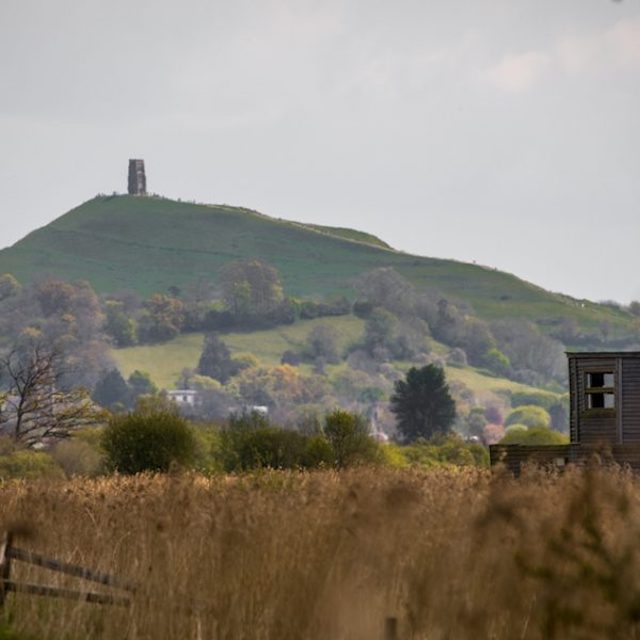
In recent years, we have celebrated the summer solstice at some of the most iconic solstice sites, such as Stonehenge and Glastonbury Tor and this year we take a Solstice walk to Avalon Marshes.
This year, our plan is different. We have a magical and mystical place to visit, but we are not there; instead, we are in a small woodland where we have parked in a glade of a small but perfect broadleaved woodland, with the owner’s permission, of course.
Last night we smoked marinated tofu over the campfire and then listened to the muntjac barking, the tawny’s calling, and we could feel the air as the bats swirled so close to us with just the embers of our fire to light this glade.
The night sky was filled with sparkling jewels, and the sound of modern life was noticeably absent. It was so peaceful.
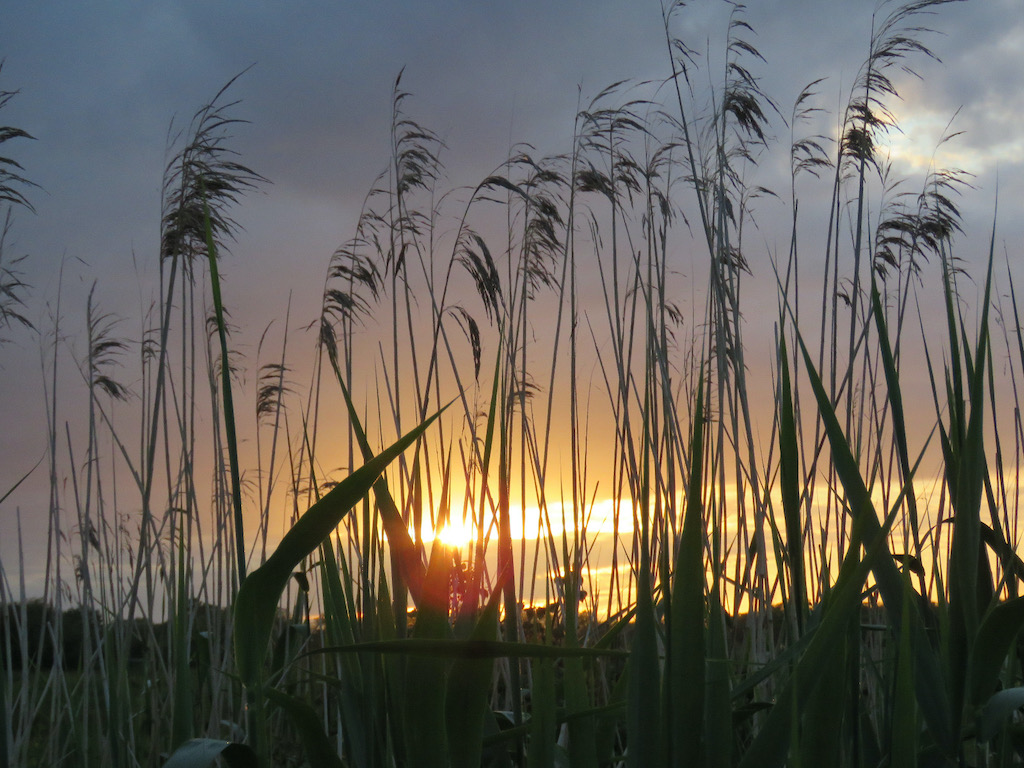
It’s 3:30 AM, and we are up, waiting for the sun to rise on this summer solstice dawn.
With the kettle boiling on the gas stove and hot coffee in hand, we sit and watch the sun break the horizon at precisely 3:42 a.m. – nature is perfection.
After chilling and enjoying the early morning wildlife of the woodland and a hearty campfire breakfast, we clear away every trace of our being there and slowly set off on the twenty-mile trip to our chosen summer solstice location this year.
Today’s adventure will take place on a 500-acre National Nature Reserve, which boasts a fantastic array of habitats, primarily wetland, with some wet woodland and an elevated heathland and has been a year in the making, as I could see this mosaic of lakes, marshes and reedbeds from the top of Glastonbury Tor which was last years summer solstice adventure.
We are at Avalon Marshes, deep in the heart of the Somerset Levels. This site was a working site for the peat industry as recently as the 1960s, but its history dates back over 6,000 years to the Neolithic period.
Today, there are three so-called Big Bird species to spot at the site. Whilst we are not birders, we do love all wildlife and nature and have to admit that these three are all very special. We will hopefully see the Marsh Harrier and Great White Egret, and I’m excited that today could be the day I see a Bittern for the first time, although I have heard them many times before.
Avalon Marshes is a mosaic of habitats run by different organisations. Today, we are visiting the Shapwick Heath National Nature Reserve, managed by Natural England, and Shapwick Moor, managed by the Hawk and Owl Trust.
There is a visitor centre that offers visitor information, a café, a craft shop, replica historic buildings, a classroom, a meeting room, a car park, and toilets.
The centre lies at the heart of the area’s nature reserves, but with a full day ahead, we didn’t stop to explore here; instead, we headed to start our day on the ancient Sweet Track.
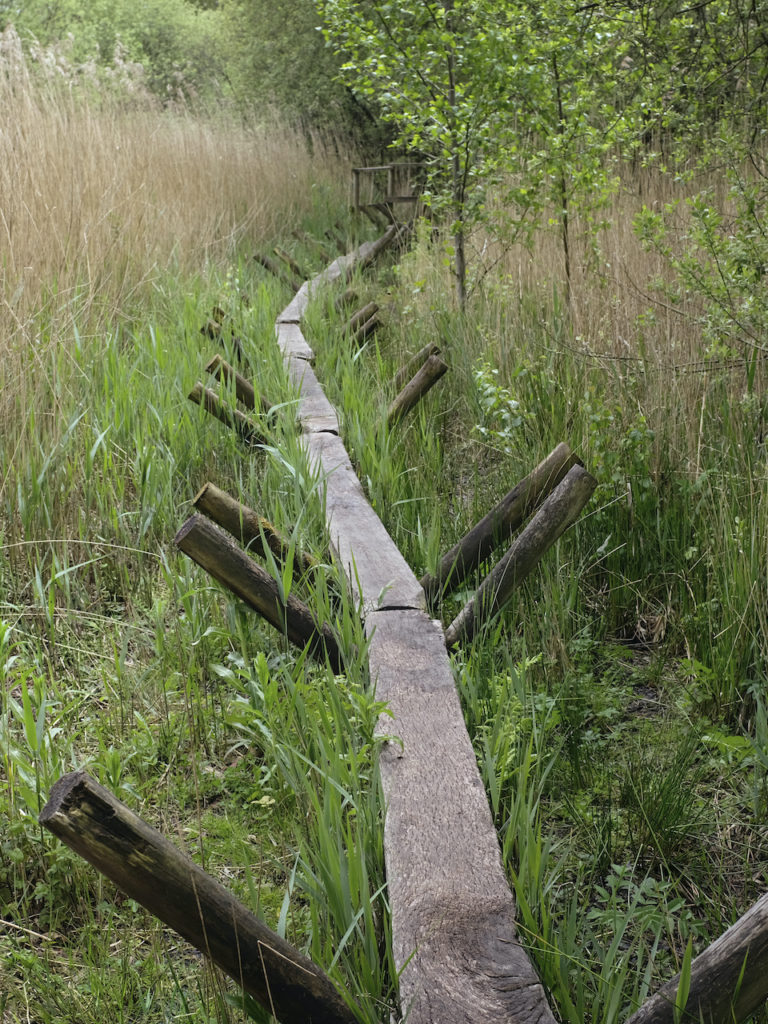
The Sweet Track, an ancient causeway named after Ray Sweet, who rediscovered it back in 1970, was constructed in 3807 BC, making it the second-oldest timber trackway found in Britain, dating back to the Neolithic period.
This remarkable pathway spans approximately 1,800 metres, which is equivalent to 5,900 ft or about 1.1 miles, and was built along the route of an earlier structure known as the Post Track.
It traverses what was once a marshy landscape, connecting a then-island at Westhay to a ridge of high ground at Shapwick.
As part of a network that once crisscrossed the Somerset Levels, the track was made from crossed wooden poles driven into the waterlogged soil, supporting a walkway primarily composed of end-to-end oak planks.
Various artefacts, including a jadeitite ceremonial axe head, have been discovered in the surrounding peat bogs.
Although it was only in use for about ten years before being abandoned, which was most likely due to rising water levels, the Sweet Track was rediscovered in 1970.
Most of it remains in its original location, with active conservation measures in place, including a water pumping and distribution system to keep the wood damp. Today, some sections of the original track can be seen at the Somerset Museum as we follow its path across the water.
Like much of the Avalon Marshes, Shapwick Heath is a landscape formed from peat. In the 1960s, the peat industry removed vast quantities of peat by machine for horticultural use.
Today, this whole area has been transformed into a landscape of Habitats, including lush wildflower meadows, water-filled rhyne, secretive fens, wet fern woods, and open water, fringed with rustling reed beds.
But we are starting our walk at Shapwick Moor, a former arable farm that the Hawk and Owl Conservation Trust now manage.
It is immediately clear that this area of land is different; it’s higher and doesn’t have the wet and boggy habitat. It is also a mosaic of hay meadows rich in wildflowers and buzzing with life.
I stand and have a look around me. This is a perfect habitat for field voles and other small mammals and birds, which will, of course, attract the owls and raptors that the area is predominantly managed for.
I’m no expert in farm habitats, but this looks to be a traditional field with wide margins and buffer strips of rough grassland, which is rich in tall herbs and rough grasses.
These will provide key pollen and nectar sources from spring until late summer, supporting numerous plant-feeding and predatory invertebrates.
As a result, rough grassland near bird nesting habitats provides a local supply of insects, allowing birds to feed more easily near their nests.
I can identify some of the wild plants here, such as hogweed, cow parsley, thistles, ragworts, and teasel, which can be vital pollen and nectar sources but also provide seeds for birds.
Rough grassland is also a key habitat for amphibians and grass snakes, mainly when situated near ponds and other water bodies, as well as for reptiles and small mammals.
Coarse tussocky grassland provides summer nesting habitat for carder bumblebees and shelter for many other insects throughout the year, including those that overwinter in the base of tussocks, hollow stems, and seed heads.
I like the management of the area and can see that there is a clear emphasis on creating aquatic habitats with a mix of ponds, seasonal scrapes and ditches, all of which will support a range of invertebrates which will encourage amphibians and reptiles that will in turn feed the owls and raptors – they are creating the food chain that all species are dependent upon.
We head back across Shapwick Heath, which boasts a diverse range of habitats, including heathland, wetland, reedbeds, wet grassland, and woodland.
I head towards the wet woodlands, a habitat I find fascinating.
They feel secretive and wild, with sunken and partially submerged willow and alder trees. Because they are difficult for us to access, they remain one of the most natural habitats in the UK.
This may be a floodplain woodland, a dynamic habitat that undergoes significant changes with the flooding events throughout the year.
The tree species include grey, white and crack willow, downy birch and alder, which have created a dense canopy.
The lower story was alive with meadowsweet, which danced its way through the ferns. I could hear frogs and toads croaking and calling as I tried to work out the mosses and lichens that hung from the trees and clung to the rocks and tree bases.
I can’t tell you what mosses, lichens and liverworts I can see, but this is something I am working on.
I can see bittersweet nightshade, with its plump, red berries that are toxic and should be avoided at all times.
The birdlife is busy even at the height of summer, with Siskin, Willow Tit, and Lesser Red Poll all here, and all species I rarely see.
Still, they have the cover and food they need here. I even caught sight of a treecreeper as I headed out of the woodlands to begin the next stage of this adventure.
We walk along the path that runs parallel to the South Drain to find a set of four hides that may help us to find the Big Three, as mentioned earlier.
One of the site’s features is the architect-designed Tower Hide, featuring a large platform base and steps that lead to an elevated hide with a stylish, overhanging roof.
It’s busy inside, so I wait on the lower deck, looking East towards the reed beds. I can hear some of the folk in the hide upstairs excitedly calling Marsh Harrier incoming.
I reach for my camera and am just in time to catch a beautiful female Marsh Harrier as she flies over the hide and across the reedbeds.
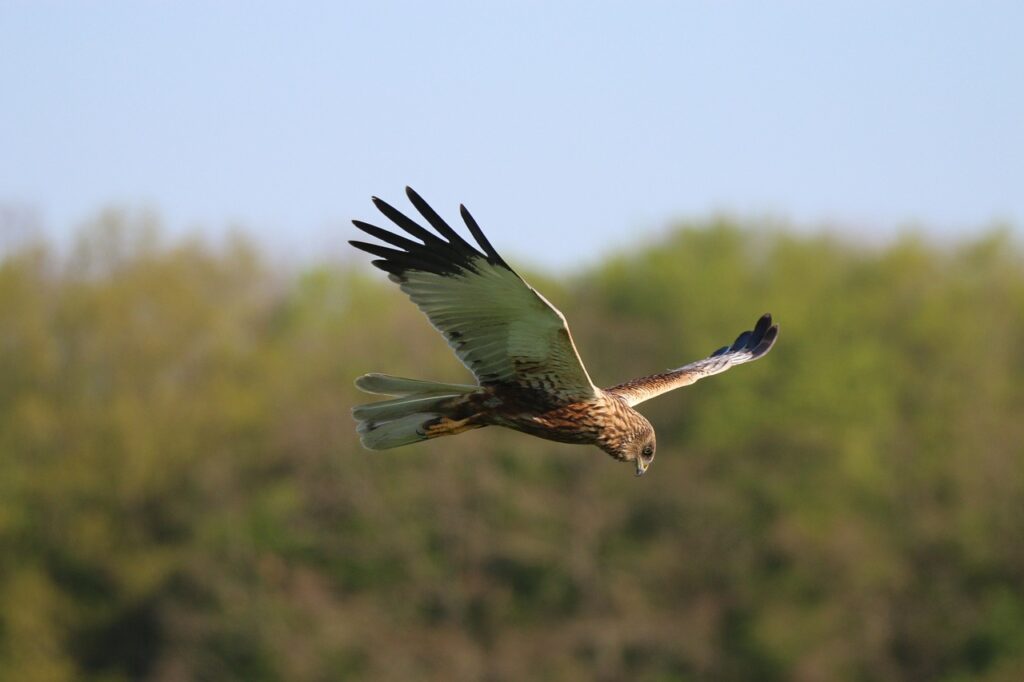
I’ve been fortunate to see Marsh Harriers, with females like this one often confused with Buzzards – yes, they are that big – but the distinctive shallow V of their wings and the way they come in low over the reedbeds, scattering the duck and wildfowl as they fly overhead is a stunning spectacle of aerial power and agility.
I’m confident that this is a female, based on her size, which is larger than that of the male, but mainly due to the creamy head colour, which can also be a feature of juvenile plumage.
Sadly, we didn’t see a male today, so we missed their spectacular summer food ‘passing’ display, which I have seen before but not today.
The Tower hide is undoubtedly a key attraction, and with no sign of space in the hide becoming available any time soon, I headed to the nearby Noah’s Tower hide.
The Noah hide is lovely, not as spectacular in design, but perfectly functional and most importantly, almost empty.
I make my way to a seat to take in the views. The hide overlooks extensive areas of reedbeds to the south or west, with some open water.
I take out my water bottle and have a drink as I put the camera on the tripod. I eat a tasty three-bean wrap as I look through the binoculars to find out who is about today.
There is a good variety of gull species, all dominated by the Black-headed Gull. Little Terns create spectacular aerial displays and graceful water landings on the scrape, which they share with Canada geese, mallards and a duck I don’t recognise
It’s tiny, about the size of a teal with a distinctive white stripe on either side of its head and a plain black bill.
I reach for my bird guide book, which nearly always leads to a question like ‘what have you spotted then? And today it works like a charm with the guy who is looking west from the hide.
I explain, and he comes over, scope in hand, and soon finds the pair of tiny ducks, excitedly telling me they are Garganey Ducks.
He goes on to tell me that they are a rare sight, as they are summer visitors who overwinter in Africa.
We spent some time discussing ducks and waders, and somehow I learned about his life history before finishing my cup of tea and getting back to it.
A little while later, my new friend moved on, and for a short time, I was alone before two ladies joined the hide and began looking around,
It was then that I saw something moving in the reedbeds to my left. I focused my binoculars and scoured the reedbeds, but there was nothing.
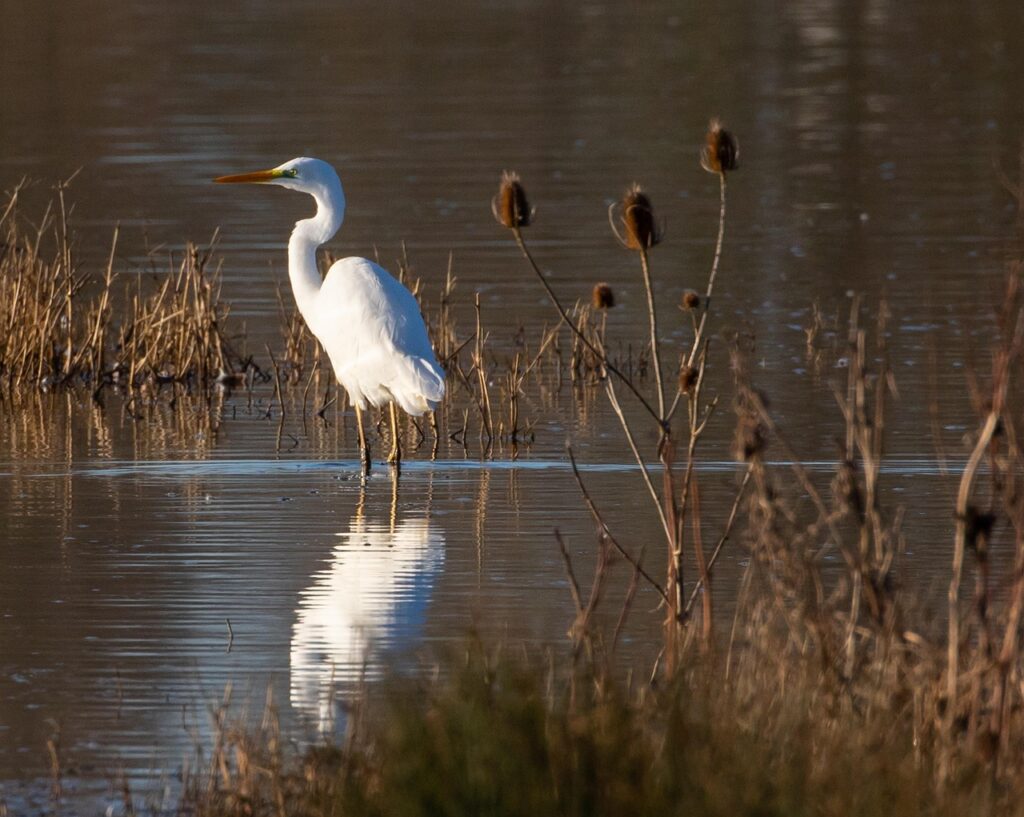
Although this reedbed was hundreds of metres away, I knew I had seen movement, and this was a waiting game. I kept the camera primed, and again I saw the reeds move, as well as the white head and plumage of a Great White Egret as it stepped out from the cover of the reeds and into the shallow water.
I’ve not seen the Great White Egret before; it’s a large bird, roughly comparable to the Grey Heron in size, but pure white with a vibrant yellow-orange beak that is impressively long and pointed.
As I watched the great white Egret stoop forward, extending its neck just above the surface of the water, I had watched grey herons many times before, but had never seen this behaviour.
Grey Heron stands still and silent, and then darts their long beak into the water and usually emerges with a fish or frog, but the White Egret was scanning the area with its long neck extended before it made its strike and emerged with a decent-sized fish.
I must have made some comment inadvertently, as one of the ladies asked what I had seen, and when I told her, she asked if she could have a look, and I invited her and her friend over, and all three of us watched the Great White egret in silence for at least thirty minutes.
We had all got some good pictures, and none of us had seen a Great White before, so we were a happy group in the hide.
Carol and Angela, my new friends, said they had seen a Bittern earlier and told me where, as I had never seen one before. I thanked them, and they set off to get some lunch.
I wanted to get to the Meare Heath hide, which was located back on the main path and the other Side of the South Drain.
When I arrived, the hide was empty. I sat down and looked around. We were closer to the reedbeds here, and the water formed a smaller pool, reflecting the midday sun into a haze of rainbow colours.
There was a collection of Ducks, Gulls and a pair of Canada geese on the pool, and the reeds were busy with warblers darting in and out of the reeds. I couldn’t see the nests, but the frequency of visits made me fairly sure they were feeding chicks.
The Bearded Reedling is a stunning bird to look at. I watched a male perched on the side of a reed stem that reminded me of a surfer riding a massive wave, staying steady as everything around him was tossed around by the breeze through the reeds.
To the right of the pool was an old branch raised above the water’s surface—a classic perch for one of the most colourful bird species.
I focused the camera and waited.
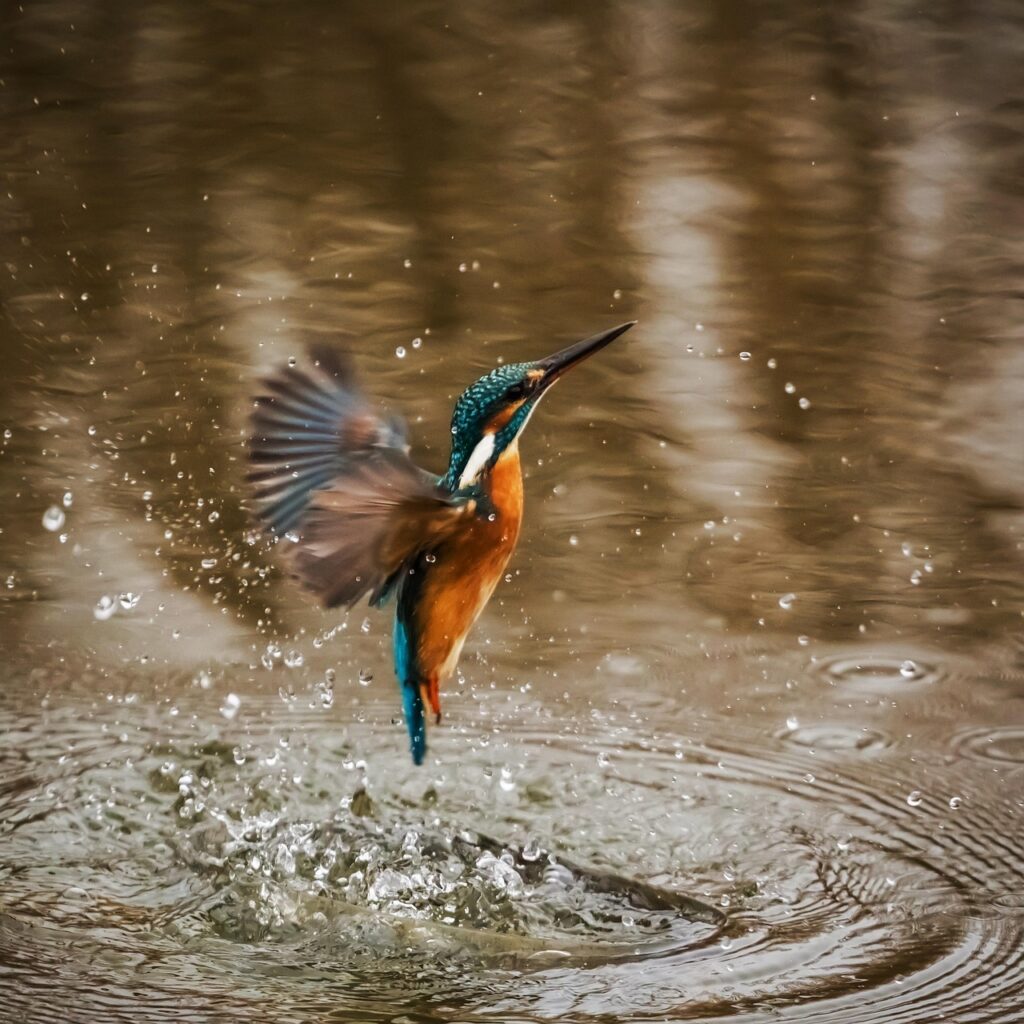
Kingfishers are as curious as they are elusive birds, and I have often waited in silence to see them, only to find they have been watching me from a perch just out of my eye line.
Today was different, with chicks in the nest, the pair of Kingfishers were focused on feeding the hungry mouths that were in a hole in the bank just a few hundred metres away.
Over the next ten minutes, I managed to capture a collection of pictures of both adults with and without fish, perched and diving.
Some shots of entry and exit from the water, which are always spectacular with the spray of water droplets and the birds’ streamlined shape on entry and wings spread, powering them out of the water on exit.
I was getting ready to move on when I heard a distinct ‘plop’ sound, one which I hadn’t heard for some time, but one that I instantly knew was a wild animal I wanted to see.
As I sat quietly and waited, reflecting on around twenty-five years to my first species conservation project working on a ditch in the depths of Surrey, lining the banks with woven hazel that would catch the natural detritus that came down the water and, over time, rebuild the banks of the stream and encourage natural vegetation to flourish. That work was primarily to benefit this species.
After a few moments, a slight bow wave appeared on the water with a small furry head visible at the front. As it got to the bank, the water vole stood on the couple of centimetres of mud and shook its dense fur before scurrying away into the reed where its den would have been.
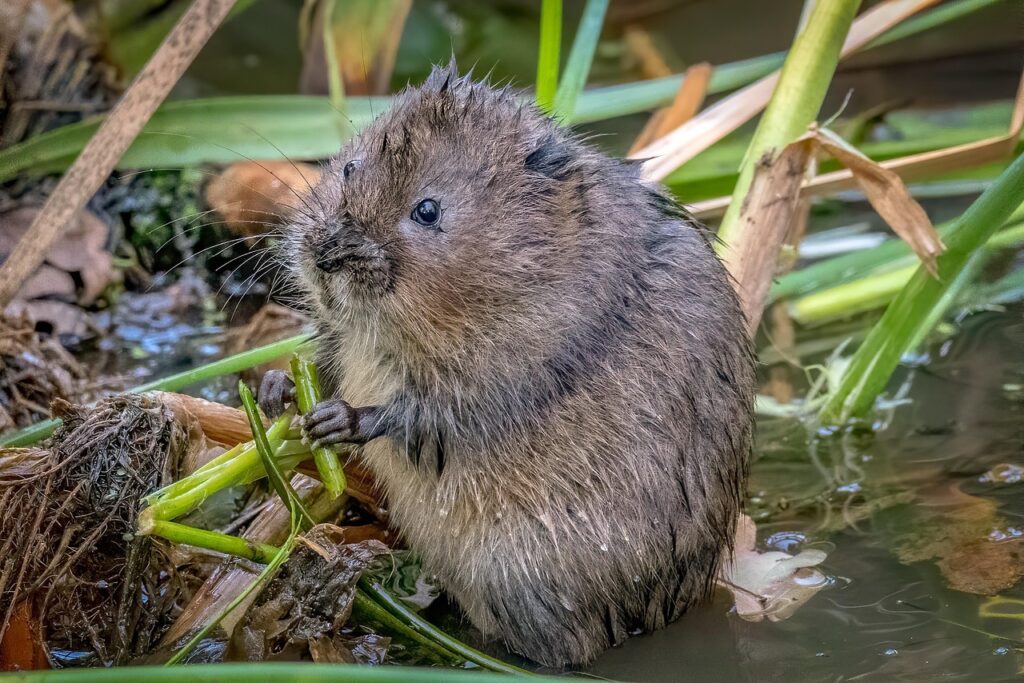
Moments later, it returned and went back into the water with that distinctive ‘plop’ sound. It was terrific to see this rare but recovering mammal going about its business for the day, and it made me realise these small mammals are always busy, bursting with energy and constantly eating to fuel their tiny bodies.
Seeing the water vole was one of the highlights of the day for me, with so many good memories attached to these beautiful little animals.
Our final destination is the Shapwick Tower Hide. As I enter the hide and take a look at the stunning view that embraces me, I can see a huge expanse of reedbeds and scrapes, perfect for a wide range of water birds, many of which are migratory.
Once again, I am alone in the hide. It’s late in the afternoon, but being midsummer, the sun is still several hours away from setting.
Having set up the camera, I poured the last of the coffee from my flask and sat down to enjoy it, with the sun to my right casting orange, yellow, and green reflections off the water.
This scene is idyllic and serves as a reminder of how amazing nature is, especially considering that not long ago, this area was devastated by peat extraction.
It was then that I heard the call of the bird I wanted to see. I’ve listened to it several times before, but I had never been fortunate enough to see one.
During the breeding season, male bitterns produce a deep, foghorn-like sound known as ‘booming’, audible from up to two miles away, primarily at night. Each male mates with up to five females, who lay four to five eggs in March or April.
I recall reading that in 2025, Bitterns have shown promising recovery, with the latest results from the RSPB and Natural England recording 283 booming males—a remarkable 20% increase from the previous survey and the most significant jump since monitoring began in 1990.
Historically, Bitterns faced significant challenges in the UK, with persecution and habitat loss leading to their extinction by the late nineteenth century.
However, the collaborative efforts of the RSPB and Natural England have been crucial in preventing their extinction once again. Targeted conservation initiatives, including at Avalon Marshes, both here at Shapwick Moor and the RSPB’s Ham Wall reserve, have fostered healthy populations of these birds.
Bitterns rely heavily on reedbeds for their survival. Therefore, the restoration and creation of these vital wetland habitats have been instrumental in providing the conditions necessary for them to feed and breed successfully.
Listening intently in case the male called again, I focused the camera on a section of the reedbed and got the binoculars out to watch for movement within the reeds.
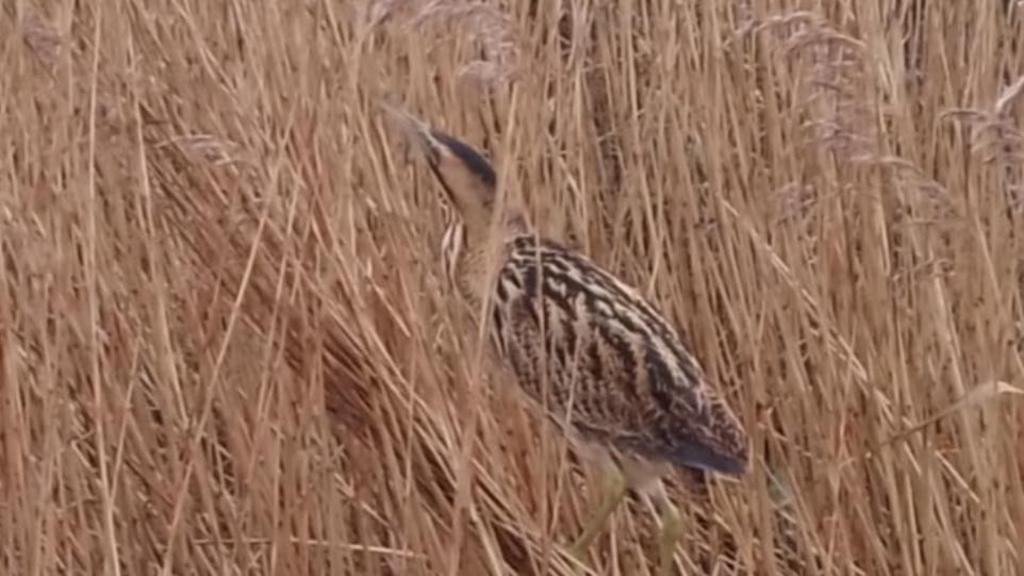
The bittern is a rare and shy heron that spends most of its time hidden in large reedbeds, feeding on eels and other fish.
Its pale brown plumage, streaked with beige and black markings, provides excellent camouflage, allowing it to blend seamlessly into the reeds.
To make things even harder, it can stand motionless for extended periods to avoid detection – something I have yet to master!
I knew there was a bittern in the reeds, but now it was the jeopardy of who would move first – I set myself and waited.
It was at least twenty minutes, which felt like twenty years, where nothing moved but the reeds themselves as they rustled in the breeze across the lake.
It was a lovely summer afternoon, with the light being good, clear like midsummer, and reflecting off the water.
It was then that I caught sight of a Bittern’s rear end – no legs or head visible, just the rear end, which was angled to make me think that the Bittern was feeding with its head stooped down.
You may laugh, but I took a picture as this was the first time I had ever seen a Bittern – well, part of a Bittern, and I was super excited.
A couple of minutes until the rear of the Bittern moved back to level, I imagine it had finished its meal and had raised its head and done that thing that all heron species do, and that is to stand still and silent.
And that was where it stayed. Motionless for maybe fifteen to twenty minutes, by now I was becoming fidgety and couldn’t stop thinking about standing up and stretching before pacing around and around the hide, but I knew I couldn’t
This was the closest I had ever been to seeing a Bittern, and I wasn’t going to give in now.
And then it happened, the bittern turned around. I could see its beak and the stunning patterns and colours within its plumage.
Again, I took some pictures, but now it was more of a head and shoulders shot, although I could see the top of its creamy white coloured leg.
It remained virtually motionless for several minutes longer, until I noticed it move its leg. As if taunting me, it stretched its leg out and stood on one leg for a while before repeating the process with the other leg.
After stretching its legs, the Bittern finally took a couple of steps forward and was now fully visible in a small space between the reeds.
I hit the burst button just to be certain, but one thing I quickly realised was that despite the frustration of only seeing half of the Bittern for over an hour, it was now in full sight and was not likely to move for several minutes.
Other birds were landing on the water, some going too close to the area of reeds where the Bittern was.
I was initially concerned that the nearby activities would scare the Bittern away, but these magnificent birds are pretty resilient. It barely moved a muscle, although it did react slightly to the closer fly-bys of the terns, clearly aware of its surroundings.
For twenty minutes, the Bittern remained in clear sight, allowing me to set aside my camera and enjoy its presence. Eventually, it stepped further into the reedbeds, disappearing from view for the day.
That Bittern will stay etched in my memory forever. While it may have been having a typical day—finding food and seeking refuge in the reeds—it was the first time I had ever seen one with my own eyes.
This encounter marked a wonderful end to our summer solstice adventure at Avalon Marshes, on the edge of the mystical Glastonbury.
We will certainly return, as we’ve only explored a fraction of this magical reserve. After speaking with a member of the Wildlife Trust team at Calcott, I’m eager to visit Westhay Moor.
Also, I haven’t yet been to Ham Wall, the neighbouring RSPB reserve, so that is another adventure to anticipate.
I hope you have enjoyed our Summer Solstice adventure to Avalon Marshes featured in this week’s Wildlife Matters podcast.
If you enjoyed this blog, please check out more of our wildlife blogs here, or you may prefer to listen to the Wildlife Matters Podcast here.
If you want to support our work
Please click on the Wildlife Matters Patreon Community.
Please click to join the Wildlife Matters Substack Community.
You can donate here.
Further Reading