
Join Wildlife Matters to discover Night birds, who is that singing at night? A summer evening walk offers the gentle sounds of birds settling into their roosts.
Linger a bit as dusk fades to night, and you’ll notice fields and woodlands changing; the familiar daytime birdsong gives way to the screeching and hooting of nocturnal birds echoing in the darkness.
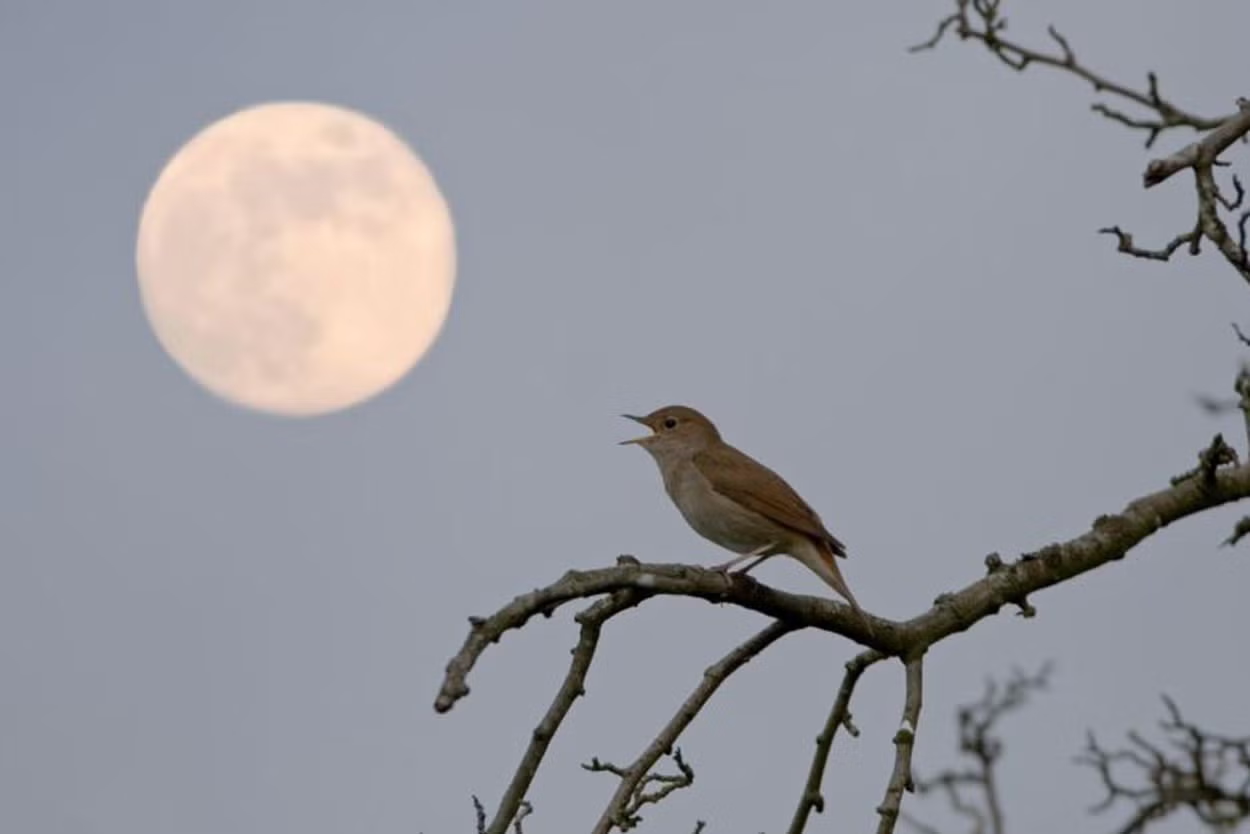
Nature holds many secrets, but if you remain after sunset, new nighttime sounds emerge. Some male birds call beneath a moon veiled by drifting clouds, hoping to attract a mate.
Nocturnal birds usually have drab plumage with few markings, as bright colours would be invisible at night. Their eyes are much larger than those of daytime birds, letting in more light—they’re more often heard than seen.
Most night birds are colored in shades of grey, brown, black, or white, helping them blend in to avoid both predators and prey.
Bright plumage would make nighttime hunters easily visible, so muted feathers keep them hidden.
They also boast a keen sense of smell and enhanced hearing, which enables them to find prey or detect threats in the darkness.
Their lack of bright plumage has other benefits, as it helps them blend into their surroundings during daylight hours, helping them to remain undetected by predators.
Many birds that work all night catching food and caring for their young act very differently during the day. Aware of their visibility in daylight, they often freeze and try to blend into their surroundings, minimising movement to avoid detection.
While they might appear calm or even tame, this stillness is a defensive strategy that protects them and their offspring. If you spot a nocturnal bird in daytime, it’s best to keep your distance and let it rest before it starts another night.
If you encounter a nocturnal bird with its eyes open during the day, it’s likely already aware of your presence. The considerate thing to do is to leave and let it be.
Nocturnal birds engage in the same behaviours as diurnal birds, just at different times—they hunt, forage, preen, court, mate, and nest at night. By day, they rest and sleep, much as diurnal birds do at night.
Spring and autumn are seasons when birds exhibit increased nighttime activity. Diurnal species may start their dawn chorus up to two hours before sunrise to attract mates and claim territory. Under full moons or bright streetlights, some diurnal birds even sing at night.
In autumn, many diurnal migratory birds begin their migrations at night to avoid predators and navigate by the light of the stars. Despite this nighttime activity, these birds are not classified as nocturnal.
Nocturnal birds in the British Isles are typically secretive and shy. When watching wildlife at night, remain quiet, keep your distance, and always give them space.
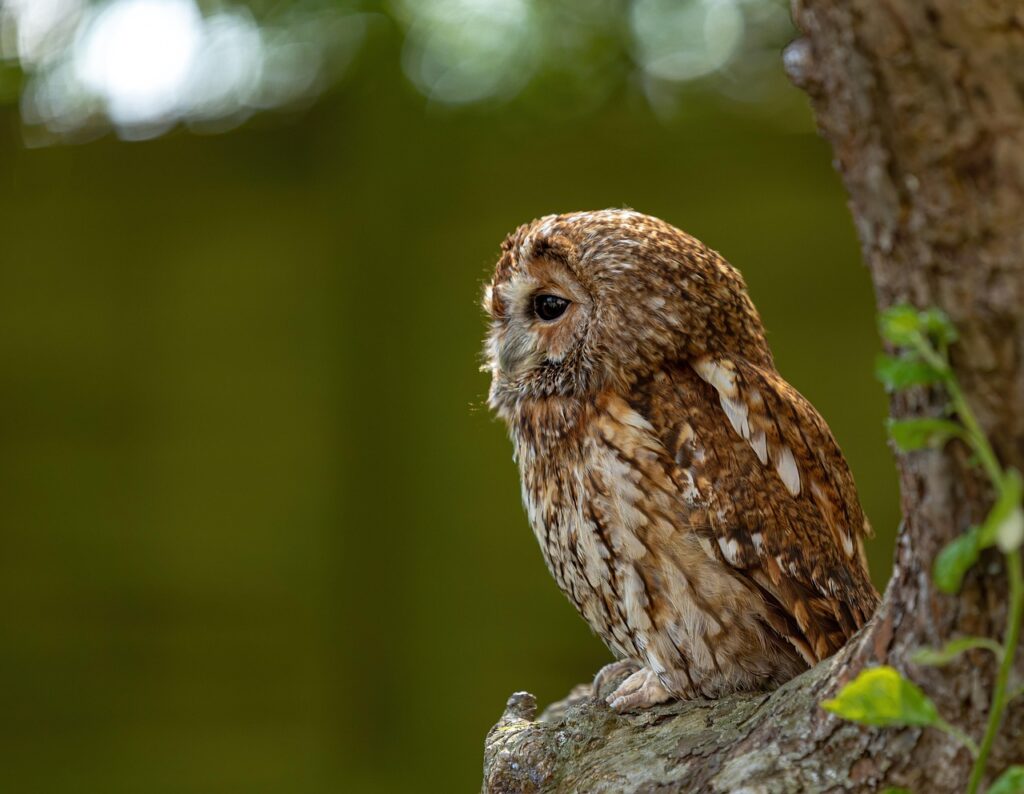
Night time bird calls often bring to mind owls, especially the Tawny Owl with its familiar “twit-twoo”.
A pair produce this call: “twit” from the female and “twoo” from the male, helping each locate the other and confirm their mate’s wellbeing—highlighting their loyal, watchful nature.
Tawny owls can be found throughout Britain. Although they prefer woodland and farmland, they are also often found in gardens and parks with tall trees, and have been spotted in urban areas.
Tawny Owls have a round, large head, large dark eyes, and are predominantly reddish-brown with a paler underside.
Tawny Owls have specialised wing feathers with soft, furry edges, allowing them to fly silently and hunt stealthily. Like other owls, they can rotate their heads 270 degrees to compensate for their fixed eyes.
These nocturnal hunters primarily eat mice, voles, birds, frogs, and large insects, but they’ve also been known to take goldfish from ponds and bats from their roosts.
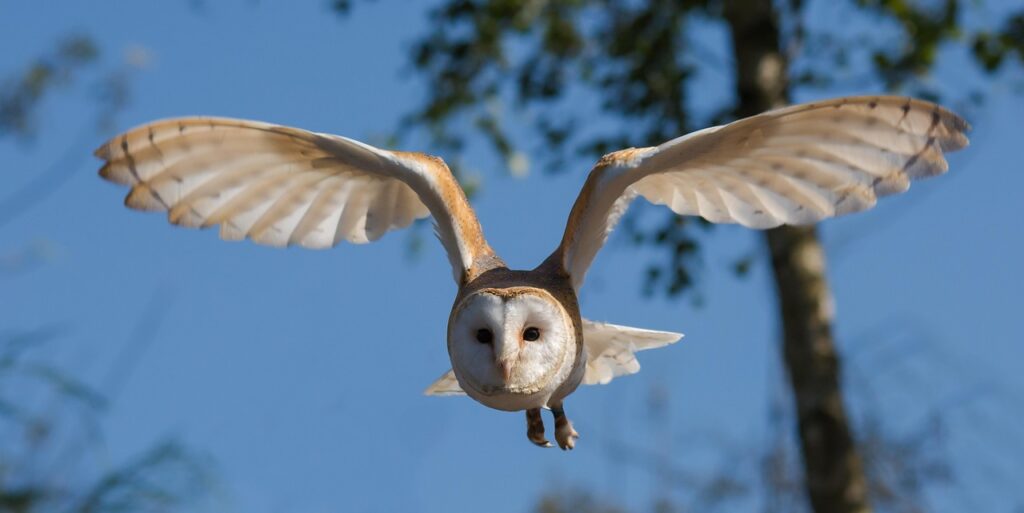
Barn Owls, another commonly observed nocturnal species in Britain, can be seen in grasslands, agricultural fields, forests, and urban areas. Instead of singing, they produce a haunting screech on moonlit nights, enhancing the countryside’s mysterious ambience.
Silent flight is a hallmark of the Barn Owl, owing to their uniquely soft, noise-dampening feathers. Their asymmetrical ears, combined with a heart-shaped facial disc, let them locate sounds precisely in three dimensions.
This keen hearing even allows Barn Owls to detect the heartbeat of a mouse from several metres away. While their hearing is exceptional, they also possess excellent night vision, enabling them to spot prey in the dark.
Perhaps surprisingly, the Barn Owl is among the most widely distributed owl species globally, inhabiting nearly every continent except Antarctica.
They are monogamous and non-migratory, typically staying in the same territory year-round.
Instead of constructing nests, Barn Owls use existing spaces like barns, tree hollows, or nest boxes and often line the area with regurgitated owl pellets, which are the undigested bones and fur from their food, to insulate their eggs.
Barn owls communicate with screeches and hisses, rather than the hooting sounds associated with Tawny and other owl species.
Barn owls in Britain have suffered from habitat loss and collisions with vehicles. Still, conservation efforts have recently led to population increases.
You may say owls don’t sing, and that’s correct, but many birds do—one of the most remarkable is the nightjar.
Nightjars are mystical and enigmatic, leaving a lasting impression on those lucky enough to see or hear them.
They are nocturnal, hunting moths and other insects in the dark and singing at night.
Their call is an eerie yet captivating churring sound that males broadcast from high perches, helping the song travel farther to attract mates.
Male nightjars also produce thunder-like clapping noises during breeding season by beating their wings together mid-flight, offering another way to draw the attention of females.
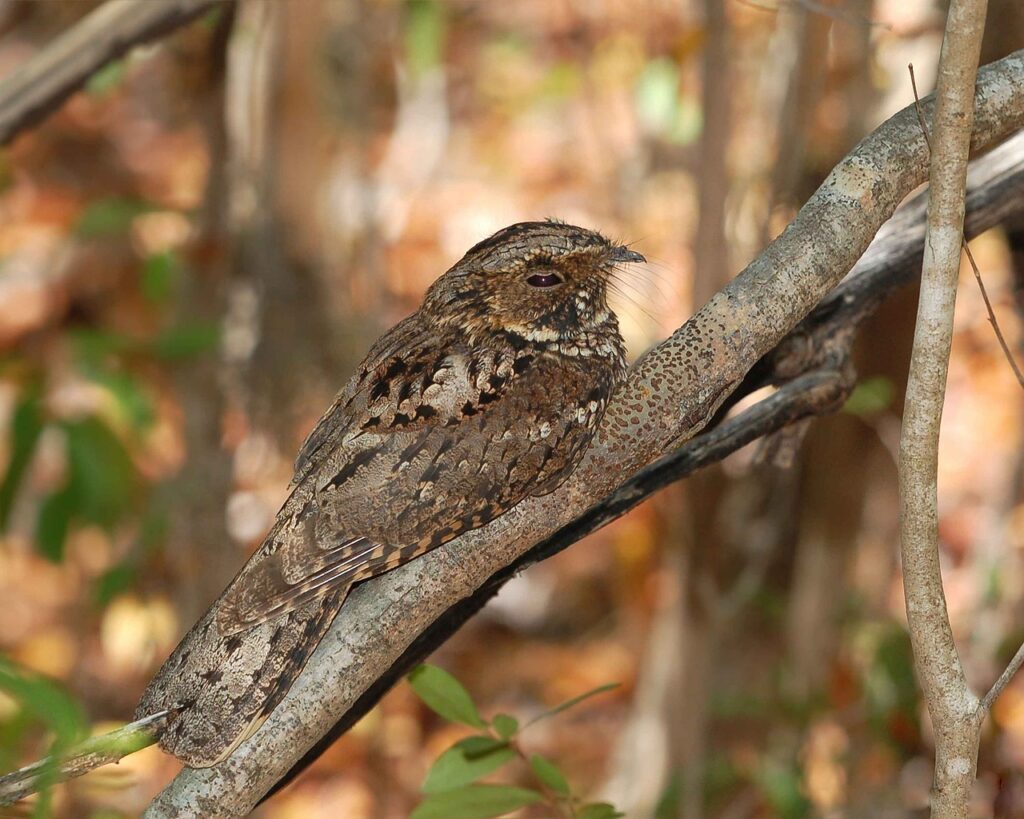
Nightjars migrate to Britain from Africa each summer, arriving by mid-May and departing by late August. They are most commonly found in southern England, including Thetford Forest (Suffolk), the New Forest, Dorset, and Surrey heathlands.
During the day, nightjars rest and rely on their mottled brown and grey plumage to blend into bracken, heather, and gravel, keeping them well camouflaged against moorlands, heathlands, cleared conifer plantations, and open woodlands.
Protected by the Wildlife and Countryside Act (1981), the nightjar has an Amber conservation status in the UK. Population declines have occurred in some areas due to habitat loss.
Lowland heathland is an important habitat due to its diverse range of nationally and internationally rare or endangered species.
Good heathland management for this species will create a mosaic of heathland habitats, which should include a good proportion of mature heather with small gaps for nesting, scattered trees for song-posts, and insect-rich feeding areas such as wet heath.
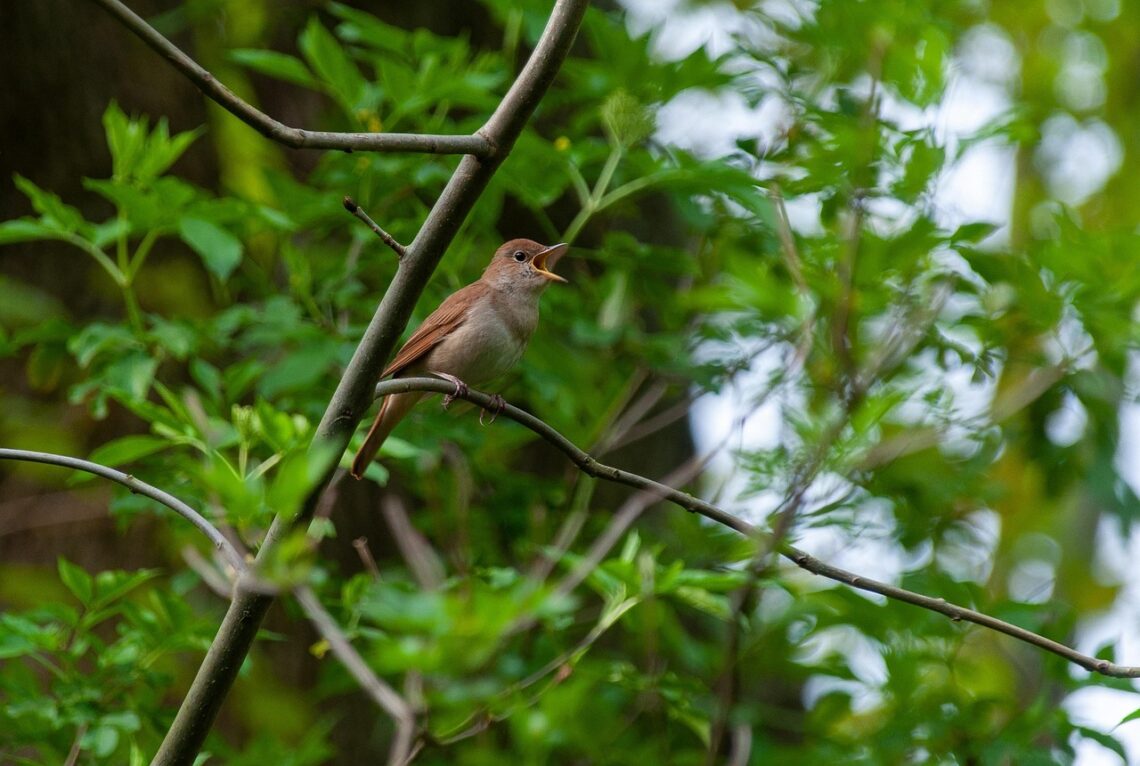
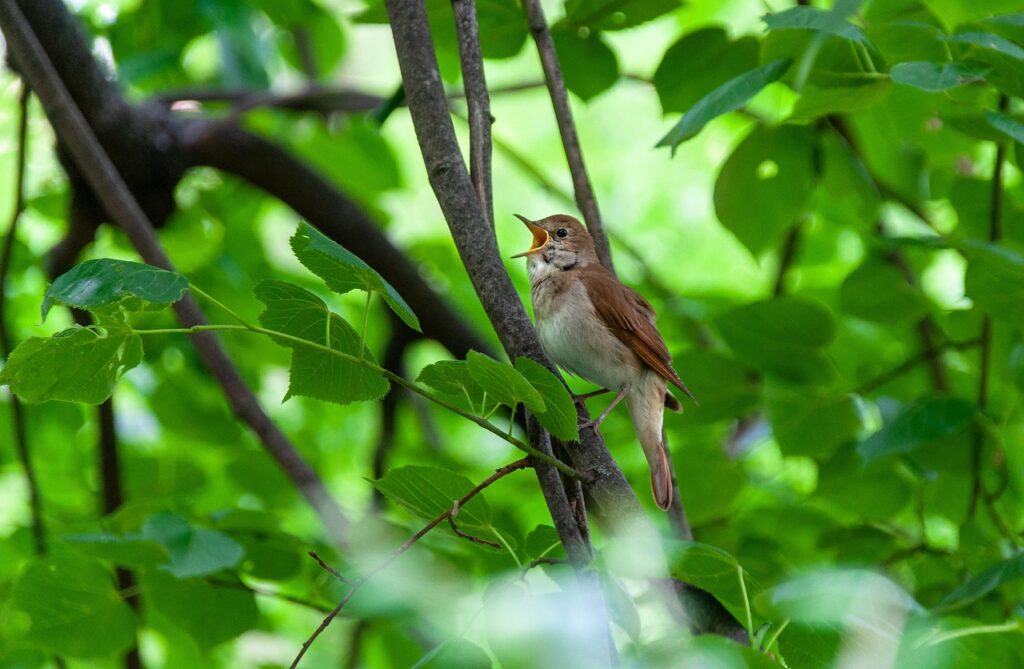
This remarkable night time songster delivers a complex and varied repertoire, rushing between rich, low and high notes, warbles, whistles, and flute-like sounds, all punctuated by brief, electric pauses.
Each song is unique to the individual, often theatrical and improvised, including guttural “chug-chug-chug” sounds and insect-like buzzes—blending high energy, careful restraint, and remarkable precision.
The nightingale’s song, typically sung under the cover of darkness, is renowned for its emotive and poignant power, making it the quintessential nighttime songbird.
Males sing through the night until they attract a mate, while females move under the cover of darkness. After pairing, the male continues its powerful, melodic, and melancholic song by day and night—often cited as one of nature’s most beautiful sounds.
Nightingales are small, brown birds that prefer hiding in thickets or dense bushes, making them difficult to spot during the day and even harder to spot at night. Their main diet consists of invertebrates.
In Britain, their stay is brief: they arrive in mid-April and typically leave before June ends. They primarily breed in the southern counties, from Kent to Dorset, with the highest numbers concentrated in Sussex, Kent, Norfolk, Suffolk, and Essex.
The nightingale is a red-listed, protected species under the 1981 Wildlife and Countryside Act.
According to the Breeding Bird Survey, there has been a 62% decline in England, primarily due to habitat loss resulting from deer browsing, reduced woodland management, and potential pressures along migration routes and at their African wintering grounds.
If you have ever spent a summer evening or night near river or lakeside reedbeds, you will know how alive they become with sound after dark.
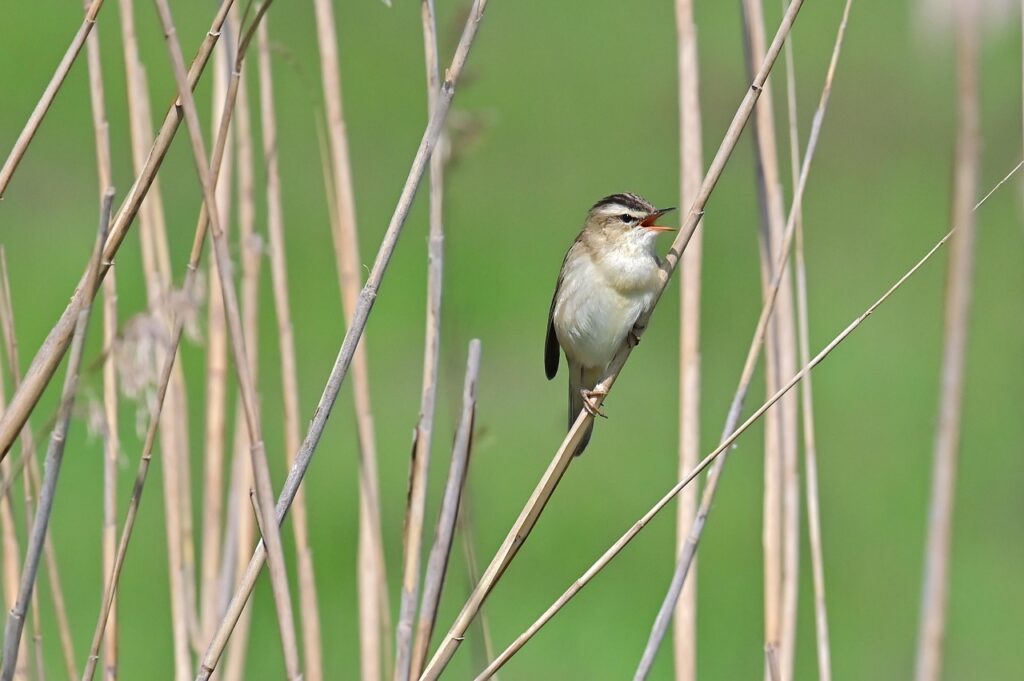
Among the chorus of amphibians and birds, one of the most distinctive is the sedge warbler.
Sedge warblers are found throughout Britain in damp wetlands and reed beds. These small, elusive birds are known for their streaky plumage; both males and females have a dark, striped head, a noticeable pale eye-stripe, and a mottled brown back on an olive-brown background.
They weigh just 10 to 13 grams, similar to a single AAA battery. Most live only two years, but some reach up to 8 years and 8 months—remarkably long for such a migratory species.
From April to October, sedge warblers appear throughout the British Isles in watery habitats, with about 260,000 breeding pairs in the UK.
As soon as they return, male warblers claim their territory and sing. Each bird’s song is a mix of random chattering and skilful mimicry, resulting in a performance that is never repeated.
The males sing while flying a few metres above the reeds and circling before parachuting gracefully back to the ground. Those with the most varied songs and best displays attract more mates.
Once a pair has formed, the female builds her nest among the reeds, just above the ground.
This cup-shaped structure is woven around the stalks and is made of grass stems, spider webs, flower heads and animal hair.
She will lay up to five eggs, which are incubated for 14 days, and the chicks fledge after a further 13 days.
Female Sedge Warblers are typically monogamous, although males show less fidelity. Despite this, most males remain faithful to specific territories, returning each year.
Primarily insectivorous, Sedge Warblers feed on a range of bugs, including mayflies, dragonflies, spiders, and beetles. Before migration, they also eat berries to increase fat reserves.
These warblers are most active at dawn and dusk, when cooler temperatures and slower-moving insects make feeding more efficient. They generally prefer reeds and rushes but may also be found in shrubs, arable land, or ditches.
Before migration, they seek food intensively to double their normal weight, sometimes travelling considerable distances before beginning their journey.
Sedge Warblers overwinter in sub-Saharan Africa, from Senegal and Ethiopia south to Namibia.
Migration begins between August and September, with individuals from Britain typically flying through southwest Iberia or Italy. From southern England, the migration to Africa is over 2,400 miles.
When winds are favourable and the birds have built up sufficient fat reserves, they can complete the flight non-stop in 75 to 95 hours—an extraordinary feat for birds less than 13 cm long.
Return migration from Africa typically begins at the end of February, with arrivals in Europe starting from March.
Although currently not threatened and classified as of least concern, Sedge Warblers may face challenges from climate change, the expansion of the Sahara Desert, and wetland loss, which could impact food availability, adult survival, and the distances between stopover sites.
The corncrake, our final nighttime songster, is a migratory bird that was once widespread but is now increasingly rare across Europe. Typically inhabiting lowlands, it can also be found in mountainous regions where fens, bogs, and marshlands persist.
In the UK, corncrakes are primarily found in Scotland and Ireland. Thrush-sized and a member of the rail family, the corncrake resembles a small moorhen, with brown and grey plumage and striking chestnut wings.
From mid-April to mid-June, the male’s distinctive, rasping ‘crex crex’ call is heard as he attracts a mate.
Corncrake numbers in the UK are declining due to changes in agriculture, such as earlier and more efficient hay and silage cutting, which destroys their vital breeding habitats.
Providing suitable habitat in April, combined with later cutting of grass crops, could significantly boost population numbers.
Once common throughout the British Isles, corncrakes are now mostly restricted to the western and northern islands of Scotland, as well as small areas of Ireland, mainland Scotland, and England.
With short lifespans of 2–3 years and only a third of adults surviving to breed again, every corncrake must rear many chicks to maintain the overall population.
A single successful breeding season has a significant positive impact; however, long-term management is crucial for maintaining sustainable numbers.
Corncrakes exemplify the importance of semi-natural habitats to a variety of species. Low-intensity farming and crofting, particularly cattle grazing, create species-rich habitat mosaics which are vital for biodiversity.
Machair, a naturally fertile grassland, supports not only farming and crofting but also a wealth of other species, such as the greater yellow bumblebee, Irish ladies’ tresses, and several wading bird species.
Birds that survive their migration from Africa usually return to the area where they bred or were born the previous year.
Male birds start calling from early cover, occasionally during the day and almost nonstop at night.
Once they attract a mate and build a nest, females lay 8-12 eggs and incubate them alone. Predators rarely discover these well-hidden nests. Females stay with their first brood for about 12 days.
Fledglings cannot fly until they are approximately one month old.
Around this time, males begin calling again throughout the night from hay and silage fields, and pairs commonly produce a second clutch. Females remain with the second brood for about 17 days.
After the second brood fledges, both parents moult their wing feathers and are flightless for approximately two weeks.
By late August, they’ve regrown their flight feathers, marking the start of their migration back to Africa. The first brood often leaves in August, while the second typically waits until September.
Most nighttime songbirds in Britain are migratory and present mainly in late spring and early summer. However, some stay through the summer before heading to warmer climates. In contrast, native owls are year-round residents, their haunting night songs marking the British countryside.
For many, the dawn chorus is when birds sing early in the morning, sometimes even before dawn, often waking us from sleep.
This phenomenon coincides with the start of the breeding season.
As days lengthen, birds’ melatonin levels decrease, and testosterone levels increase, triggering breeding behaviours like territorial displays and attracting mates.
Usually, only male songbirds sing. Defending a territory is essential because it provides resources for raising young.
Through their songs, males signal to rivals that the territory is claimed and should be avoided.
Birds incorporate pauses in their songs to listen for responses, allowing them to assess the presence of nearby rivals and adjust their effort accordingly. Species such as chaffinches and great tits boast extensive song repertoires, giving the impression that many birds occupy the area and discouraging competitors.
In addition to territorial defence, birds sing to attract mates. Courtship songs are generally longer and more intricate than alarm calls. A male’s singing demonstrates his strength and suitability as a mate—singing after a night without food is particularly impressive, indicating resilience and a resource-rich territory that weaker birds cannot match.
Birds perched higher in trees can amplify this effect, as elevation lessens sound distortion from temperature changes and wind. While singing from exposed positions increases a bird’s risk of predation, its ability to evade predators may demonstrate its fitness to potential mates.
Two main factors explain the dawn chorus: dim early morning light and low insect activity make foraging difficult but improve acoustic conditions for bird song, and overnight territorial shifts mean mornings are pivotal for defending territory.
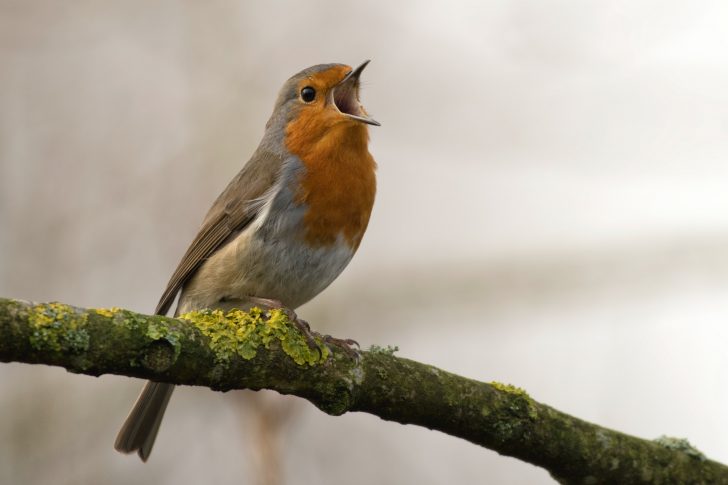
For these reasons, early morning is the prime time for birds to sing and protect their territories.
As morning unfolds, birds begin singing in a specific sequence, creating a unique soundscape. Robins, blackbirds, and thrushes are usually the first, starting up to two hours before sunrise, which, in Britain’s late spring and early summer, can be as early as 3 a.m.
The timing of their songs is influenced by moonlight and weather; warmer, lighter nights may prompt earlier singing. Initially, the chorus is gentle and interspersed with silence.
Gradually, wood pigeons, wrens, pheasants, and warblers join, layering the symphony. Great tits, blue tits, sparrows, and finches wait for daylight before joining, bringing the chorus to a near-climax.
Personally, there is nothing quite like hearing tawny owls converse, or listening to early blackbirds and robins as I rest or wake in woodland tranquillity.
We hope you have enjoyed getting to know some of the night birds that fill our woodlands and will take a moment to listen to their enchanting songs wherever you are tonight.
If you enjoyed this blog, please check out more of our wildlife blogs here, or you may prefer to listen to the Wildlife Matters Podcast here.
If you want to support our work
Please click on the Wildlife Matters Patreon Community.
Please click to join the Wildlife Matters Substack Community.
You can donate here.
Further Reading
BTO British Trust for Ornithology Identifying Nightingales and other night singers
Birdspot – Why do birds sing at night
Natural History Museum – Identifying Bird Song