London’s Wildest Places is a new series exploring the wildest places in the capital to see wildlife and nature. London is one of the greenest cities in the world, with some famous parks and green spaces, but there are also some wild places where you can escape the hustle and bustle of the city and immerse yourself in less well-known nature. Today we visit Greenwich Park.
Getting There
Buses 177, 188, 286, 53 and N53
River Buses RB1, RB2 and RB6
Maze Hill or Greenwich Stations
DLR Cutty Sark
However you arrive, Greenwich Park is very accessible. It is the oldest of the eight Royal Parks of London.
Greenwich Park features many attractions, including spacious boulevards, flower-filled gardens, wildlife-rich meadows, and historic spots dating back to Roman times.
For us early birds, it’s one of the best places in London to see the sunrise or sunset, and it is so peaceful for night owls.
Greenwich Park is a Grade I-listed place that is well worth visiting if you are in SE10.
It is home to an array of ancient trees that provide an ideal nesting ground for species, including tawny owls, woodpeckers, thrushes, and warblers. It’s also home to pipistrelle bats and over 92 species of spiders.
So let’s check it out.
Greenwich is a special place for me. Generations of my family have lived and worked in the area, and a few still do.
Greenwich Park has a record-making history. It’s where east meets west at Longitude 0° on the Meridian Line, part of the Maritime Greenwich World Heritage Site.
I usually arrive at Maze Hill station and enter the park by the playground area before starting the fairly steep climb to One Tree Hill, one of the park’s highlights.
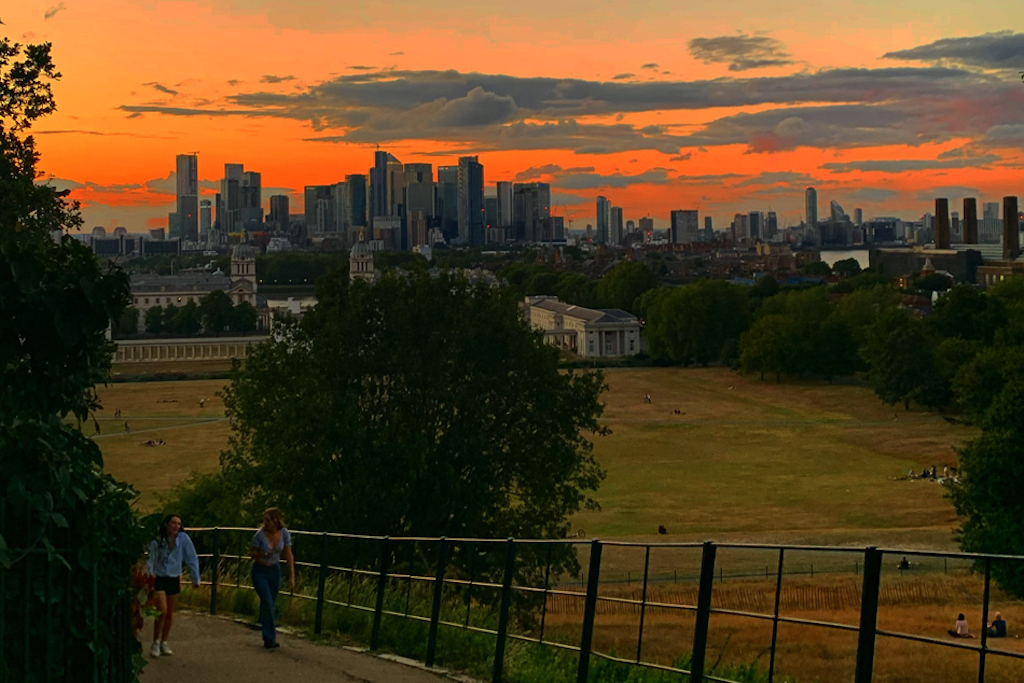
One Tree Hill is a high point about 300 metres east of Observatory Hill. It has been popular with artists and visitors for centuries and provides the most atmospheric viewpoint across the River Thames to London, especially at sunset.
In the seventeenth century, it was called Five Tree Hill but has also been called Sand Hill, a reference to its sandy summit, which is now paved over. Since the eighteenth century, the name One Tree Hill was adopted because of the single prominent tree at its highest point.
The current tree is a London plane that replaced its predecessor, probably an oak, which was blown down in a storm on 22 August 1848. I am told it was a year of dreadful weather. There was scarcely any summer that year—which sounds familiar—along with devastating crop failures throughout the country.
One Tree Hill was a popular venue for pleasure seekers during the Greenwich Fair, with a band often playing at the top. It was also the place where the main activity of the fair – ‘tumbling’, which is as it sounds – was rolling down the hill as quickly as you could go.
The view has brought many artists to it, most notably J.M.W. Turner, whose painting, ‘London from Greenwich Park’, exhibited in 1809, shows a view strikingly reminiscent of today. Louis Jules Arnout painted it from a balloon in 1845, showing a different scene.
A poem about One Tree Hill was published in 1784, and a verse from it is carved into the seating along the southerly wall. This poem is ascribed to Thomas Nichols, a little-known amateur poet of that era. The ironic theme of the poem is that no famous poet has ever written about One Tree Hill despite its worthiness.
There are many stories about One Tree Hill, including Queen Elizabeth I stopping on the hill to picnic under the great oak tree in 1602. The oak was known as the Oak of Honour, which gave the local area its name: Honor Oak.
According to other local stories, One Tree Hill was also the site of Queen Boudicca’s last stand against the Romans in AD61 and was also a haunt of famous highwayman Dick Turpin.
Today, a commemorative oak tree planted in 1905 takes pride of place at the summit of the hill. There’s also an old gun emplacement built to shoot down Zeppelin airships during the First World War and a beacon constructed to mark the silver anniversary of King George VI in 1935, which was also used to see in the new millennium in 2000.
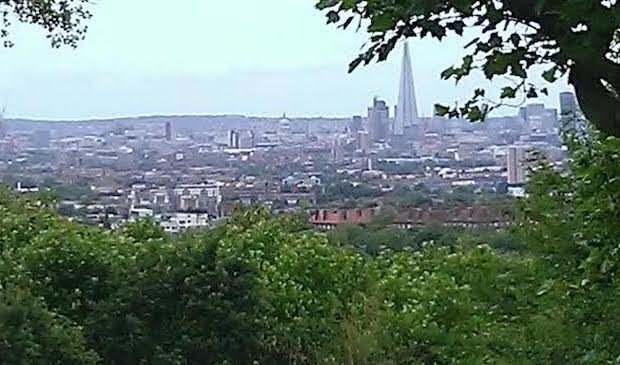
Best of all though is the view of London. From the top of the hill, you look past London plane and oak trees to see the City of London’s skyline. It’s hard to believe that this small patch of natural tranquillity is so close to the busy City of London, which you can see so clearly.
One Tree Hill is a bit of a climb, but it is worth it for the stunning views over the city skyline and the spectacular sunrises and sunsets. You will often have the place to yourself, making it one of the best places for anyone seeking solitude in London.
As I walked down from One Tree Hill and headed towards the Roman ruins, I was drawn to the sounds of the corvids, mainly jackdaws and magpies, who were trying to out-compete each other with the loudest squawk and call as they circled above me.
Now, if you heard me say “Roman Ruins” and you think a vestige of old Londinium might have escaped your notice, calm down. All there is to see is a grassy knoll, almost indistinguishable from the grassy plain that surrounds it, which would be utterly unremarkable were it not for the helpful explanatory panel that, with the help of an artist’s impression, encourages you to imagine how the Roman temple might, perhaps, have looked once upon a time.
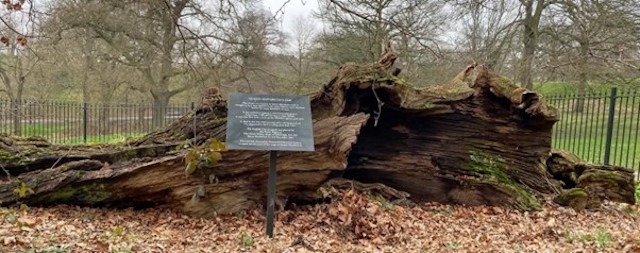
Next is one of Greenwich Park’s natural highlights: the Ancient Queen Elizabeth oak. This ancient tree’s remains are tucked away in a central but secluded location in the park’s centre.
Despite its name, the oak is believed to have been planted long before Queen Elizabeth I’s reign, probably as far back as the 13th century. A tree-ring analysis undertaken in 2012-13 estimated the date.
There are many stories to be told about this tree. I am starting with King Henry VIII dancing around the tree to impress Anne Boleyn. Another old story is that Queen Elizabeth I enjoyed sitting in the shade of the tree and taking refreshments when she was in the park.
Whether this is true or not, what is certain is that Greenwich was one of the Tudors’ favourite locations and that the 200-year-old tree would have been a noticeable feature of the park during their time.
Another story is that in the 19th century, the hollowed-out trunk, some 7 metres in circumference, was used to lock up anyone who had broken park rules.
By the late 19th century, the tree had died and was only kept upright by a thick ivy covering. This ancient oak finally toppled over during a storm in June 1991 and has assumed its horizontal position ever since. A tree that is around 750 years old has earned its rest.
Today, another oak stands next to it, planted in 1992 by the Duke of Edinburgh to celebrate Queen Elizabeth 2 40th anniversary since her accession to the throne.
Next, we headed towards the flower garden. I enjoy stopping off at the Flower Garden, created in the 1890s. It has stunning cedar and tulip trees and always colourful seasonal beds. It is a quintessential Edwardian Garden and an excellent place to sit and enjoy the views of the pond area.
We follow the deer trail through what is known as the wilderness, and today, that is true, as there are no deer in the park. I later found out that the fallow deer are having a break in Richmond Park, which is why some work is being carried out in the area.
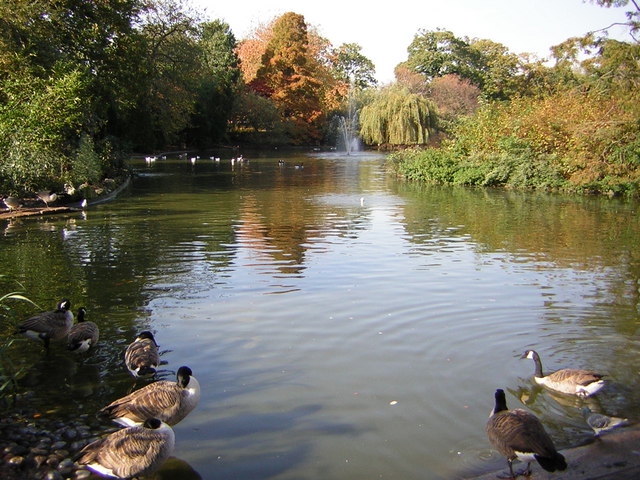
We quickly moved along to visit the Park Pond and soon spotted mallards with their ducklings on the grass.
We walked round to the far end of the lake and found a pair of moorhens and a juvenile robin within the lakeside shrubs. A single Egyptian goose was seemingly enjoying a little solitude on the grass. We carried on, and as we meandered through the woodland area, we did manage to see quite a few robins, wren, dunnock, great and blue tits and a female greater spotted woodpecker.
The bright green ring-necked parakeets—maybe thirty to forty—were lading in the treetops, squeaking loudly as they triumphantly celebrated their return to the park.
The grey squirrels are constant entertainment as they hurry about their business. Some are incredibly tame and have no fear of humans, which is not good for any wild animal. However, they scamper towards you and stop and take a look—maybe just checking you out—and if they feel you are okay, they will come closer.
I did enjoy this brief interaction. Squirrels are so charismatic and have distinct personalities, and they have so many cute looks and moves that it is hard not to fall in love with them.
The next stop is the Rose Garden. The classical beds are home to various flowers, creating a vibrant, colourful display each summer.
The rose gardens were part of the Park Rangers House, managed by English Heritage and houses The Wernher Collection, a collection of artworks amassed by diamond magnate Sir Julius Wernher (1850-1912).
The Rose Garden was originally planted in 1960-61. It was enlarged and replanted in 1993-4, and that is when the yew hedge was planted. The beds are laid out semi-circularly and planted with predominantly hybrid tea and floribunda roses.
We visited in August 2024, and the rose gardens were closed for restoration. The sign said that The Rose Garden urgently needed restoration. The existing roses have become exhausted through Rose Replant Sickness. This is a soil-borne fungal root disease in the soil where roses have been grown for some time, and it can prevent the growth of or cause the death of new roses planted in those areas. A build-up of rose-specific pests will also be present in and around the rose garden area, making new roses more susceptible to disease and damage.
We saw many of the same wildlife species in the rose garden that we had seen, but we did see a pair of blackbirds and a wren.
We were heading towards the Royal Observatory, where Greenwich Mean Time was born and where you can stand with one foot in the eastern hemisphere and one in the west.
We arrived at 1 p.m., when you can set your watch or, in our case, phone the way generations of Londoners have done since 1833—by dropping the bright red Time Ball. This historical timekeeping tradition hasn’t missed a day a day in almost two hundred years.
It’s a busy place, and we don’t stay long, preferring to head towards Croom’s Hill’s woodland and grassland.
Croom’s Hill is a road that runs adjacent to the west side of Greenwich Park and is said to be one of the oldest roads in England. The name comes from the Celtic word ‘crum’, which means crooked or twisty.
This area of the Park has more woodland, with some of the sweet chestnuts being over 400 years old. There are many fine ancient oaks and cedar trees here. Their gnarled and crevassed trunks are perfect micro-habitats for roosting bats, fungi, and many species of beetles and spiders in the park.
A survey by the Friends of Greenwich Park revealed over 92 species of spider living in the park, plus 11 just outside the Park boundary. They found species such as the Cucumber spider, Cellar spider, Flower crab spider, False widow spider, Garden spider, Wasp spider, Giant house spider, Water spider, Nursery web spider, and the Raft spider, and in a first for London, a Nigma puella which is a tiny green spider with a distinctive red mark on its abdomen.
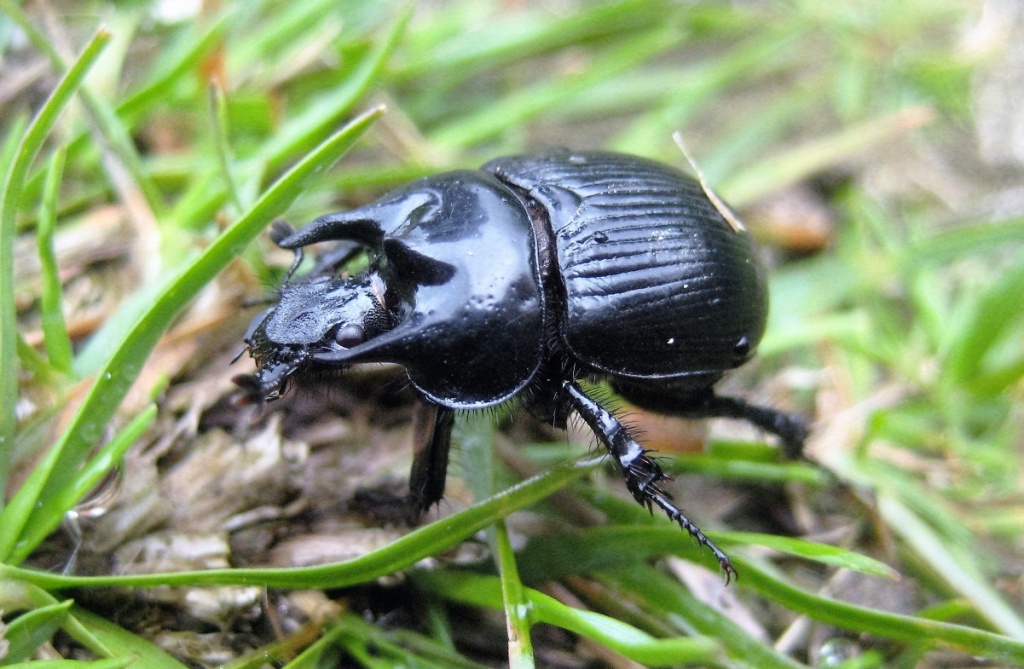
One of the current surveys within the park is searching for Dung Beetles. Dung beetles are an essential provider of ecosystem services. By burying, moving, and eating dung produced by rabbits, deer, and horses, they carry out ecological functions such as soil fertilisation, nutrient recycling, bioturbation, and seed dispersal.
Their clean-up operation also helps to reduce populations of biting flies and deer parasites.
Throughout Britain, the once common dung beetle has declined and is now at risk of extinction, mainly due to the use of anti-parasite medication in the dung of farmed animals.
Historically, dung availability in London was not an issue as parks, commons, and pastures were regularly grazed by livestock, but in recent years, many of these areas have been lost, and as a result, dung beetle populations in London are also in decline.
The good folk at People’s Postcode lottery are funding volunteers to carry out surveys for the correctly named Minotaur beetles, so-called after the shape of the horns on the male beetle—see picture. The next phase of surveys will be carried out in October.
As we leave the woodland, we are heading towards St Mary’s Gate entrance and a chance to enjoy the Herb Garden.
You will all know I love plants and enjoy growing and cooking with them. I have been vegan for many years, so herbs and spices are a big part of my food. I enjoy walled and herb gardens like this one which is tucked away beside St Mary’s Lodge.
The Herb Garden was originally established in 1969 but was then re-designed in 1993 to what we see today. From mint to rosemary, these herbs are surrounded by box hedges in an ornate English garden-style landscape.
At the centre of the garden, a circular thistle-shaped fountain sits within its own walled and fenced area. Its waters flow gently onto pebbles nestled on its banks, providing a peaceful and tranquil spot to enjoy the great outdoors and people-watch.
There are plenty of benches on each side of the garden to sit and enjoy tea, as seen from the nearby White House Café in the park.
We don’t have time for such pleasures as we want to see the Queens Orchard.
The Queen’s Orchard is an enclosed garden that dates from 1661 when Sir William Boreman, the park keeper, began the layout and planting of the major avenues, the Giant Steps and this area known then as the Dwarf Orchard – all of which were completed by 1662.
The mulberry tree, which is still in the centre of the garden, is believed to date back to 1610, and there is some evidence that other fruit trees were planted here around the same time.
The Orchard had a challenging time belonging to the Admiralty, who sold it to the Greenwich Hospital Trust in 1807. In 1862 and 1872, plans to build houses on the site were abandoned after local opposition.
In 1976, the local Council purchased the site from the Greenwich Hospital Trust for housing, but their plans were defeated following much public protest. After this, the council lost interest, and the site remained largely inaccessible to the public and was managed as a wildlife area until 2007, when it was reincorporated into Greenwich Park.
In 2011, the Royal Parks began restoring the Queen’s Orchard to its early eighteenth-century design. The park includes a formal circular pond and a very attractive wildlife pond built on the sides of an artificial hill.
We also walked around the heritage fruit trees that have been planted and enjoyed looking at the excellent range of vegetables and flowers that are grown alongside them.
There is an old well that was rediscovered on the site that has been made a feature and is capped with a wrought iron cover made by local artist Heather Burrell.
Sticking with the gardening theme, it’s time to look along the Herbaceous border.
At 200 metres long, Greenwich Park’s Herbaceous border is London’s largest. It dates back to 1925 but was redesigned in 2013 by award-winning garden designer Chris Beardshaw.
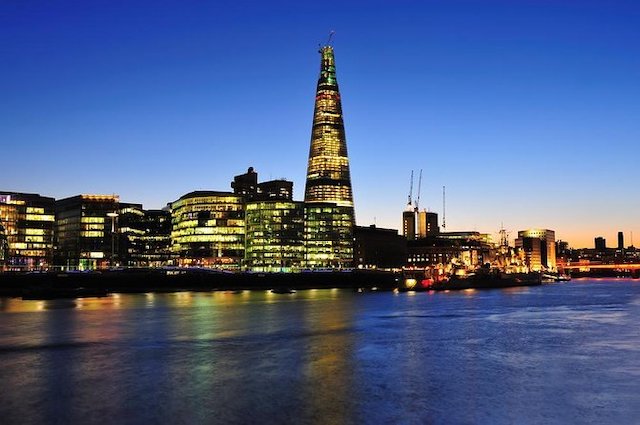
We decided to end our day by visiting the Cutty Sark before getting the Uber River Boat from Greenwich Pier along the Thames.
We took in some of the iconic sites of central London before departing at Waterloo for our onward trip home.