Picture credit Craig Murray
Join Wildlife Matters as we explore the wild waters of Loch Doon in South West Scotland
The sunset over Loch Doon was one of those rare, unhurried moments that demand you stop whatever you are doing and watch. I sat on the step of Raven, my campervan, and watched the last light dissolve into the water. I went to bed knowing that, whatever tomorrow brought, this evening was already worth keeping.
I woke before sunrise to find a thin mist lifting from the loch, the water barely visible in the grey half-light. Over porridge, fresh fruit, and a second coffee, I settled into the quiet ritual of tying my boots on Raven’s step, the day still full of possibility.
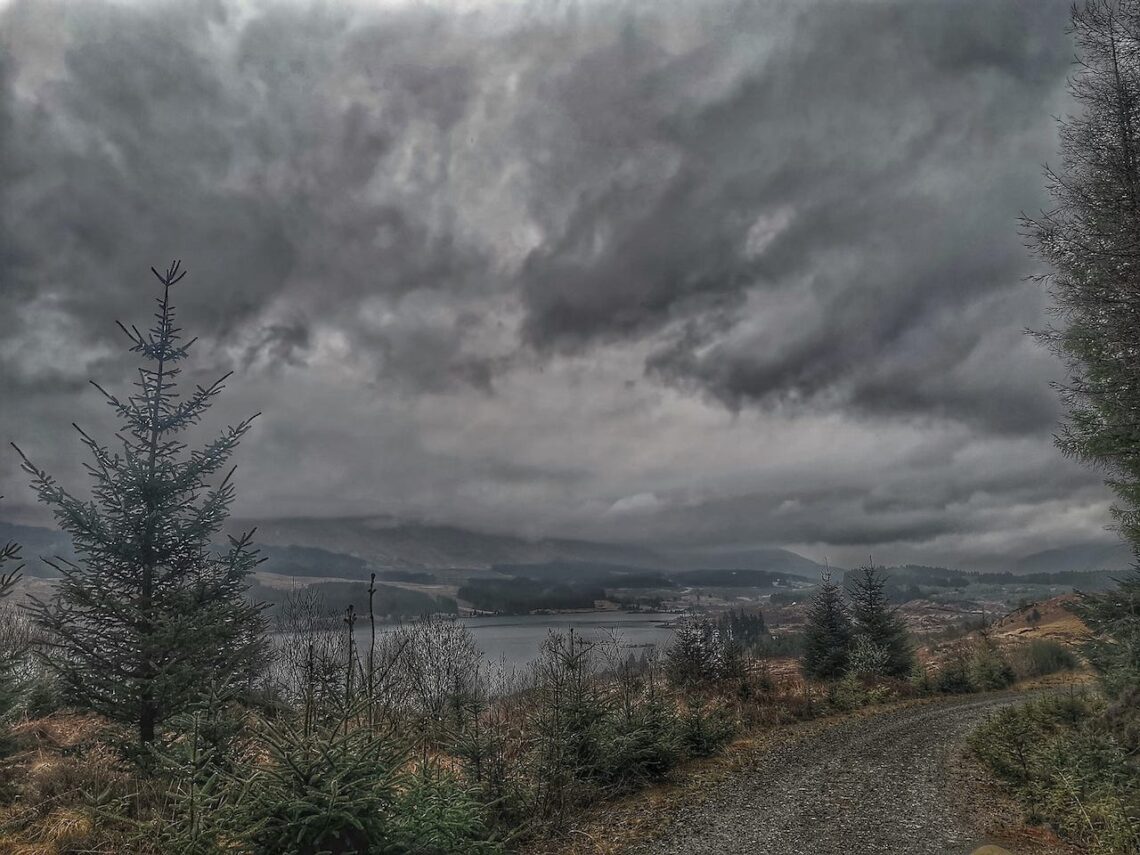
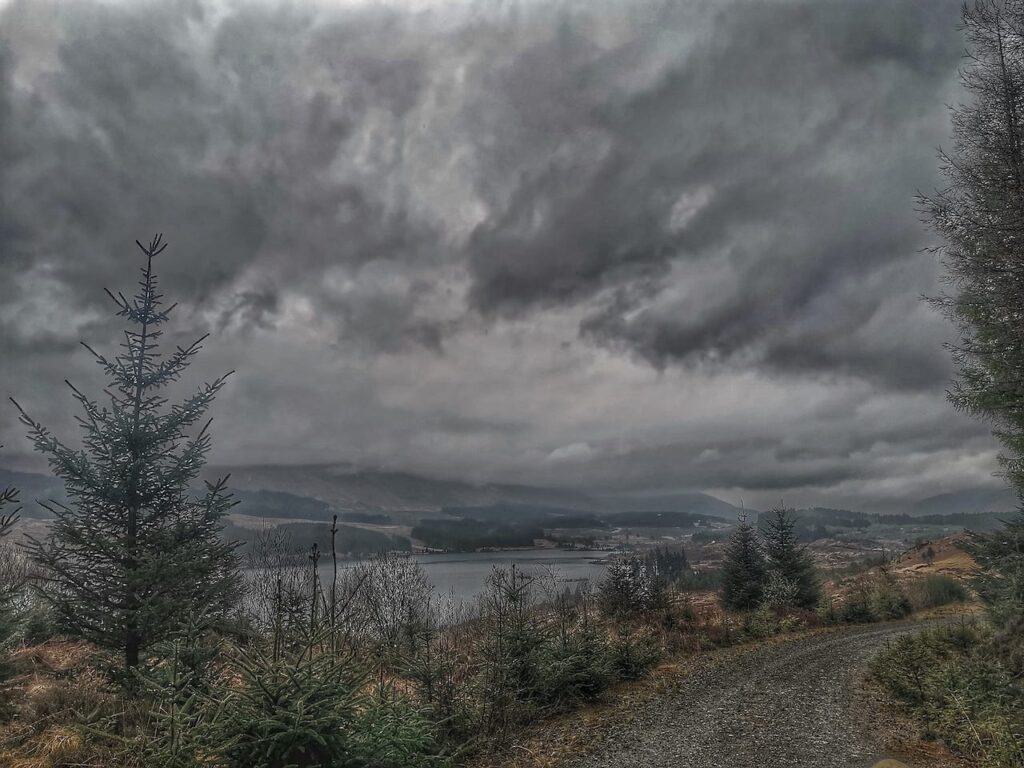
The loch lay calm and grey, the surrounding hills no more than dark silhouettes against a pale, brightening sky. The whole landscape had the feeling of a held breath.
Whether you come for the birdwatching, the photography, or simply the pleasure of being somewhere wild and quiet, a November walk around Loch Doon is something genuinely special.
The summer crowds have left, the ospreys have flown south, and what’s left is the loch at its most authentic: raw, windswept, and all yours. Sturdy boots are a must. With the days so short, plan your route carefully and bring a map. Instead of fighting the weather, embrace it. Winter is truly the best time to see Scotland’s toughest wildlife.
Loch Doon is the largest inland loch in southern Scotland, stretching a full seven miles from end to end. It is a vast, moody body of water that feels even bigger when you stand at its edge than it does on a map.
The loch was dammed in 1935 as part of the Galloway hydroelectric scheme, and the engineering, though easy to take for granted, is quietly extraordinary. The dam anchors the northern end of the loch, with a road running across its top. Beside it sits something that tends to stop visitors in their tracks: a fish ladder of striking octagonal design, its stepped chambers guiding fish patiently upstream, one pool at a time.
No other fish ladder like it is known to exist anywhere in the world, a quietly extraordinary detail hiding in plain sight. What’s truly remarkable about the dam is how it manages the water. Instead of letting the loch drain naturally northwest into East Ayrshire, the dam completely reverses the flow, sending it back over the watershed into the Galloway catchment. This supplies a chain of lochs and hydro stations that reach all the way to Dumfries, about forty miles south.
At the time of its construction, the Galloway scheme was one of the most ambitious engineering undertakings in Britain. Stand on the road that crosses the dam, look out over the loch and the hills beyond, and try to imagine the scale of what lies hidden beneath the landscape. It is almost impossible.
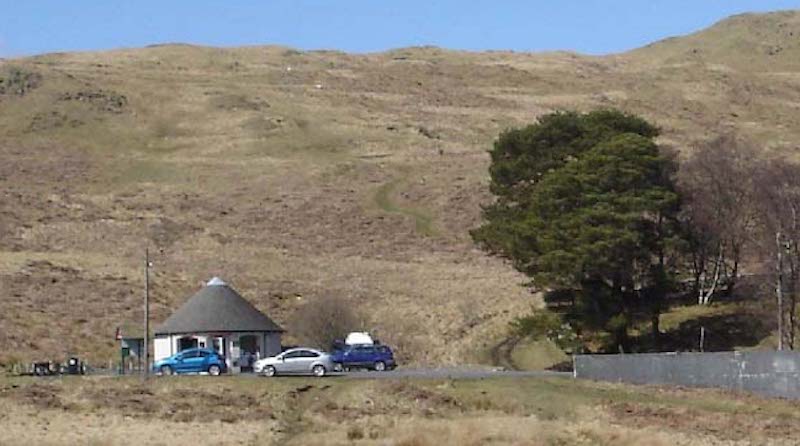
A fine way to begin the day is at the Roundhouse Café, a welcoming spot beside the loch with a good selection of food and drinks, including plant milks. The café also has a dedicated osprey-watching area, and with good reason.
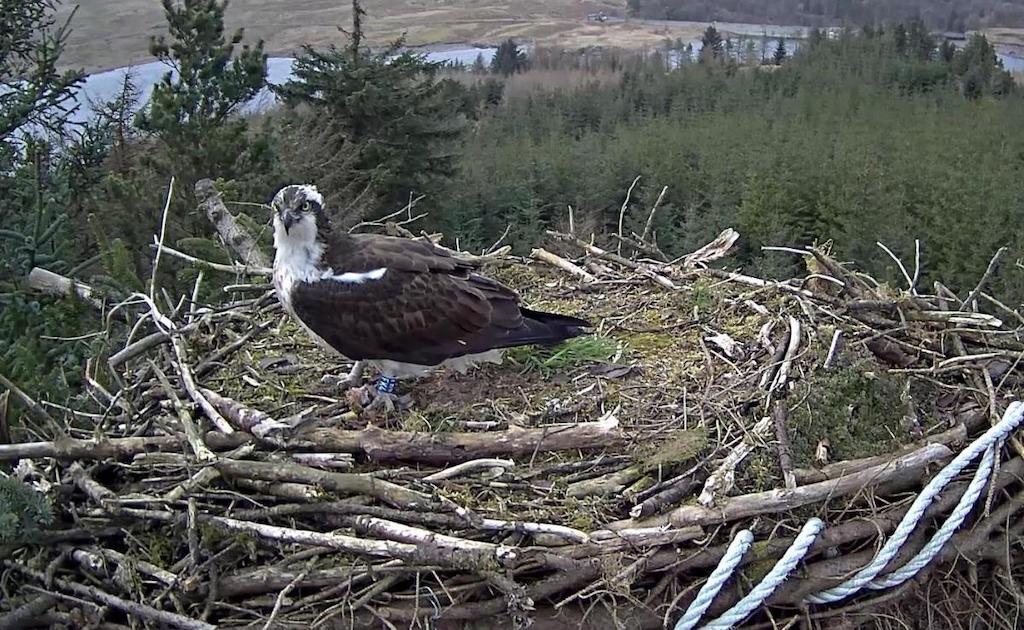
Freddie and Angel, the resident pair, have been returning to Loch Doon every year since 2012, raising chicks and making this one of the finest places in southern Scotland to watch these magnificent birds.
In November, though, they are far away, somewhere in western Africa, about three thousand miles to the south, and won’t return until at least the end of March. When they do come back, you can follow their daily lives on the East Ayrshire live webcam (eastayrshireleisure.com/countryside-outdoor/osprey-cam). It’s a great way to keep up with the nest during the breeding season, no matter where you are.
It was Angel and Freddie who first brought me to Loch Doon. I spent a weekend here at the end of last summer, watching them fish the loch and carry their catch back to the nest, and I knew before I had even packed up Raven that I would return. Ospreys are among the most exciting birds of prey to watch, especially when they are hunting.
They occupy a category of their own within the hawk family, unique in both appearance and behaviour. Once you have watched one fold its wings and plunge feet-first into a loch, surfacing with a fish gripped in both talons, the image stays with you permanently.
Their anatomy is a masterpiece of evolutionary design. Unlike most raptors, ospreys share a bone structure closer to that of an owl, allowing them to reverse their outer toes and grip a slippery, struggling fish with two talons on each side in a vice-like hold that almost nothing escapes. Their hooked beak does the rest, tearing through the catch with surgical precision. In every detail, they are built for the water. Their story in Britain is one of the most remarkable wildlife recoveries the country has ever seen.
Ospreys were once persecuted and hunted until they became extinct in Britain by the early twentieth century. Then, in 1954, they returned on their own, without help. The recovery was hard-won. For years, egg thieves and people interfering threatened to undo all the progress, and the birds needed constant protection before they were safe in Scotland. Today, just over 250 breeding pairs live in Scotland, making a total population of about 1,500 birds. To put that in perspective, there are about twice as many golden eagle breeding pairs in Scotland, which surprises many people who think golden eagles are rarer.
The recovery is real and remarkable, but the numbers are still fragile. Every successful nest, and every pair of chicks that fledges and flies south in autumn, is important. The nest at Loch Doon is no exception.
In the field, ospreys are easy to recognise and are rarely mistaken for other birds, though large gulls can look similar from far away. Look for the large white head with its bold brown eyestripe, the pale underbelly contrasting sharply with the dark brown back, and that distinctive crooked-wing silhouette in flight. Up close, the details become even more impressive. A transparent third eyelid, shared with many birds of prey, slides across the eye at the moment of impact, protecting it during the dive.
The eyes of a young osprey begin a deep orange, slowly shifting to yellow as the bird matures. Their wingspan is considerable: females reach around 1.8 metres, and even the smaller males span an impressive 1.5 metres. Despite their size and power, ospreys are surprisingly vocal.
Their usual call is a soft, repeated chirp that sounds almost gentle, but when danger approaches the nest, it quickly becomes urgent and unmistakable. Once you hear it echo above the loch, you’ll remember it forever.
Ospreys are highly specialised fish hunters. They show little preference for any particular species, but favour fish that inhabit the upper layers of large open water bodies, such as Loch Doon, where prey is visible from above.
Using their extraordinary eyesight, they quarter the water from a height of 90 to 100 metres, scanning the surface below with an intensity that leaves almost nothing unnoticed. Once the osprey spots its prey, it commits. It either goes into a steep, fast dive, hitting the water at up to 125 km/h, or makes a more controlled swoop, grabbing the fish cleanly from just below the surface.
The osprey always carries the fish head-first, a habit that reduces drag and makes it easier to manage, as it flies steadily toward a favourite treetop perch to eat in peace. Ospreys are deeply habitual birds. They return to the same nest year after year, adding sticks and making repairs with each new season. Some nests are thought to have been in continuous use for close to a hundred years.
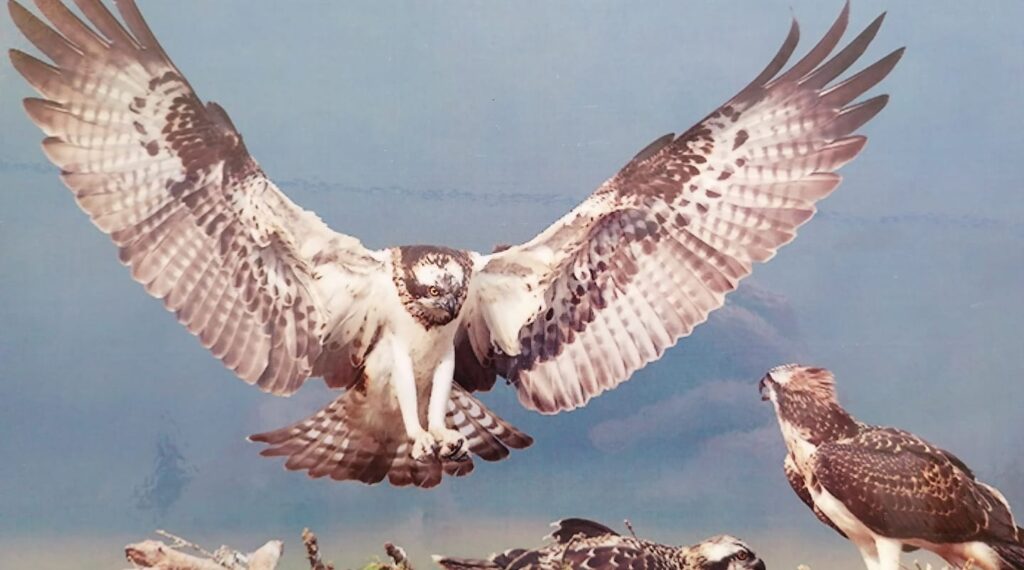
Picture Credit: Roundhouse Cafe Loch Doon
At Loch Doon, Angel and Freddie have returned to the same nest for over ten years, adding to it each season until it has become a truly impressive home, built with patience and devotion.
Freddie, it must be said, is not always the most restrained of architects. More than once, he has arrived back at the nest with such an armful of sticks and material that he has come perilously close to burying Angel entirely.
People who know the pair well say it’s just his way of showing devotion, like an osprey’s version of bringing flowers. It’s charming in its own way. When the time is right, Angel lays two or three eggs, each one ranging from cream to pinkish-cinnamon, marked with reddish-brown spots that make them look like small, hand-painted stones.
Both parents share incubation duties, taking turns over 36 to 42 days and rarely leaving the nest unattended. When the chicks hatch, they grow at a remarkable pace over the next seven or eight weeks, and they are ready to fly, typically fledging between late June and August.
Before committing to that first real flight, young ospreys spend days at the nest’s edge practising what is affectionately known as “helicoptering”, hovering in place, wings beating hard against the air, testing their strength. Once airborne, the young birds remain near the nest for another four to eight weeks, learning to fish and building the stamina they will need for the extraordinary journey south that lies ahead.
Leaving the Roundhouse Café, we pick up the trail to Glessel Hill, which sets off just to the right of the café and climbs steadily toward the summit. At 1,062 feet, the summit is well within reach, about 30 minutes of steady walking from the dam, and the views waiting at the top make every step worthwhile.
From the top, the views over Loch Doon are some of the best in the area. On a clear November morning, with the loch lying grey and perfectly still below, the scene is breathtaking. To the southeast, Cairnsmore of Carsphairn rises to 2,614 feet, its broad shape dominating the horizon and reminding you how wild and open this part of Scotland is.
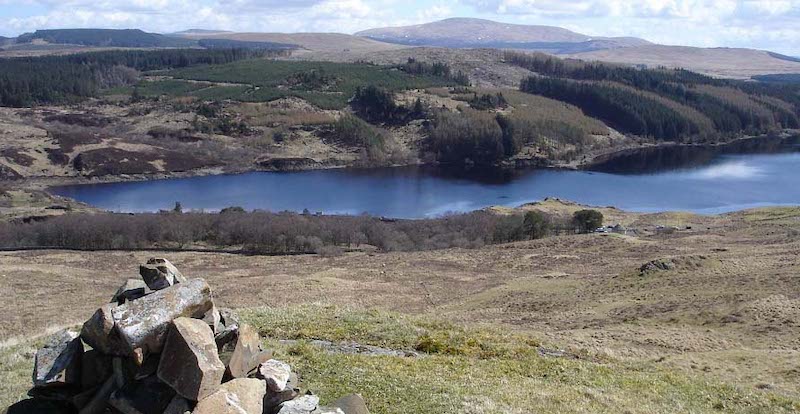
Looking southeast across the full length of the loch, the Rhinns of Kells, also known as the Corserine Range, fills the horizon with one of the most dramatic ridgelines in all of southern Scotland, its highest point Carlin’s Cairn at 2,648 feet, with Corserine rising just behind it.
On a day like this, with clouds moving their shadows slowly across the hills and the loch shining below, it’s the kind of view you don’t want to leave. From the top of Glessel Hill, the path toward Glen Ness leads back to yesterday’s adventure.
Today, though, we’re heading in a different direction, toward what used to be the Scottish Dark Sky Observatory. It opened in 2012, officially unveiled by Scotland’s First Minister at the time, Alex Salmond, and was built in one of the UK’s largest areas of natural darkness, the perfect place to explore the night sky.
The observatory grew into one of Scotland’s most distinctive attractions, open year-round and welcoming everyone, from seasoned astronomers to those seeing the stars properly for the very first time.
Then, tragically, in the early hours of 23 June 2021, fire broke out at the observatory. By morning, the damage was clear. The building was gone, along with a chapter of Scottish dark sky tourism that had introduced thousands of people to the wonders of the universe.
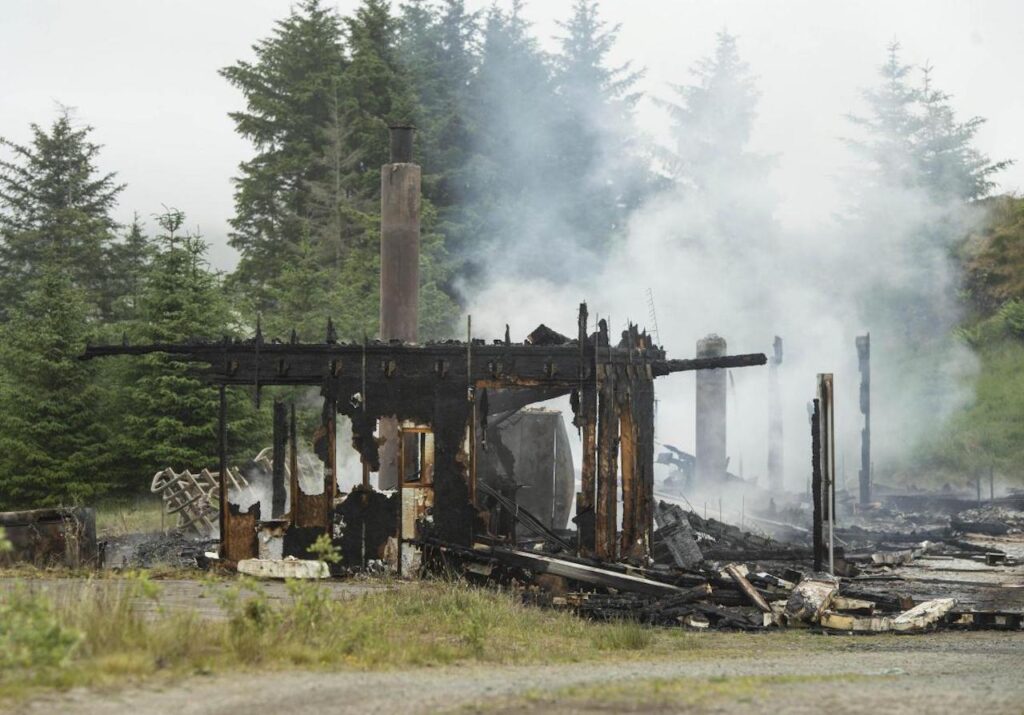
But the story does not end in ashes. Plans are well underway for a new £1.5 million observatory and visitor centre at Clatteringshaws Loch, around thirty miles south of Loch Doon near Newton Stewart.
The new centre will have two observation domes, a planetarium, a café, and a gift shop. It’s a bigger and more ambitious project than anything before it. No confirmed opening date has been set yet, but it is very much something to watch for.
I’ve spent a night at Clatteringshaws in Raven, and I can say without hesitation that the dark skies there are extraordinary, the kind that make you look up and lose track of time.
I follow the trail onward, we pass a large stone weathered and tilted, not unlike a broken trig point, before turning toward Craighead Wood, a semi-ancient broadleaved woodland in private ownership and listed on the Woodland Trust website.
At the gate, take the track on the right, heading up toward Fort Carrick. Follow it around in front of the fort, keeping the structure to your right. It was here, in this woodland, that the day delivered its most extraordinary moment.
Wandering slightly off the trail to look more closely at the trees, their bark thick with lichen and moss, their branches reaching in every direction, I was not paying nearly enough attention to what lay ahead.
As I crested a small ridge, I came face to face with a Red Deer stag. No more than a couple of metres separated us. I cannot say with any confidence which of us was more surprised. I froze, fully expecting him to bolt or, worse, to charge. He did neither. He looked at me.
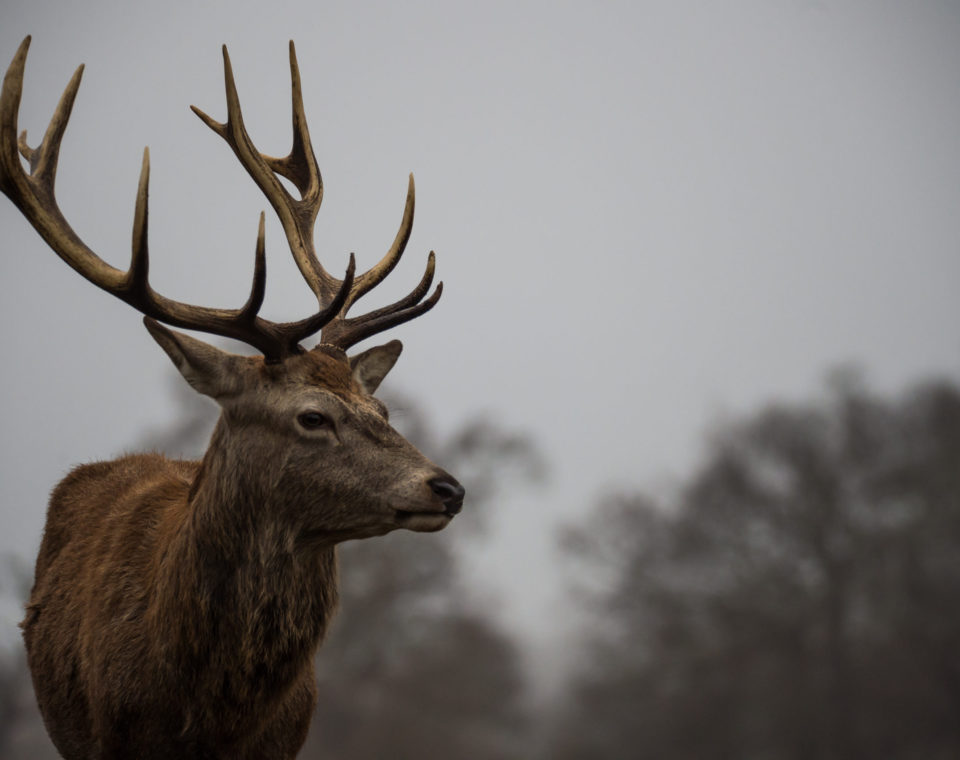
This was November, the peak of the rutting season, and the stag in front of me was in his full autumn glory. His shoulder was level with the top of my head, and above that, his antlers tangled with bracken, huge and unmistakably real.
I began to back away slowly, never once taking my eyes from his. He did not move a muscle. Step by careful step, I retreated over the ridge until I sank below his line of sight, then dropped quietly to the ground.
My heart was hammering. Adrenaline had done its work, and I sat for a moment with my eyes closed, taking slow, deliberate breaths and trying to think clearly about what to do next.
He did not follow. After a few minutes of sitting still, breathing steadily as the adrenaline faded, I heard the quiet, slow sound of the stag moving away through the undergrowth. I stayed where I was for several more minutes, just to be sure.
Scotland’s most iconic animals are a living symbol of the Highlands in every sense. I had not expected to meet one quite so directly, but standing in that woodland with my back against a tree and my pulse still racing, I had never felt my appreciation for them more immediate.
The Red Deer, Britain’s largest land mammal, moves across Scotland’s windswept moors and misty glens with a calm confidence, like an animal with little left to fear. The biggest stags are truly impressive, weighing up to 500 pounds and standing 1.4 metres at the shoulder.
Despite the stag’s commanding presence, Red Deer are led not by the males but by the hinds, the females who quietly hold the herd together and guide it through the seasons. They are long-lived animals, able to live to 20, though most live around 14 or 15, a quiet sign of their resilience in some of Britain’s toughest terrain.
As herbivores, Red Deer graze on whatever the land offers: leaves, coarse grasses, and the heather that washes the Scottish Highlands in purple and green through every season.
Nothing defines the Red Deer quite like its antlers. These bold, branching structures can grow to a metre long and are the stag’s weapon of choice in the dramatic battles of the rut.
Each spring, the antlers are shed in a process called casting. At up to 9 kg (about 20 lbs), growing them takes a lot of energy, and shedding them frees up strength for foraging and the next rut. Soon, new growth starts at the base, and the cycle begins again.
Few sounds in nature match the raw power of a stag’s roar. It’s deep and guttural, rolling across the Highland landscape like distant thunder. As autumn approaches and the rut takes hold, these calls spill across hills and valleys in a chorus that feels as ancient as the hills themselves.
Stags bellow to attract hinds and warn rival males, their voices carrying across the open moors with surprising clarity. A single roar can travel up to 2 miles, rolling through the glens in waves.
Heard up close, it’s a sound that stays with you. Every roar carries information too; it’s a vocal measure of the stag’s size and strength, broadcast to every ear on the hillside. But sound alone is not enough. Stags also communicate through scent, releasing a pungent, musk-like substance that lingers long after they have moved on, an invisible signature written across the hillside for hinds and rivals alike to read.
It’s worth clearing up a common confusion: antlers and horns are not the same. Antlers are made of bone, branching and complex, and are shed each spring in a dramatic ritual. Horns are made of keratin, like our fingernails and hair, and once grown, they are permanent. Antlers reach outward in elaborate shapes, while horns usually grow straight or with a gentle curve.
As winter approaches, Red Deer undergo a quiet yet remarkable change. Their fur becomes hollow, with each hair turning into a tiny insulating tube that traps warmth close to the skin, creating a natural coat no tailor could match. When temperatures drop across the moors, this adaptation is truly life-saving.
When she is ready to calve, the hind does something she rarely does: she leaves the herd. Guided by deep instinct, she seeks out a quiet, sheltered spot away from the group’s noise and movement, and brings her calf into the world in peace. Only once the newborn is strong enough to keep up does she return.
Calves are born dappled with pale spots, natural camouflage that dissolves them into the shifting light and shadow of the undergrowth. As the weeks pass and the calf grows stronger, the coat darkens, and the spots quietly retreat, vanishing entirely when the first winter coat arrives.
Red Deer are extraordinary animals: powerful, graceful, and deeply connected to the Scottish landscape in a way that feels ancient.
Meeting one up close makes you feel, even for a moment, like a guest in a world that has existed long before us.
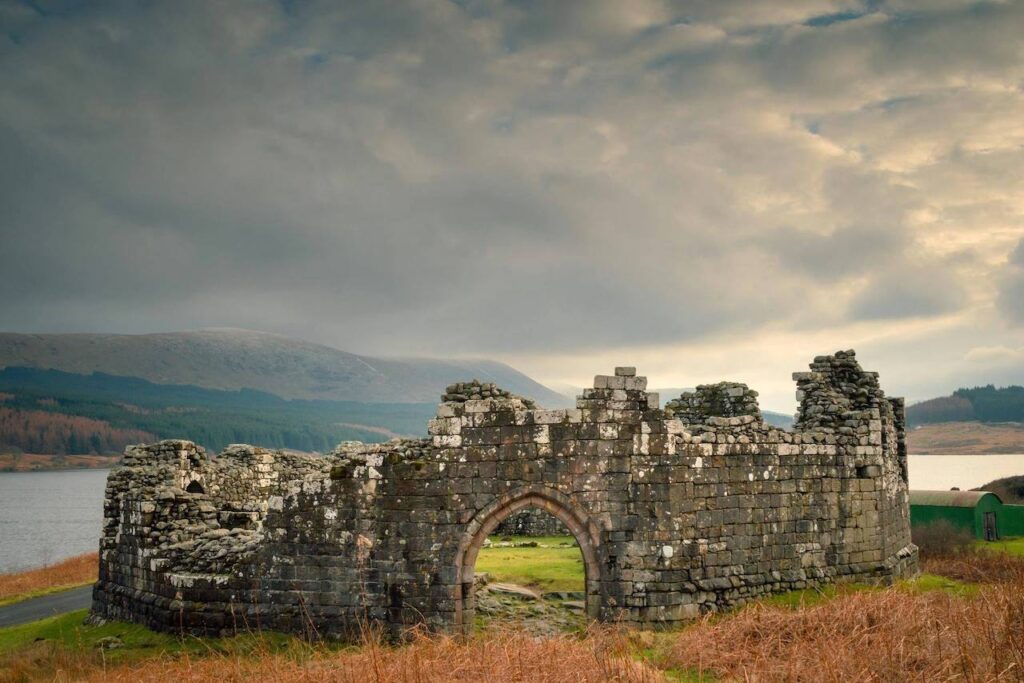
At the far end of the loch, Loch Doon Castle rises from the shoreline with the quiet authority of something that has outlasted almost everything around it. Its stones are dark with age, its walls shaped by centuries of Highland wind and rain, and its connection to Robert the Bruce gives it a weight that no amount of weathering can diminish.
The castle’s survival is, in itself, a story worth telling. When the dam was built, and the loch’s waters began their slow, relentless rise, the castle stood directly in their path. Rather than watch it disappear beneath the surface, the decision was made to move the entire structure, stone by numbered stone, carefully dismantle and rebuild it on higher ground beside the shore. It stands today exactly as it was, in a different place, but no less itself.
From the castle, the trail forks. The right-hand path climbs steadily to the Wee Hill of Craigmulloch, where wide, sweeping views open out over the dark and glassy waters of Loch Doon far below, a reward well worth the effort. The left-hand path takes a quieter route, crossing a small wooden bridge before threading through trees and rising gradually to a rocky knoll. It is here, stepping out from the treeline, that Craiglee Hill reveals itself for the first time, broad, unhurried, and entirely commanding on the horizon.
One practical note: the ground between the small hill and Craiglee often holds water. In summer, it’s usually passable, but in winter, it can get very boggy. When it’s wet, it’s better to take the Wee Hill of Craigmulloch first and cross to Craiglee along the rocky ridge, which keeps your boots much drier.
The hills surrounding Loch Doon are arranged into three distinct ranges, each with its own character. To the right lies the most dramatic of the three, home to Shalloch-on-Minnoch at 2,520 feet, Kirriereoch at 2,579 feet, and the mighty Merrick at 2,766 feet, the highest point in all of southern Scotland.
Access to this range follows the forest road that winds around Loch Riecawr. To the left, the range is anchored by Carlin’s Cairn at 2,648 feet and Corserine at 2,671 feet, two fine hills worth every step.
Park on the south side of Loch Doon and follow the forest road up to the western flank of Carlin’s Cairn. The middle range may not reach the same heights, but it more than compensates with character, with its rocky, rugged hills cut through with dramatic cliffs, and crowned by Mullwarchar at 2,270 feet, a summit that earns its place on any walker’s list.
Beneath the dark, glassy surface of Loch Doon, life carries on in near-perfect silence. Brown trout, Arctic charr, perch, and some impressively large pike move through the cold, peaty depths, each one a well-kept secret in these Highland waters.
I’ll admit I’m not a fisherman; the appeal has always been a bit of a mystery to me, except for the simple pleasure of standing somewhere beautiful and taking it all in. Still, even with an untrained eye, there’s something quietly magical about a still loch on a clear day. If you wait long enough, the water reveals itself: a sudden ripple, a flash of silver just below the surface, and then nothing, as if it never happened.
Of all the species that call Loch Doon home, the brown trout may be the most widely travelled. Native to Europe and Asia, it has been introduced into cool, well-oxygenated rivers and lakes on almost every continent, a fish that readily adapts and settles wherever the water suits it.
Its golden-brown sides and dark red spots make it one of the most attractive freshwater fish in Britain. Given the right conditions, it can live for 20 years and grow to over 20 pounds, an impressive lifespan for a fish.
Beneath its unhurried exterior, the brown trout is a patient and versatile predator. It picks off insect larvae from the riverbed, ambushes small fish that stray too close, and rises to take mayflies and damselflies clean from the surface with a precision that belies its calm appearance.
Between January and March, females move to gravelly riverbeds where competing males are present and lay their eggs directly on the riverbed. The eggs are fertilised externally and buried under the gravel, hidden from predators and protected by the current. The fry emerge into a vast, cold, and threatening world. For their first fragile days, they draw on their own yolk sac a built-in survival kit before growing bold enough to hunt the tiny invertebrates drifting through the current around them.
It may come as a surprise to learn that the sea trout and the brown trout are, in fact, the same species, a distinction science has only recently formalised. What separates them is not biology, but character.
The sea trout is a restless wanderer, heading out to the open ocean and all its uncertainty, before the pull of fresh water brings it back to spawn. The brown trout, on the other hand, is deeply loyal to its home, spending its whole life in the rivers and lakes where it was born, never feeling the urge to go to sea: same fish, two very different lives.
Another fish species found in Loch Doon is the Arctic charr, which carries the memory of the sea in its blood. Though their ancestors were ocean-going fish, every population found in Scotland today has made a permanent home in freshwater; these landlocked descendants of a more restless past have settled in places like Loch Doon.
The Arctic charr is closely related to the Atlantic salmon and the brown trout and shares with them a quiet elegance that belies its extraordinary resilience. But what really sets the Arctic charr apart is how far north it can live.
In the farthest northern places, where few creatures survive, it’s often the only freshwater fish around. Across the northern hemisphere, about 50,000 populations have been recorded, showing its amazing ability to colonise cold, clear water wherever it’s found.
Norway has the most, but the species is spread widely across lakes and rivers in the region. Here in Scotland, at the southern edge of its European range, it survives at high altitudes in the Rhine and Danube catchments, a sign of how tough this fish is.
In Britain, the Arctic charr lives in the cold, clean waters of the northern uplands, with Scotland as its main stronghold. Here, the species is mostly found in still water. At least 258 Scottish lochs are home to these fish, each one a quiet refuge in the Highlands, but not all of Scotland’s charr live in lochs.
Some populations are known to have moved into rivers, and a few are known to spawn in streams and rivers that flow into areas with standing water. This shows that even within one species, individuals can find their own paths.
Scotland has, on the whole, been spared the worst of the losses suffered by Arctic charr elsewhere, but that is not the same as saying all is well. Several sites have already seen their populations vanish entirely, and others are hanging on by the thinnest of threads, their futures genuinely uncertain.
The losses have been concentrated in south and central Scotland, where at least five populations are believed to have been wiped out by acidification, a slow, invisible process that quietly strips the water of the precise conditions these fish depend on to survive. It is a sobering thought: that a creature resilient enough to outlast the ice age can be undone not by predators or disaster, but by a gradual, almost imperceptible change in the chemistry of its home.
Few freshwater fish are as easy to recognise as the perch. Its olive-green body has bold, dark vertical stripes, earning it the nickname “tiger of the shallows,” and its lower fins are a bright orange-red that almost seems too vivid for a river fish. As a true carnivore of the genus Perca, it’s common in lakes, rivers, and canals across Britain, moving in groups and hunting invertebrates and smaller fish with quiet efficiency.
If the perch is the tiger of the shallows, the Northern Pike is the top predator, the undisputed ruler of the freshwater world. It’s a master of ambush, waiting motionless among weeds in lakes and rivers across the Northern Hemisphere, invisible until it strikes.
Its long, torpedo-shaped body is built for speed, and its jaws have between 300 and 700 razor-sharp teeth, leaving no doubt about its intentions. Pike can grow over a metre long, live up to 25 years, and will eat almost anything: fish, mammals, and even birds.
That’s when I saw it, a sleek, dark head moving through the water, leaving a bow wave that could only belong to one creature: the otter.
One of my very favourite wild animals, and it was right there in front of me. I’ve been lucky to see otters several times across southwest Scotland, in Dumfries and Galloway and here in Ayrshire. Still, every sighting feels as rare and special as the first. I’ll never get tired of them.
This one moved with purpose, heading for shore alone and quickly. I noticed it was a dog otter, broad-headed and powerfully built, even from a distance.
When it reached the rocky shore of Loch Doon, it pulled itself from the water without pausing, shook off briefly, then lowered its nose to the rocks and boulders, sniffing carefully for anything the tide might have left. After a short while, the otter seemed satisfied and stopped. It pressed its back against a seaweed-covered rock, stretched out comfortably, and began to groom itself.
I stayed completely still, hardly breathing, and watched through my camera lens as the otter carefully worked through its fur. As it turned out, what looks like a moment of rest is anything but.
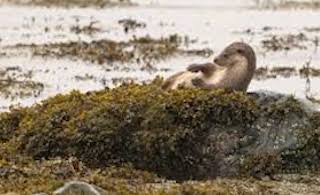
Otters spend between a quarter and half of their day grooming, a commitment that sounds excessive until you know what’s at stake. Unlike seals or whales, otters don’t have a layer of blubber to keep them warm in cold water. Their only protection is their fur, which is the densest of any mammal on earth, with up to one million hairs in a single square inch. It’s hard to imagine just how dense that is, but it shows how remarkable otters are.
When their fur is clean, it traps a thin layer of air against the skin, acting like a natural wetsuit to keep the otter warm even in the coldest water. But if the fur gets dirty or oily, it loses its insulation and heat escapes quickly, which can be deadly. To stop this, otters use their paws to work natural oils from their skin into their fur, creating a waterproof barrier that keeps them dry and warm underwater.
That trapped air also helps the otter float, letting it move through the water with ease. Grooming removes not just dirt and debris, but also oils from prey like fish and crabs, leaving residues that, if left, would slowly damage the fur that keeps the otter alive.
Otter cleaning is vigorous and thorough. Otters lick, bite, rub, and scratch with impressive energy, twisting and somersaulting to ensure that not a single inch of fur goes unattended. Their loose skin and extraordinarily flexible bodies allow them to contort into positions that would challenge a yoga instructor, reaching every awkward angle with ease.
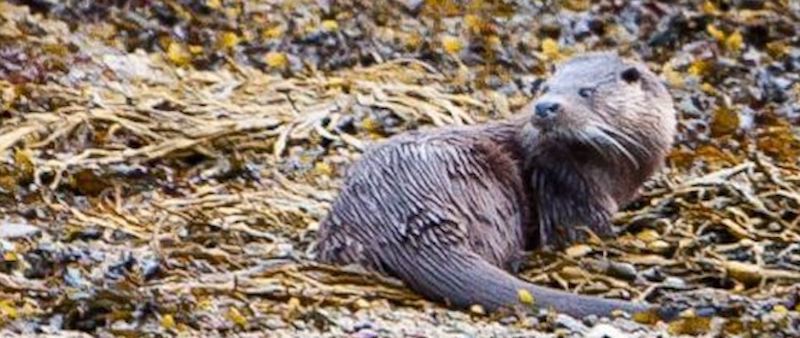
After some time, the otter slipped back into the deep, dark water of the loch without ceremony. It was there one moment and gone the next, just as otters always seem to be. I watched the ripples settle for a little longer than I needed to, then turned and walked back toward Loch Doon Castle and along the Craiglee path to the campsite.
Back in Raven, my campervan, I put the kettle on and let a hot coffee do its quiet work.
The sun had set over an hour ago, and the cold was beginning to press against the windows. With the chill of the evening and the diesel heater ticking quietly in the van, I made some notes from the day’s walk and looked at some of the pictures before relaxing with nothing left to do but open the door and look up at the night sky.
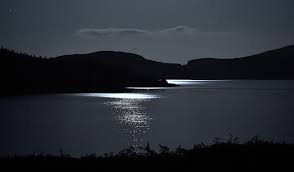
Scotland’s skies on a clear night are truly something else: vast, incredibly dark, and so full of stars that it takes a moment to find the familiar constellations. It’s the kind of sky that makes you feel both very small and incredibly lucky at the same time.
It was the perfect end to a wonderful day at Loch Doon. And the end of this week’s main feature in Wildlife Matters.
If you enjoyed this blog, please check out more of our wildlife blogs here, or you may prefer to listen to the Wildlife Matters Podcast here.
If you want to support our work
Please click on the Wildlife Matters Patreon Community.
Please click to join the Wildlife Matters Substack Community.
You can donate here.
Further Reading
Ayrshire Scotland. Com – Loch Doon