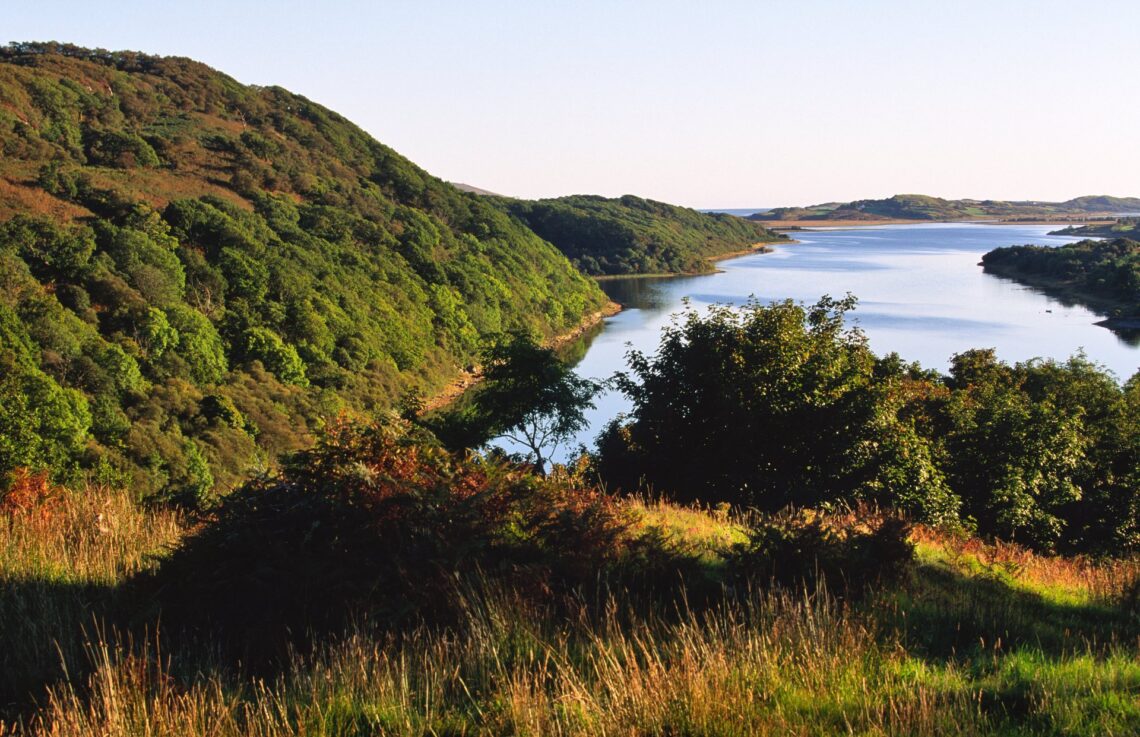
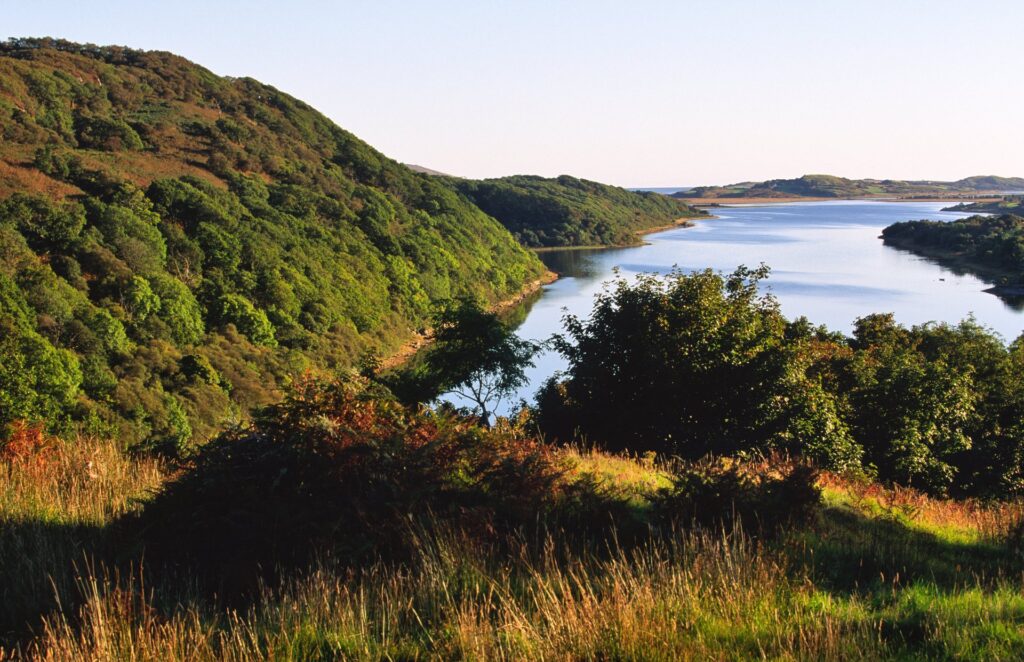
This is the start of a very special and pretty unique adventure exploring Scotland’s ancient rainforest. We are in Argyll, in the west of Scotland, in October. There are many things to do on Scotland’s west coast, including fantastic walks, Castles, the Sea, and lochs.
We have arrived in Lochgilphead. Although modest, it is the administrative centre home to around 2,300 people.
It also provides a great starting point for our adventure to explore a globally rare and endangered habitat and a species that began its reintroduction in this area around fifteen years ago.
Scotland’s Atlantic woodland, also known as the Celtic rainforest, is a unique habitat. It’s an ancient and native woodland that supports a high level of biodiversity and stores large amounts of carbon, making it an internationally critical habitat.
Scotland’s rainforest is found only on the west coast, where high rainfall and relatively mild year-round temperatures mean woodlands are consistently very humid.
Along with the clean air and low levels of nitrogen pollution, these conditions help provide a refuge for some of the world’s rarest bryophytes and lichens. Some species are important internationally, and some are found only in Scotland.
The varied species and ages of trees in the rainforest support this biodiversity; the different tree species and the presence of ancient and veteran trees are significant, along with the diversity of habitats, including open meadows, ravines and river gorges.
The woodland types that make up the rainforest are recognised in the Biodiversity Strategy List as essential habitats. Scotland boasts some of Europe’s highest quality and most significant rainforest remnants, and we support protecting this unique and vital ecosystem.
The Celtic Rainforest is a recent term for the temperate broadleaf woodlands along Europe’s extreme western seaboard. In the past, they were usually referred to separately as Atlantic Oakwoods and Atlantic Hazelwoods.
The temperate rainforest should also include remnant ash-elm woodlands, which now exist mainly as fragmentary wood pastures. In the western Highlands, these woodlands survive as fragments on the slopes of steep-sided glens and bordering sea lochs.
A slight annual temperature variation, high humidity, and high annual precipitation make these woods a nationally critical habitat for Atlantic bryophytes. Numerous species of rare mosses, liverworts, and lichens are found here.
Wildlife proliferates across this part of western Scotland; besides the native Red and Roe Deer, Badgers and Pine Martens are also widespread, and you may see one of the critically endangered Scottish wild cats that call the area home.
Migrant birds such as redstart, pied flycatcher, and wood warbler are here, whilst the pearl-bordered fritillary butterfly, a nationally critical butterfly, is still widespread here.
There is so much I want to explore, but time will not allow me to do everything on this visit, so I sit in the Smiddy, the local cafe, finalising my plans over a perfect oat latte.
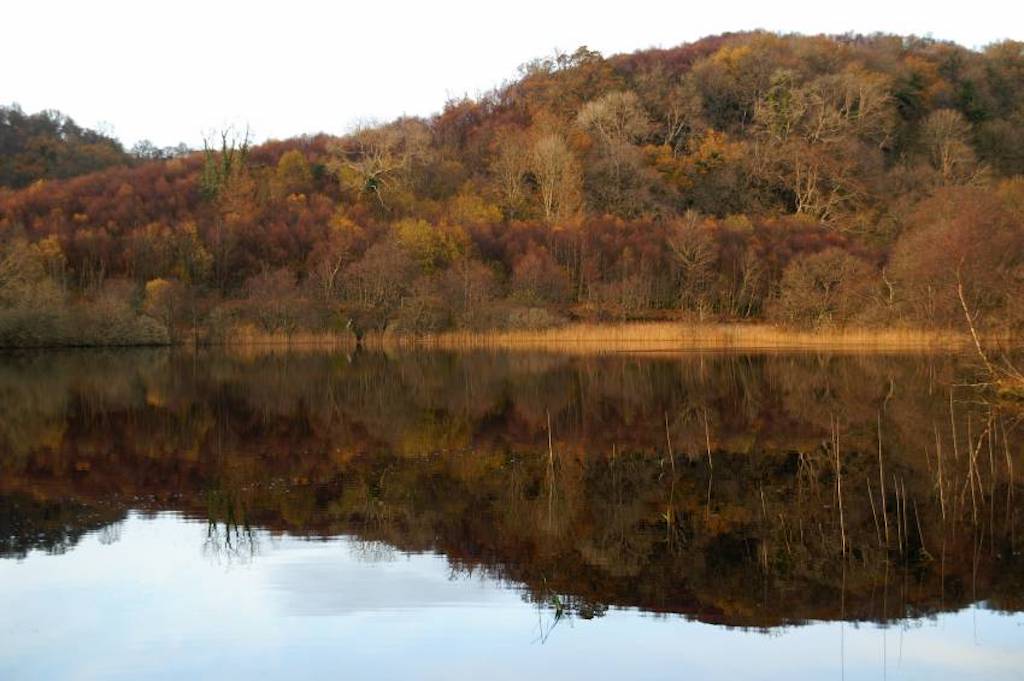
Loch Barnluasgan in Autumn Knapdale ForestKnapdale Forest
Knapdale Forest
Early the next day, we begin at Knapdale Forest, which includes ancient rainforests, oak, hazel, and birch.
The range of lichens, mosses, and liverworts here is incredible, and they play such a vital part in the rainforest’s international importance.
I am not an expert on lichens, liverworts and mosses, but they have inspired me with stunning names like Slender mouse-tail moss, Tree lungwort, Glue fungus and Wilson’s filmy fern.
I am told that all these can be found here in Knapdale.
We begin our walk from the Barnluasgan Loch Car Park, which has a paid-for car park and a wooden hut with many leaflets for information.
The scenic Loch Barnluasgan on our left has beautiful views and very clear water, which must help attract the range of birds I’ve seen, from the migrant Whoper Swans to Grey Herons.
After a short while, the path weaves its way steeply uphill as we climb ‘the knap’ which derives from the Gaelic word “cnap”, meaning a steep wooded hillside rising from a valley we are passing hazel with lots of big ‘leafy’ lichens – a good sign of clean air quality.
The top of the slope is an open area of Bracken, and as I dip down the other side, there is a large stand of mature sessile oak. Look into the branches of the closest oak tree to the path on the right-hand side—it is adorned with lichen, and tree lungwort is one of the plants on my ‘must-see’ list.
Lungworts are a type of lichen known as foliose – meaning leafy. When wet, they appear very bright and green.
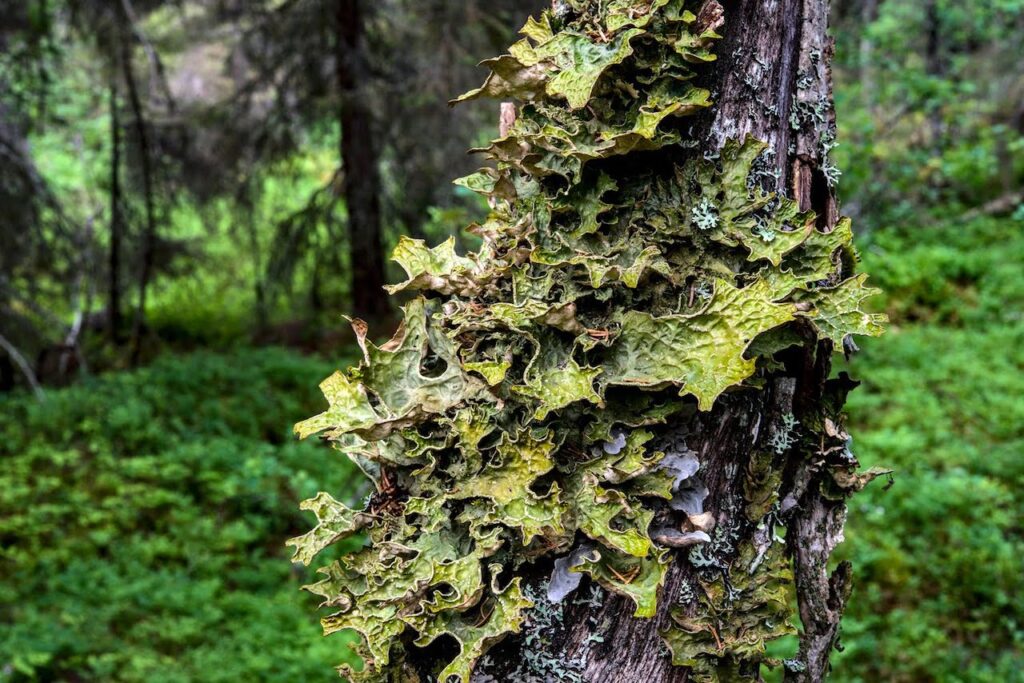
Tree lungwort Lobaria pulmonaria at Knapdale Forest Argyll Scotland
Tree lungwort (Lobaria pulmonaria) is formed from a fungus and two types of algae – one green and a blue-green one.
Lungwort lichens are known as indicators of ancient woodlands.
So, if you spot them while exploring, it’s a reliable sign that you’re in a rare habitat.
Lichens play a crucial role in woodland ecology. They provide essential microhabitats that shelter and feed small invertebrates, which prey on larger insects and birds.
Lichens can also host parasitic fungi and provide many other ecosystem services, such as carbon cycling and water retention.
Tree lungwort resembled the tissue inside our lungs and was considered a remedy for lung diseases.
In traditional medicine, it has been used to treat various medical conditions. In India, it is used to treat haemorrhages and eczema. In British Columbia, Canada, the Hesquiaht use it as a remedy for coughing up blood. In the high Molise region in Italy, it is used as an antiseptic for wounds.
Lungworts have also been used to produce orange dyes for wool and leather and to make perfumes and beer.
As we continue along the top of this ‘Kanp’ between Barnluasgan and Loch Linne, a long line of oak trees continues along this ridge, and if you look for a tree to the right of the path, there is an Oak with a dead tree below it. This is where I found the diminutive Wilson’s filmy fern.
Wilson’s Filmy Fern, with the Latin name Hymenophyllum wilsoni, is a small plant that looks more like a tuft of moss than a fern.
Its leaves are thin, transparent, and divided into parallel-sided, toothed segments.
This plant is found only in the west of the UK, including Wales, Ireland, and the west coast of Scotland. It thrives in damp, shaded areas among trees or rocky crevices.
Further along the ridge, the path begins to descend through an area of birch and hazel trees. Here, I see the beautiful red squirrels scampering through the thin branches that whip and bend. The squirrels jump between trees in their haste to discover more hazel nuts to store for winter food.
At the bottom of the valley is a small stream with fast-running crystal-clear water. I’m drawn to a side pool of the stream by what I can see in the clear waters. There are Palmate newts in the pool.
The palmate newt looks similar to the smooth newt but favours shallow pools on acidic soils like heathlands. During the breeding season, males grow distinctive black webbing on their hind feet. In Scotland, the tadpoles, which are known as efts, can take two years to lose their gills and move onto land.
As the path starts to climb again, I notice how the woodland has changed to mainly birch, rowan and willow.
The gradual climb is much steeper, and a flight of steps has been installed to help. This leads to a stunning viewpoint across Loch Linne.
The path then descends steeply, finally passing through a gate in a deer fence. We are now back in a birch and hazel woodland. The path turns sharply to the right, and we find more steps to help our descent. Along this stretch on a large boulder, I found the slender mouse tail, a moss synonymous with Scotland’s Ancient rainforest woodlands.
A rich and luxurious green carpet covered the boulder. A Closer examination revealed a thick, growing moss with narrow leaves tapering to a sharp point. This growth pattern gives rise to the common name of Slender Mouse-tail moss, named after its slender, tapering stems, which resemble the tail of a mouse.
From here, the path continues its descent through a hazel grove before rejoining the lochside path, where the hazel trees form an arch over it. This is where I found Glue fungus.
The glue crust fungus (Hymenochaete corrugata) engulfs the twigs and branches of its host tree and sticks them together, allowing it to move from branch to branch (and even tree to tree). It then feeds off the decaying wood beneath its gluey pads.
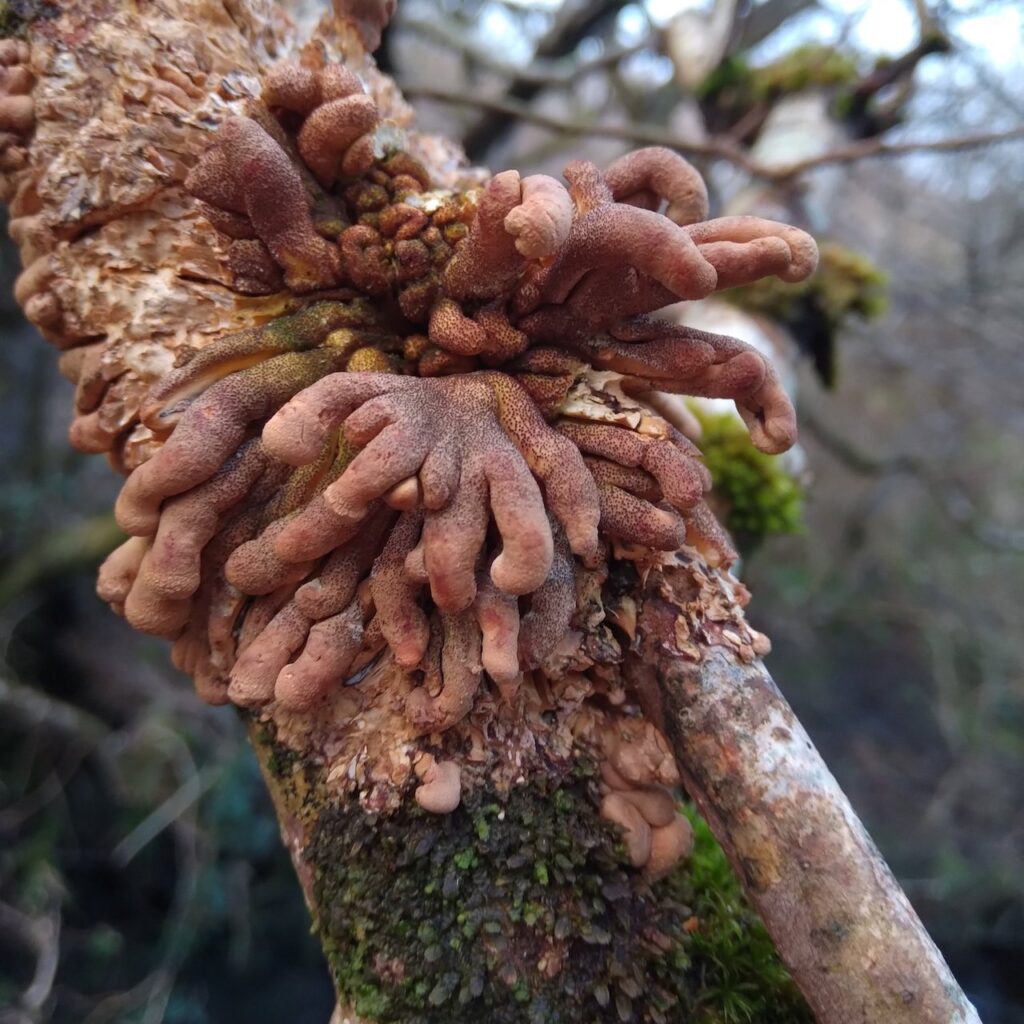
Hazel Glove Fungus
At this site, the Glue Fungus has Hazel gloves, another fungus living off it. Hazel gloves do not feed on their host tree but are a parasite of the glue crust fungus.
Hazel Gloves that resemble glove fingers have tiny black dots on the surface of these orange lobes, which are the sac openings that release the spores. Once the fruiting bodies are past their best, they may remain on the tree surface as dried-up, black crusts.
The presence of Hazel Gloves and Glue fungi in wood indicates good air quality and Atlantic rainforest conditions, making it a flagship species for this critical habitat.
I’ve now returned to the flat path that runs along the Loch. Walking along the route with the Loch to my right and the shady woodland to my left, I noticed the first lichen I could recognise.
The Dog Lichen, Peltigera sp., grows in damp habitats, often on Mossy logs and rocks, but it can also establish itself on garden lawns. Its leafy lobes have white dog-tooth-shaped root-like rhizines on their undersurface, loosely connecting them to the substrate.
I also spotted a wood sorrel nestling in the crooks of an oak tree. This is an excellent find for a thirsty forager, as it will quench your thirst.
A word of caution, Wood Sorrell. Like all members of the oxalis plant family, it contains oxalic acid. This can be a problem if you consume massive quantities. It has a sour, fresh taste in small portions between apple peel, grape skin and citrus.
The word ‘sorrel’ comes from the same word root as ‘sour’, and once tasted, it’s easy to see why. Wood Sorrell has so much vitamin C that it was once used to prevent scurvy.
We are back at the car park, and our first visit to Knapdale Forest is over. A place I will return to that has so much more to explore.
Now, it’s time to head towards the village of Tayviallach, which will be home for tonight, and tomorrow, we will head off to explore the

Taynish National Nature Reserve Argyll Scotland
Taynish National Nature Reserve
Taynish is an excellent example of Atlantic oak woodland. A pollen survey discovered that native woodland has existed at Taynish for about 7000 years.
The trees colonised northern Britain from the far south, where they survived the Ice Age.
Over 250 species of mosses and liverworts have been recorded, and Taynish is also attractive for its lichen communities, with over 475 species of lichens recorded here.
This includes many nationally scarce species and the Norwegian speckle belly, one priority Biodiversity Action Plan (BAP) species.
I’m awake early and excited to explore Taynish. The Taynish peninsula has a range of habitats, including shoreline, grassland, scrub, bog, heath, and woodland, each hosting its unique species of plants, insects, birds, and mammals.
Before I went to the nature reserve, I headed to the shoreline. There are several reasons to do this, but a big one for me was to look out to the Isle of Jura.
I plan to make many island trips soon, and Jura is high on my list.
But my decision to look across the sounds of Jura this morning had some very special bonuses. As I stood lost in my thoughts, gazing across the sea to Jura, something caught my eye that was much closer.
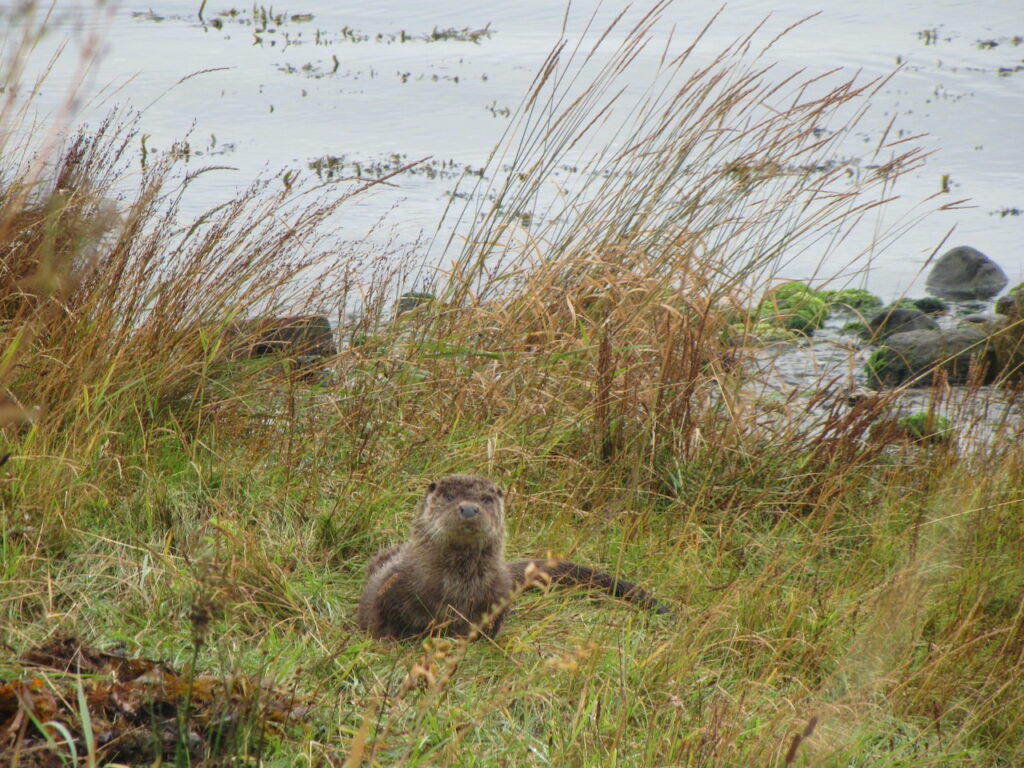
Male Otter at Taynish National Nature Reserve Argyll
Maybe 100 metres away, there was an otter on its back and eating a crab. I sat down and got my binoculars out for a closer look.
It was a solo otter, probably a male, lying on his back in the classic pose. I slowly reached for the camera and quickly captured the scene.
He didn’t seem worried by my presence; he rolled over and began to swim from my left, heading right across my line of vision.
He dived below the waves again and was gone for a minute or maybe two before he broke the surface and went to his back to eat a second giant crab.
It’s very unusual to have time when watching wildlife, but today was different.
This male otter was in no rush. He was in an excellent spot to find his food and take his time having breakfast.
The otter population in Scotland has made a remarkable recovery, with an estimated 8,000 otters now. This recovery is a testament to the improved water quality in Scotland.
Otters are mainly solitary, semi-aquatic mammals that primarily obtain food from lochs, rivers, or the sea. Around half of the otters live and feed almost exclusively in the sea in Scotland. Despite this coastal preference, these otters are the same species as those living in lochs and rivers.
Coastal otters, also known as “sea otters,” have smaller home ranges than their river-dwelling counterparts due to the abundance of fish and crustaceans in western coastal waters. They eat around 1–1.5kg of prey daily.
To remain effective as insulation, otters must use fresh water to keep their fur salt-free.
I set the camera to silent and sat back to take a wonderful collection of pictures of this handsome lad in his natural environment.
From the same place, as I looked to my left, I spotted a pair of heads with large, dark eyes bobbing with the waves about two hundred metres away.
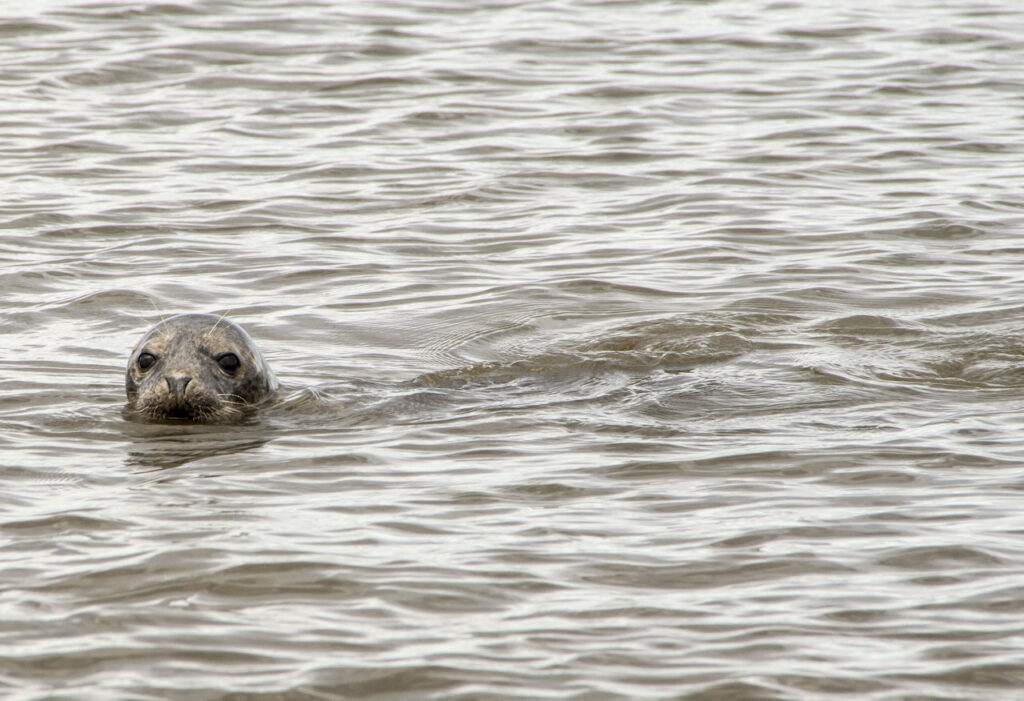
Harbour Seal Taynish Nature Reserve Argyll West of Scotland
They were Harbour Seals, resembling large Labradors. Their deep, soulful, dark eyes watched me with the same curiosity I was watching them with.
Harbour seals can live for up to thirty years. Adult harbour seals are about 1.5 meters in length and can weigh in the region of 80-100 kilograms.
It’s hard to tell males and females apart, but males are slightly larger than females. Harbour seals have a rounded, dog-like head, with a steep forehead and eyes to the front of their face.
Harbour seals prefer to come ashore in sheltered waters and usually feed within 40-50 kilometres from their haul-out site.
Harbour seals are widespread around the west coast of Scotland and throughout the Hebrides and the Northern Isles but are found in fewer numbers on the Scottish east coast.
Female harbour seals give birth in June and July, often returning to haul-out sites where they were born. Pups are born having already shed their white coat in the womb and can swim almost immediately.
You may be thinking, “How lucky can this guy be?” I would agree, except I was about to see another iconic Scottish wild species, but this one was in the sky.
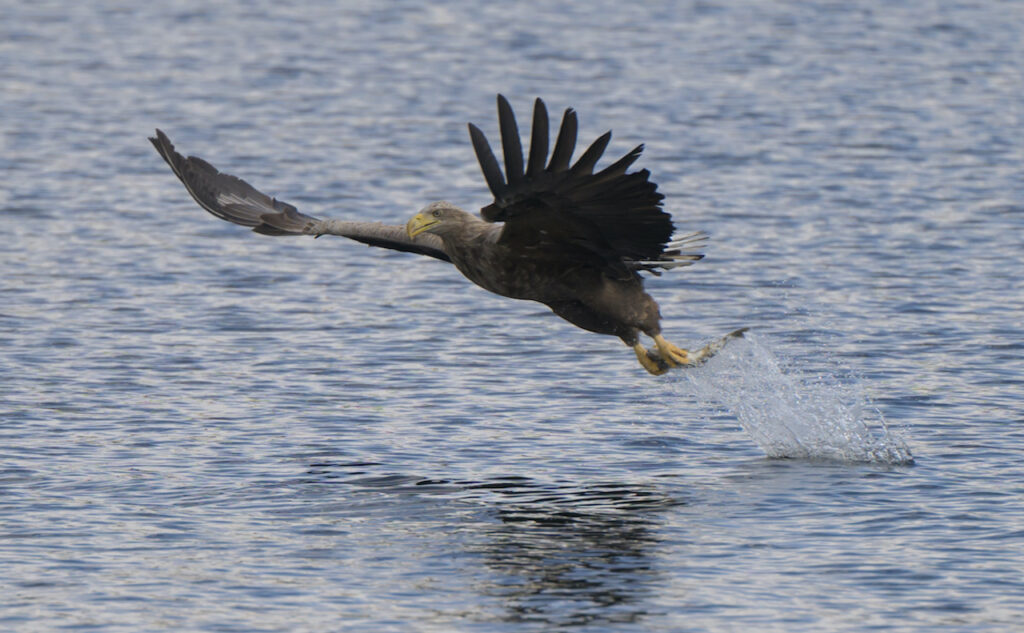
White-Tailed Eagle Taynish National Nature Reserve
Often referred to as ‘the flying barn door,’ the sheer size of these birds is hard to describe in words.
These majestic birds have a wingspan of around 2.5 meters and glide, riding the thermals above the sea in search of food.
Scotland’s last sea eagle was shot in 1919. Over fifty years later, reintroductions began, and today, there are around 150 resident pairs in Scotland.
When soaring, white-tailed eagles’ enormous wings look almost rectangular, giving them the nickname ‘flying barn doors’.
Unlike Golden Eagles, they will catch fish and can be seen, like today, flying low over the sea, waiting to pounce on any fish they spot.
White-tailed Eagles are versatile and opportunistic hunters and carrion feeders, sometimes pirating food from other birds and even otters.
They mainly eat fish but take other seabirds, such as gulls, geese, and ducks. On land, they target rabbits and hares.
Some pairs have been known to feast on Fulmars, which are thought to be the source of DDT and PCBs (chemicals) recorded in eagle eggs.
Carrion is an integral part of their diet, especially during winter. Most lambs are taken as carrion.
During the breeding season, an adult sea eagle requires 500-600g of food daily while rearing young. This drops to 200-300g per day during winter when the birds are less active.
I am sitting on this gravel beach in awe of the wildlife around me.
The otter wisely decided to stop feasting on crabs and dived under the waves. As I look towards the seals, the waters are empty—that is the impact of a white-tailed sea eagle.
They are the UK’s largest bird of prey. From my vantage point, I can see how heavy-set these birds are.
I recently saw very impressive golden eagles, but the sea eagle’s wings are visibly broader, and the finger-like end wing feathers are apparent.
The sea eagle passes my position on the beach and continues along the coast.
It is maybe 150 meters above me, and I don’t need binoculars to see the detail of the pale head and neck feathers, which fade beautifully into the rich brown body feathers.
As it passed me, the trademark pure white rear tail feathers came clearly into view.
The bright yellow beak is large, solid, and chunky-looking. It is noticeably hooked for tearing flesh and is the most striking feature of these incredible birds.
But then the bright yellow legs came down from the body as the sea eagle banked, turning upwards into the sky and making a tight turn before heading back towards me.
The long yellow legs extended, and it dropped to the sea’s surface below. I strained to see the bird on the water’s surface.
After grabbing my binoculars, I could see the incredible power in those wings as the sea eagle left the water.
Its waterlogged wings powered it upwards, out of the water rushing off its body and back to the ocean.
A large fish was held on long talons in its large yellow feet.
Then, I noticed the wings are held flat, not in a V shape like the golden eagle’s. Its ice-blue eyes gleamed in the morning sun.
White-tailed sea eagles are awe-inspiring birds.
They induce a primaeval feeling deep inside me, like the feeling I felt when I first saw a wild lion, heard a tiger roar, and looked into an elephant’s eye.
Today, the majestic white-tailed eagle earned its place on that short list of wild animals that have genuinely stirred my soul.
And I haven’t arrived at the Nature Reserve yet! What a fantastic start to the day!
As I arrive at the Taynish NNR and park in the car park, I set off towards the woodlands, which in Autumn are vibrant with the ochres, russets, reds, and browns of oak, birch, willow, hazel, and alder trees. Nature’s colours in autumn inspire me.
I’ve decided that the Bàrr Mòr Trail is good for today, but there is also the delightful Woodland Trail or the Mill Trail.
To reach Taynish National Nature Reserve, take the B8025 Bellanoch to Tayvallich Road. You can walk to the reserve from the car park just south of Tayvallich village.
I did this as the track that gets you closer to the start of the trails is very rugged, and I am in my camper van.
The Bàrr Mòr Trail is a three-kilometre or two-mile trail that takes you up the Bàrr Mòr – Gaelic for ‘big top’, from which you will have superb views over the surrounding woodlands, coastline, and islands.
You’ll need to be reasonably fit to reach the viewpoint at the top. There are steep paths that climb through the stunning woodland, but there are many steps to help your ascent before you finally emerge from the tree cover and onto the hilltop.
Taynish is a National Nature Reserve set in this stunning part of Argyll; it is a real sensory treat.
The clean air and damp West Coast climate make it a perfect habitat for lichens, liverworts, fungi, mosses, ferns, and wildlife amongst its ancient Atlantic oak woods.
The humid woodland offers an ideal home to around 250 species of mosses and liverworts. Taynish has recorded around a quarter of all the bryophyte species found in Britain, including seven that are nationally scarce.
Among the unique ferns, delicate and translucent filmy ferns grow on rocks and tree trunks. Around 500 lichen species, including 91 nationally scarce species, have been found in the reserve.
Over 300 flowering plants grow at Taynish, including the aword-leaved helleborine and the spotted heath orchid, for which Taynish is a stronghold.
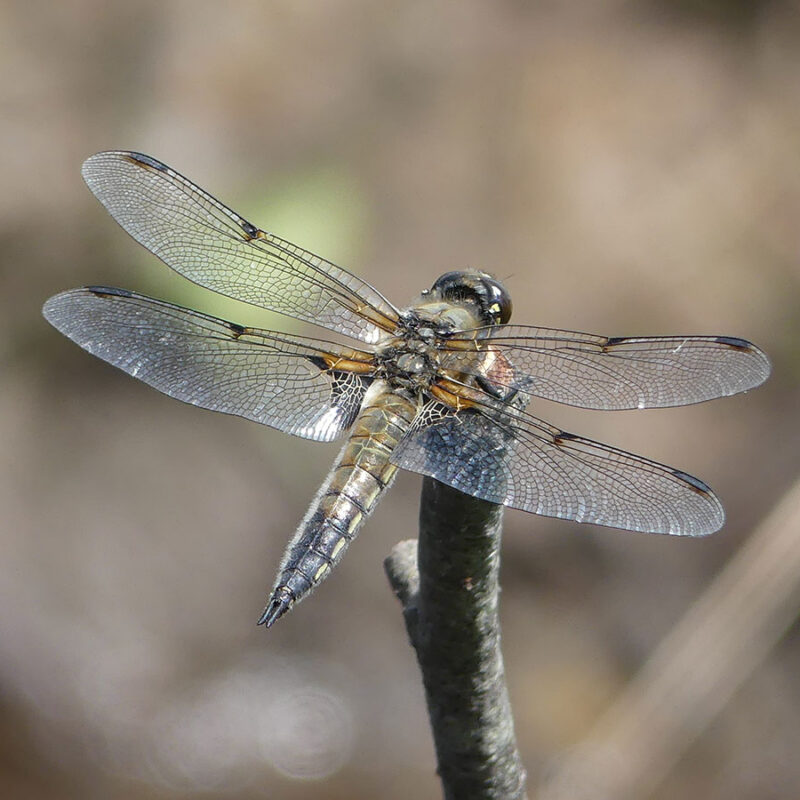
A wide range of butterflies, moths, beetles, dragonflies and other insects live in the woodland and woodland clearings, including many that are nationally scarce.
Taynish is also home to many species of mammals, birds, amphibians, and insects, including otters, spotted flycatchers, and the marsh fritillary butterfly.
According to the NatureScot website, this important temperate rainforest is estimated to be over 6,000 years old, making it an incredibly valuable habitat.
Oak woodland covers much of the National Nature Reserve, and the moist, clean air here means that lichens and mosses cover the trees. You’ll find smaller trees amongst the oak trees, like holly and birch.
Autumn sees the woodland ‘come alive’ in a riot of colour with vibrant hues of russets, reds and ochres of oak, birch, willow and alder.
The bracken and ferns add muted hues of brown and gold to create a stunning autumnal visual feast.
As autumn turns to winter, the scene changes. The woodlands are frosted with the pale grey-green of the old man’s beard lichen, dotted with the bright red of the holly berries.
Taynish is one of the few areas believed to have been continuously covered in woodland since the last Ice Age.
Soil pollen records show a dip in the Iron Age when we first felled some of the trees and again from the 18th to the early 20th Century when the woodland was heavily, albeit largely sustainably, coppiced.
Thankfully, for the last fifty-plus years, the woodland has been allowed to regenerate and is gently reverting to its pristine state before the eighteenth century.
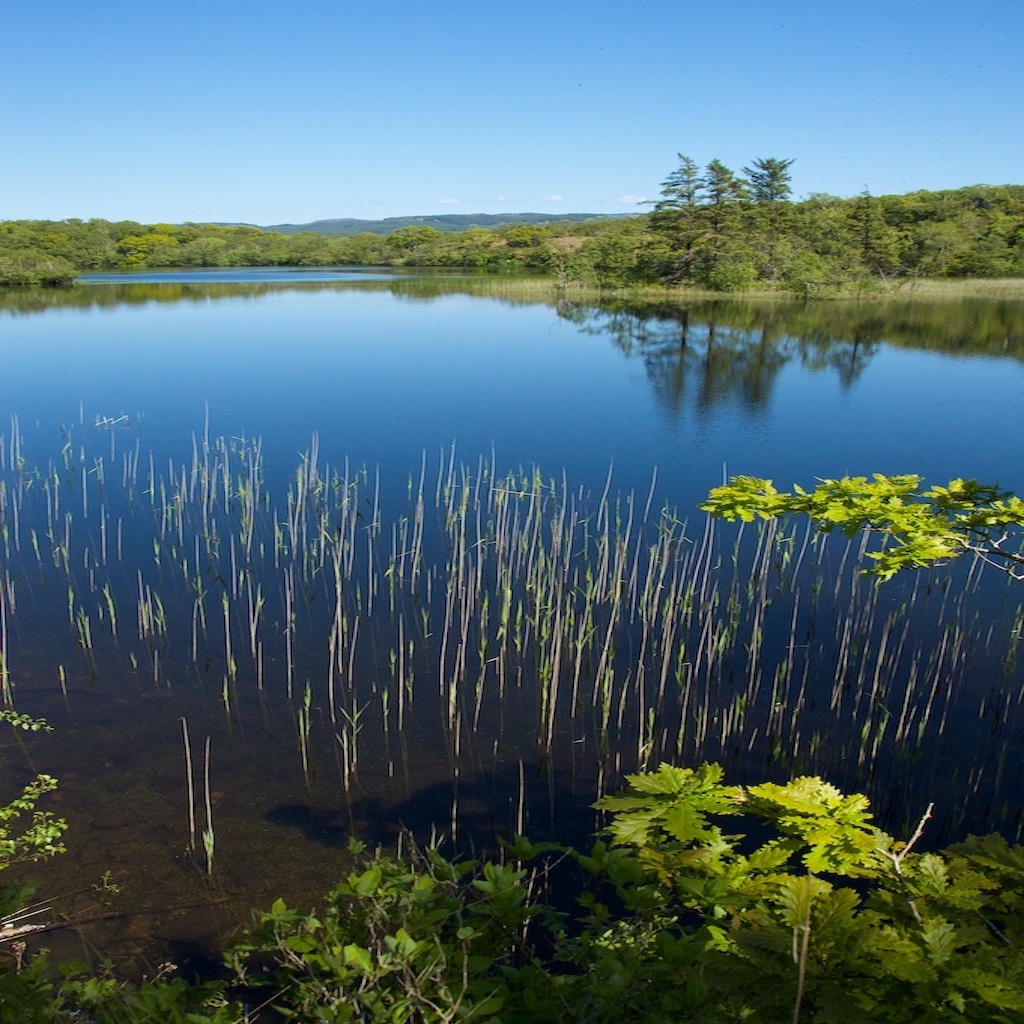
Lochan Taynish at the Taynish National Nature Reserve Argyll
Taynish is known as a temperate rainforest. Few people know that the UK has some pristine and globally rare rainforests.
Let me try to explain. There are two types of rainforests: Tropical and Temperate. Both are globally rare and endangered.
Tropical rainforests are warmer and humid and are found closer to the equator. The Amazon rainforest in South America is a good example.
Temperate rainforests, which are found in the UK, are cooler and have high annual rainfall, which provides a cruelly wet habitat. They are found along the extreme west of the UK, from Cornwall, Wales, Ireland, and Scotland, and in coastal areas further north or south of the equator.
Because of its high rainfall, well over three times the amount that falls in London, Taynish’s relatively mild climate and its location on a sheltered peninsula make It a truly spectacular place.
The Bàrr Mòr Trail was as steep as I had been warned, but being encapsulated in the ancient oak woodlands was a magical experience, and my frequent stops to look at the various mosses and lichens, most of which, I do confess I couldn’t identify at the time, provided a constant source of interest to distract my aching legs.
In the understory of the woodland, I spotted a small boulder in one of the small patches of morning sunlight that had penetrated the canopy. On the boulder and warming itself was an Adder.
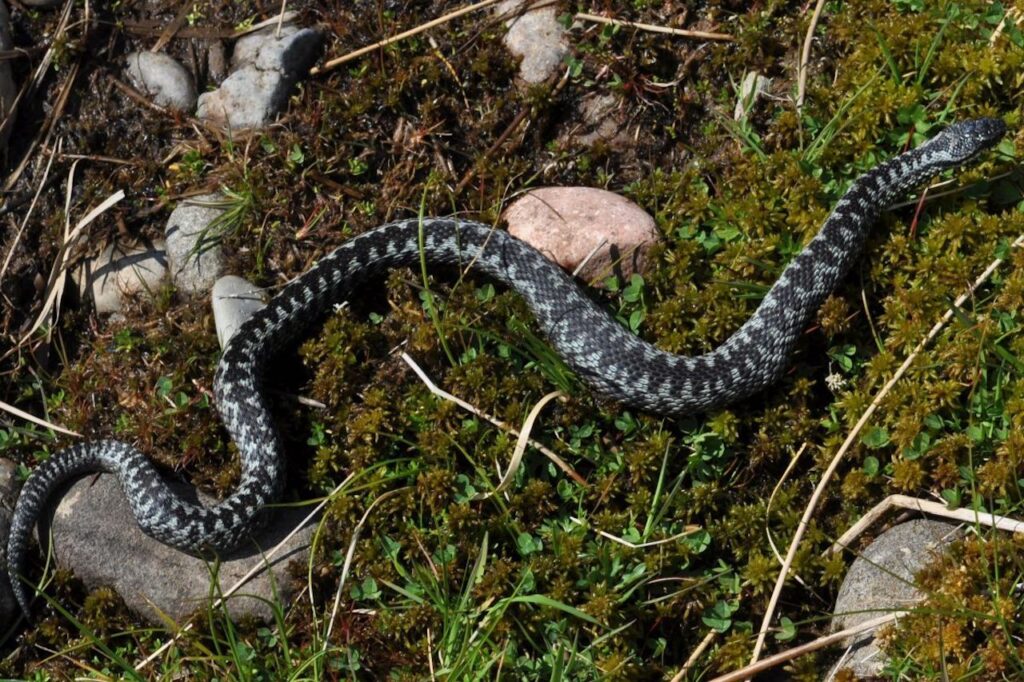
Male Adder at Taynish National Nature Reserve
It was dark, almost black, with a distinctive zig-zag pattern nearly as striking as its red eye. Its tongue tasted the air as it sensed me and weighed my threat risk against its energy levels to escape.
It raised its head slightly but did not stiffen to strike; instead, we just respectfully watched each other.
It’s late in the year for Adder, and this guy would be hibernating very soon as his food supply, like small lizards, amphibians, voles and rodents, would also more quickly be less active or hibernating.
I took a few pictures, left him alone, and continued to the top of the trail.
It is a reasonably challenging climb but well worth the effort when you reach the top.
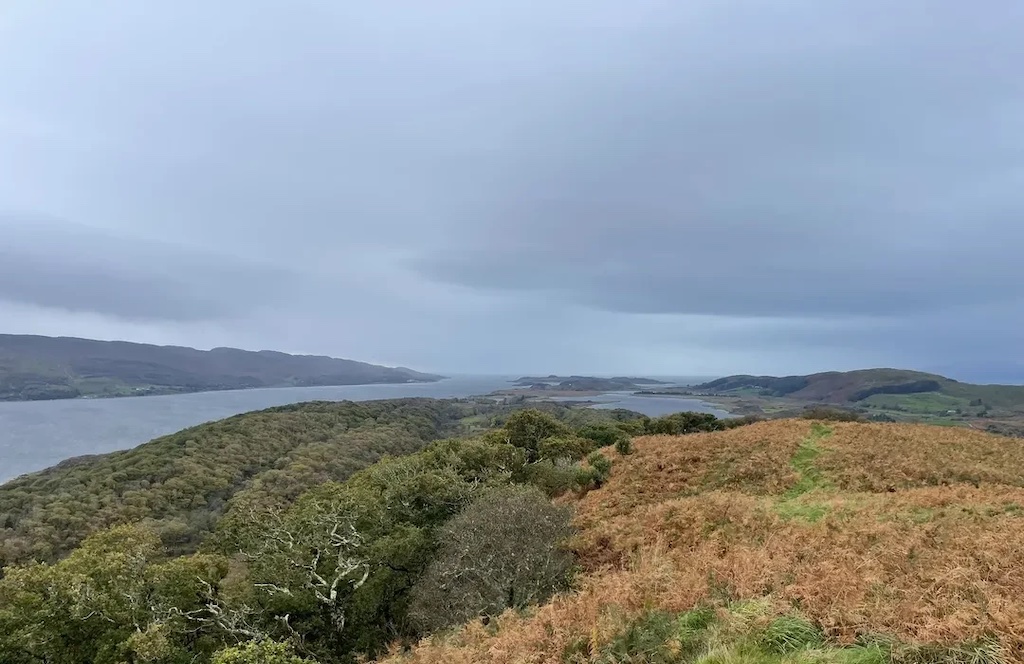
A view from the top of Taynish NNR Looking at the Loch towards the Atlantic Ocean
I recommend you check out the article on our website for the pictures, but from here, I can look along the Loch and out to sea, with the Atlantic oak rainforest flanking the loch peninsula on both sides as far as I can see and right down to the coastline.
I stood and soaked in that stunning view for some time. I was lost in my thoughts while feeling integrated with this spectacular landscape.
Time slipped by, and around thirty minutes later, I decided to have a coffee and a snack and spent another forty minutes or more before putting my rucksack on my back and beginning the descent towards the car park.
It was a Saturday, and I had not seen anyone else. It was such a privilege to have this stunning place to myself. As I got nearer the car park, I stopped to chat with a couple of locals who walk this way most days—lucky people who gave me a little tip that I will follow this evening.
Acting on the tip from earlier, I arrived at the given place. The van was parked in a small lay-by area, and I set off with my camera and recording gear to sit quietly and wait.
Around nine-thirty, after a couple of hours sitting and enjoying the dark and quietness of the woodland, I got to see what I had come for. Badgers
Although I don’t have favourites, and all wildlife species are equal, some species resonate with you, and Badgers and Foxes resonate with me.
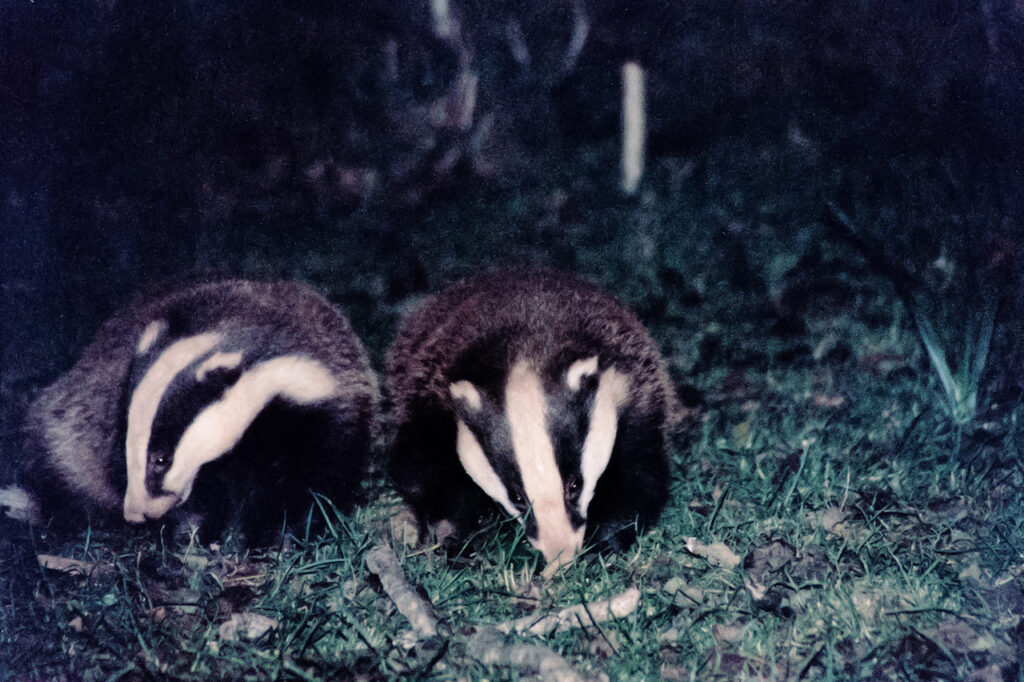
There was no food baiting; this was as natural as it can be a family group of badgers emerging from their sett.
Two young adults were first out, and they began to play, role-play, and tumble with each other in familiar badger fashion.
A large male was next. He sniffed the evening air, sat down and had a scratch before heading off into the night to forage for food.
A couple of minutes later came four more young adults with a play on their minds. They ran and played rough and tumble together with the first two young badgers.
A female emerged from the large sett entrance. She yawned and sat back to scratch herself, raising both rear legs off the ground. It was a comical pose, but it was so cute.
She was joined by two others who began grooming her. These would have been her daughters, who were looking after their mother by helping groom her.
She was the main saw of the clan, as when the play of the younger badgers got a little too boisterous – she barked at them. It was a distinct sound I had only heard once before, and the tumbling youngsters stopped and looked before resuming much calmer play.
After some time, the whole family group dispersed into the dark woods to forage for the night. I sat back in gratitude for the experience I had just shared with them.
I began to walk back towards the road when I heard a rustling in the near distance. I stopped, switched my headtorch to infrared and was as quiet as possible.
I knew it was an animal, maybe one of the badgers, perhaps a deer, but the sound was near the ground; I could hear it breathing.
I knew it could hear me, too, possibly see me and pick up my scent. I stood statuesque and waited.
After a short while, the animal began to move, the leaves and twigs crackling just slightly. It wasn’t running away through. I slowly raised my head so the headtorch could light the area in front of me, and there it was, looking back at me.
It was a Pine Marten. It stood looking directly at me. I don’t believe it could see the infrared light on my head, which gave me a glimpse into the world of nocturnal mustelids like the pine Marten and Badgers.
We looked at each other for thirty to forty seconds, a wonderful moment I will not forget. Of course, I had no pictures, my action camera was off, and my phone was in my jacket pocket. The Pine Marten would be long gone before I could reach either.
It wasn’t until I returned home that I discovered my Wireless mics were still on, so I have an audio memory of the encounter that I will share on the Wildlife Matters podcast.
The following day, I was up early and excited to visit Crinan Woods, a Woodland Trust woodland with stunning views!

Crinan Wood Argyll, Scotland
The wood is mostly oak and birch, with some groups of alder, ash, elm, hazel, holly, rowan, and willow.
Today, the plan is to find some of the rare Ferns that grow abundantly at Crinan Wood and enjoy the views over Loch Crinan from the woodlands.
Seeing Siskin, a species I don’t see in the South of England, was lovely. They were busy feeding on the birch and alder seeds.
Thirteen fern species have been recorded at Crinan Wood. I am no Fern expert, but I am drawn to them when I am out in nature, and I regularly take pictures because I like their structure and colours.
I found two fern species today and probably walked by the other eleven! The first is known as the hay-scented Fern. The fronds of Eastern hay-scented fern can be up to twelve inches wide, and they are often in large groups of single plants.
In Autumn, the ferns change from vibrant green to yellow, but they are still spectacular. The most striking thing about the hay fern is its physical size—some are a bit over a metre in height—and its fronds’ soft, hairy surface.
The Hay Fern can be confused with the Lady Fern as they look similar. So, to be sure I had found the hay fern, I crushed the blade with my fingers, and the smell of newly mown hay was very clear – success!
My second fern find was pleasing to me. This fern is known as the Tunbridge Filmy Fern.
It is a fern of temperate rainforests, but there is a small population around the Tunbridge area on the Kent/Sussex borders. I have never seen them in the south, so finding them in the west of Scotland was special for me.
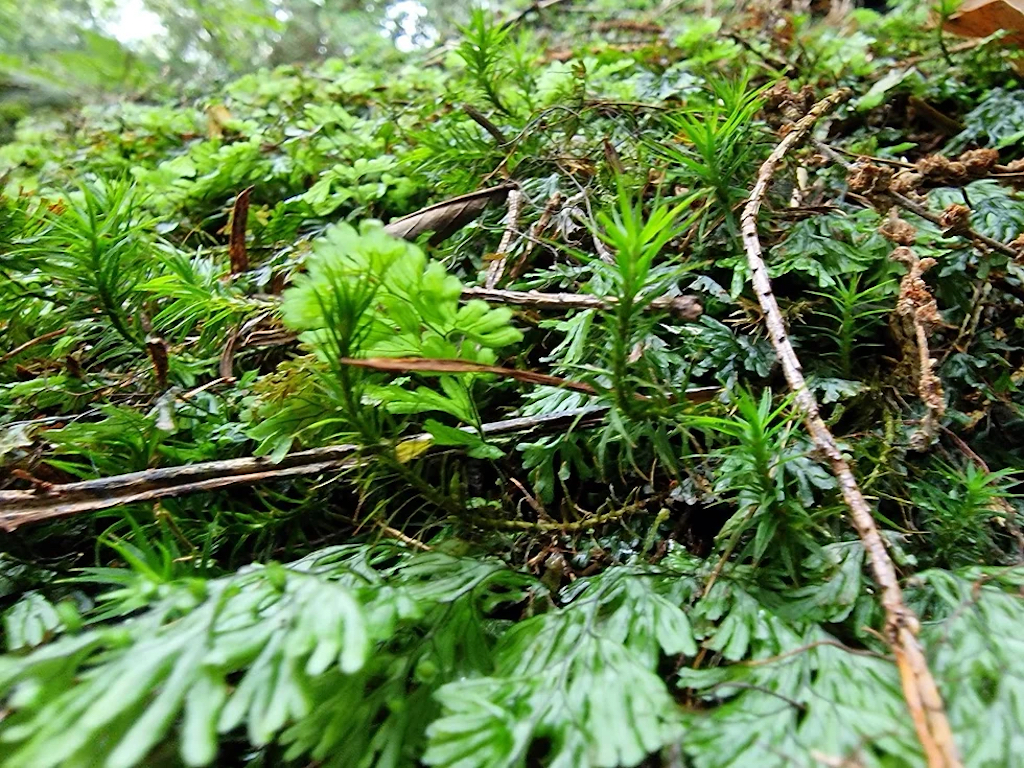
Tunbridge Filmy Fern Taynish NNR Autumn 2024
The Tunbridge Filmy Fern is Delicate, sensitive, and engagingly beautiful. This tiny fern is found in moist woodlands, temperate rainforests, and mountain cloud forests, where it occurs on the vertical surfaces of acidic rocks and sandstone or sometimes as an epiphyte on mossy branches.
The scientific name Hymenophyllum (literally, ‘membranous leaf’) refers to the many delicate fronds. I was told to take a hand lens to see the natural beauty of the leaves, which is a great tip I am happy to share with you.
The pattern is often described as resembling a bird’s ruffled plumage. Under ideal conditions, the fronds are a stunning blue-green colour that glistens with moisture—another great find.

Crinan Canal Argyll Scotland
Crinan Wood adjoins the Atlantic Ocean and the Crinan Canal. The Crinan Canal stretches nine miles from Ardrishaig on Loch Fyne to Crinan on the Sound of Jura.
It was built in 1801 to offer mariners an alternative route from the west coast and islands to the Clyde Estuary and was said to reduce the arduous journey around the Mull.
I am at the very start of the canal and have decided to walk the nine miles to the town of Ardrishaig, although I will catch the local bus back, so maybe this is an excellent place to end our adventures in the Atlantic Oak Woods or the Rain Forests of Scotland’s West Coast.
If you enjoyed this blog, please check out more of our wildlife blogs here, or you may prefer to listen to the Wildlife Matters Podcast here.
If you want to support our work
Please click on the Wildlife Matters Patreon Community.
Please click to join the Wildlife Matters Substack Community.
You can donate here
Further Reading
Scotland’s Rainforest Nature Scot
Scotland’s Rainforest Forestry and Land Scotland
Saving Scotland’s Rainforest – Alliance for Scotland’s Rainforest