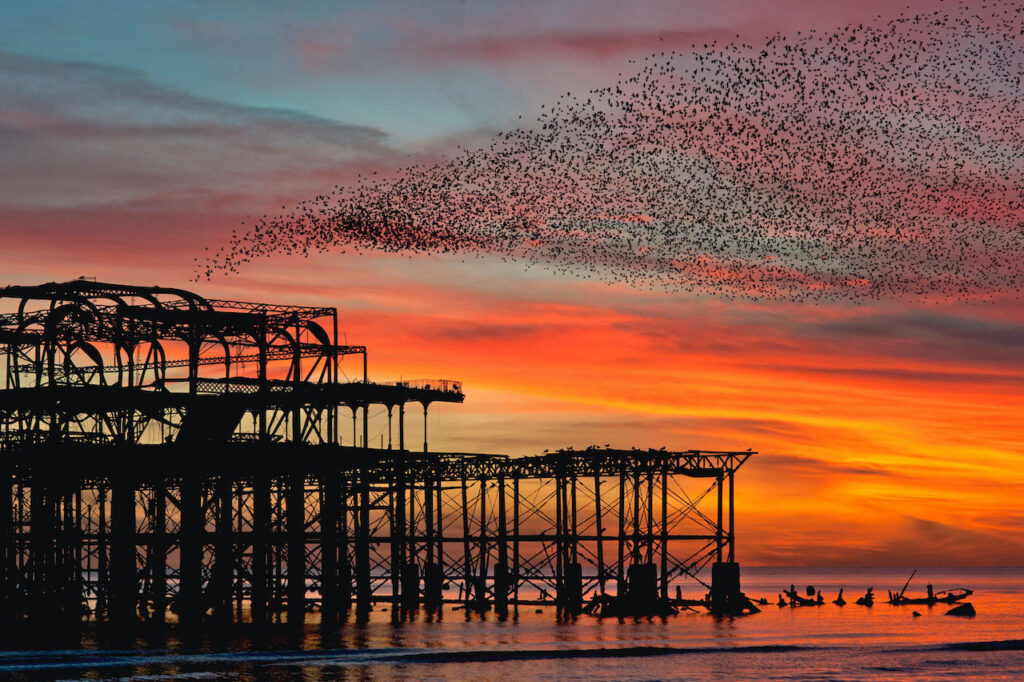
Sunset at West Pier, Brighton
The Magic of Murmuration – A Night with the Starlings is Wildlife Matters’ exploration of the spectacle that is the Starling Murmuration.
It is one of the UK’s most awe-inspiring wildlife spectacles, and the breathtaking sight of thousands of starlings gracefully swooping overhead in perfect formation, like a living, breathing masterpiece in the sky, can be witnessed across the nation.
Here is Wildlife Matters’s in-depth look into starling murmurations, where we will delve into the fascinating reasons behind their occurrence and the remarkable ability of starlings to navigate the sky without colliding. Using the best scientific knowledge available, we will unravel the mysteries of murmurations.
The murmuration is a work of art in the sky, the birds’ swirling movements reminiscent of the practice of t’ai chi. As the sun sets and the starlings drop to the reed beds to roost, you know the spectacle is over.
They move as one, twisting and turning, rapidly changing direction yet never breaking rank. The formation flows like a liquid, darkening as the birds overlap and paling again as they spread out.
Starling murmurs occur at dusk and early evening in the autumn and winter.
It’s been hailed as the most extraordinary wildlife spectacle in Britain, and it’s hard to argue when you witness the mesmerising sight of thousands of birds creating intricate, swirling patterns in the early evening skies. It’s a wonder of nature that never fails to inspire awe.
In the UK, starling murmurations occur from late October to late February.
Studies suggest that starlings congregate in these remarkable ‘murmurations’ to deter predators who might be confused by the swirling masses.
Scientists have been interested in murmuration, an incredible wildlife spectacle, for years. Many questions have been raised, such as why these great congregations occur and how starlings know when to turn in unison without colliding.
Starlings have swift reaction times and can change their flight direction in a split second. It is an incredible experience to hear and watch the mesmerising sight of thousands of birds performing their aerial dance at dawn and dusk.
Murmurations are vast groups of starlings that twist, turn, swoop and swirl across the sky in beautiful shape-shifting clouds.
Just before dusk, small groups of starlings from the same area come together above a communal roosting site.
The group grows ever larger, moving in unison in an aerial dance that casts gorgeous shapes against the waning daylight.
However, the more starlings in a flock, the less likely an airborne predator will catch each individual.
Studies have shown that individual starlings move around within the flock and try to minimise their time on the edge, where they are most vulnerable.
Starlings are gregarious birds that live in flocks for much of the year. However, in winter, migrant birds from colder parts of Europe boost their numbers, and these aerial displays are at their most breathtaking.
Starlings are known as ‘partial migrants’: birds that migrate in some places but not others. British starlings tend to stay put while those from colder countries in Eastern Europe head to our shores, swelling our numbers during autumn and winter to form seriously impressive flocks.
We all have heard the old saying about safety in numbers, the ethos behind starling murmuration. After all, it can’t be easy to single out just one starling from a whirling group of hundreds or even thousands! Experts still aren’t sure how each starling knows which way to turn without bumping into the others.
Murmurations always form over the birds’ communal roosting site. As the number of starlings peaks and the last of the daylight begins to fade, an unspoken signal seems to tell the group to funnel towards the ground with one last sweeping motion and calming whoosh of wings.
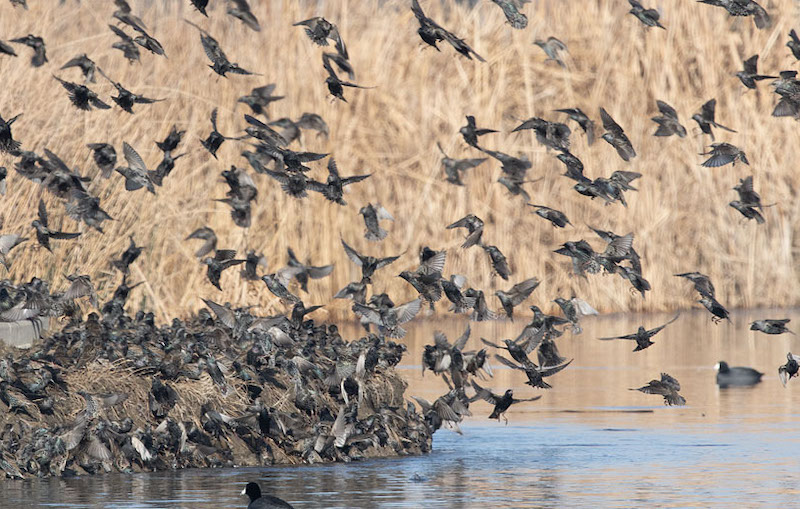
Roosts can be anything from a reedbed to a seaside pier where the group can huddle together for warmth and chatter about the best feeding grounds.
Being based in Sussex, I know several sites where you can reliably see murmurs.
Brighton and Eastbourne are well known for their dramatic fireworks displays. Other coastal towns like Bognor, Chichester, and Hastings occasionally host magnificent fireworks displays.
Spectacular displays are also regularly seen.
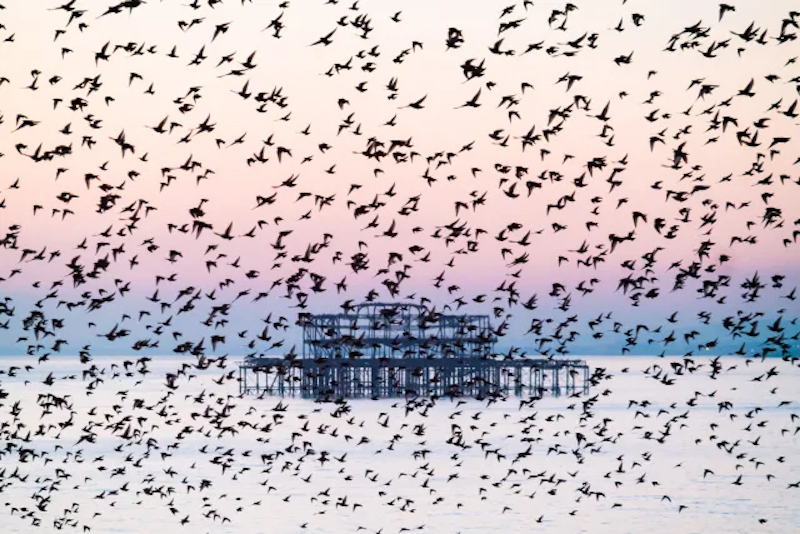
West Pier Brighton, Sussex
Perhaps the most famous starling murmuration in Britain occurs around the skeletal, derelict West Pier on Brighton’s stony seafront. Up to 40,000 birds arrive from as far away as Scandinavia to winter alongside their native cousins on the pier.
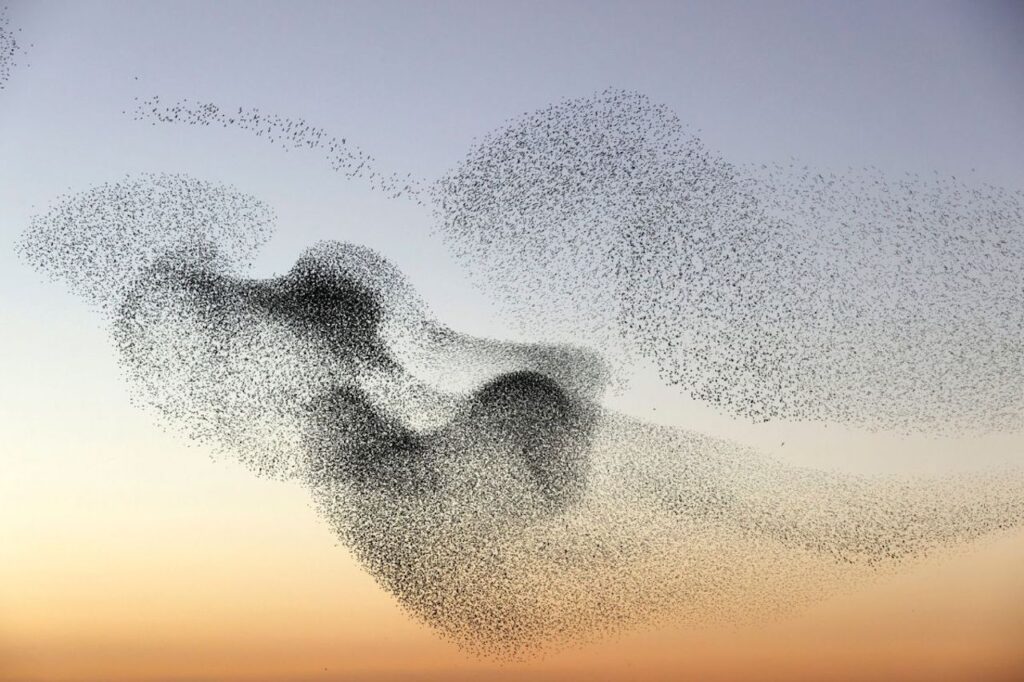
Gretna Green, Dumfries and Galloway
There was a time when only eloping couples flocked to Gretna Green on the English/Scottish border. Nowadays, aerial visitors attract the most attention.
This mobile roost of about a million birds is usually seen just west of Gretna, on the border with Cumbria. The landscape here is sparsely populated, with forest, maritime and dairy pasture, coastal flats and estuaries. As autumn advances, keep watch too for whopper swans returning from Iceland.
There are other well-known Murmuration sites around the UK. Although Wildlife Matters has not been able to visit them individually, we have consulted leading local wildlife groups to compile this list.
Aberystwyth, Ceredigion
You might hear them before seeing them – a thrilling whoosh above Aberystwyth (Heol y Wig in Welsh). This Welsh resort on Cardigan Bay offers another opportunity to see the birds – even a local hotel called the Starling Cloud. Some 30,000 starlings swirl from their coastal feeding grounds to roost beneath the iron latticed pier, engaging in an incredible choreography of synchronised aerobatics.
Newport Wetlands, Newport
Keep watch for bearded tits and wintering bitterns at the most extensive wetlands in Wales, with a visitor centre, accessible trails and boardwalks. The reserve was created to counter habitat loss from the development of Cardiff Bay. The murmuration of about 50,000 is visible across the reserve before the starlings drop into the reeds.
Whisby Nature Park, Lincolnshire
Regenerated sand and gravel quarries are now a mosaic of lakes, grassland, marshland, scrub, willow carr and small oak woodland, whose winter migrants include goldcrests, redpolls and grey wagtails. The park boasts a visitor centre and paths from which to view the murmuration of about 10,000, billowing like smoke above the reserve.
Fen Drayton Lakes, Cambridgeshire
Nine thousand starlings begin their display at dusk over these beautiful lakes in Cambridgeshire.
Although starling murmurations may look enormous, they are much smaller now than before as starling populations decline in the UK and Europe.
In the UK, starling numbers have seriously declined, plummeting by over 80% since the 1970s. As a result, this species has been red-listed as a bird of high conservation concern.
This population crash is likely due to the shortage of food and nesting sites caused by more intensive agriculture, increased urban development, reduced outbuildings, and the lack of open eaves on houses.
Our guide will help you experience the magic of murmuration at a roost site near you this late autumn and winter. We encourage you to get out on a chilly winter evening at dusk to witness this incredible natural spectacle, inspiring you with the power and beauty of the natural world and the fantastic wildlife that calls the UK home.