Join Wildlife Matters as we head out into the snowy winter woodland to identify wildlife tracks in the snow
The snow was still falling when I arrived at the woodland this morning. The car park is covered with a pristine layer of soft, fluffy snow untainted by car tracks and footprints. This was exciting as my plan today was to head out into a local woodland I know well and look for some animal tracks.
Snow is now relatively rare in southern England, with perhaps a few days in most years. But everything we cover today will help identify animal tracks in soft mud throughout the year.
Today, the snow was fluffy but powdery and possibly three cm deep in the car park.
So join me as we head to the woodland and delve into the secretive lives of the woodland wildlife that call this woodland home.
As they move across the snow-covered ground, animals leave footprints, often called tracks. These tracks can tell us what creatures live in the woods and give us insight into their activities.
Wildlife can be elusive, especially if it is nocturnal. However, the signs that animals frequent an area can be a good start to discovering all kinds of species.
Ecologists rely on animal signs to help them understand species numbers, behaviours, and movements. These signs include calls, burrows, leftover meals, territorial markings, fur, droppings, and—what we are looking for today—wild animal tracks.
So, if you are out in the woodland and find animal tracks in the snow or mud, what should you look for to help you identify the animal that left them?
The first thing I will look for is whether there are claw marks before counting the number of toes, which is vital to a successful identification.
The next thing I will do is look for patterns in the tracks. Are the individual tracks identical, or do they vary in shape and size? Are they in a straight line, or do they meander? Next, I will assess whether the footprints are close together or further apart.
Then look around you. You are now the Detective looking for clues or evidence to confirm your findings.
You should be looking for droppings. Are fur or feathers on the ground caught on trees and bushes? If you think you have bird prints, are there nests around, and if so, what size are they, and what are they made from?
It’s important to listen. What wildlife can you hear? One point here: Be patient and quiet. If you’re lucky, you might spot the animal that made the tracks, which could still be nearby. How Exciting!
I believe in using all your senses whenever you are out in nature; indeed, smell can be beneficial in finding some wildlife. Foxes and Badgers have distinct smells, as do other mammals and mustelids. In the rutting season, Deer have a very musky scent.
Finally, you can measure the length and width of the track. If you don’t have a measure with you, you can find a leaf or twig in the woodland as a physical guide to length and width.
Now that we have some basic information about identifying wildlife tracks let’s head into the woodland and see what tracks we can find.
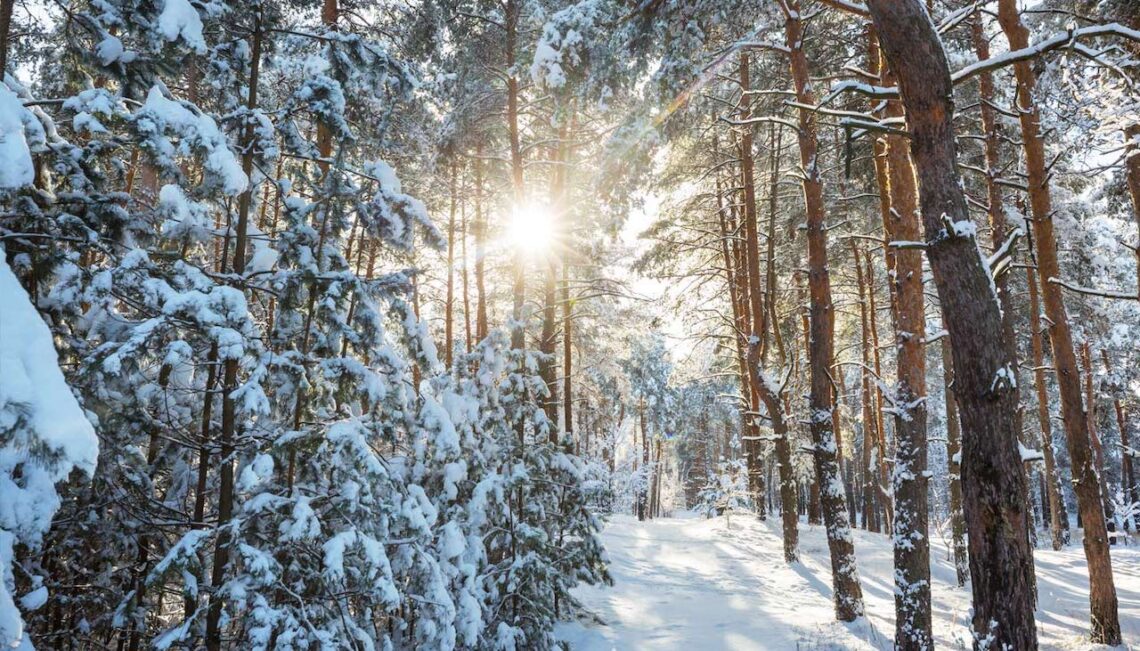
As I head along the familiar footpath, I listen to my boots making a comforting crunch as I am the first to walk the path since the snow fell overnight.
A few charcoal grey clouds linger in the burnt umber with mustard yellow sky, and I can see the sun as it begins its daily climb above the horizon.
The woodland around me mainly consists of deciduous trees, which stand silently, skeletal and devoid of leaves, as they slumber through the winter months. But I can smell the Yew trees liberally positioned around the woodland, bringing much-needed greenery to the snowy winter landscape.
As the woodland path leads us to the edge of a small glade, I can see the first wildlife tracks of the day.
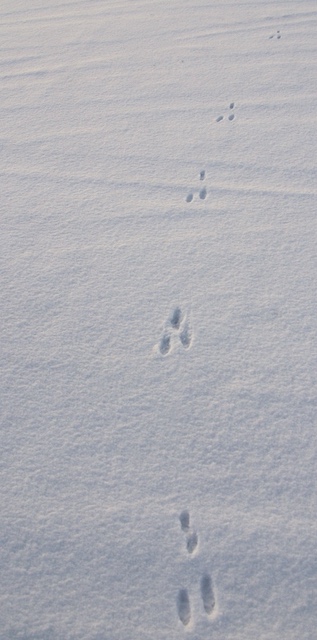
There are lots of these prints spread out across the glade. The individual tracks each have a pair of long, thin prints at the rear and shorter prints for the forefeet. Each paw print, front and rear, has four pads.
So we know these animals are social, as many tracks are in the same area, and their hind feet are larger than their front paws.
It is also clear that these animals do not place all their back feet on the ground when moving.
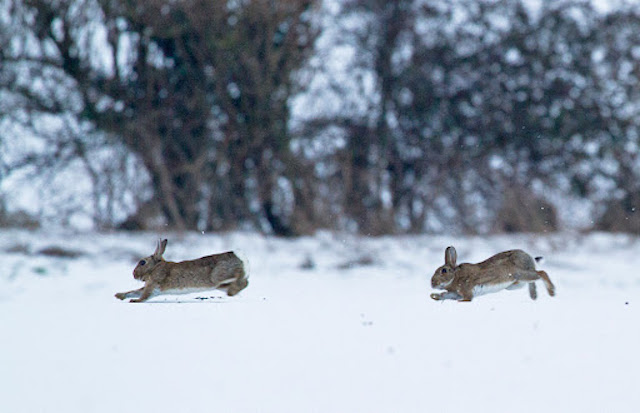
I’m sure many of you have already guessed whose wild tracks we have found—yes, we have discovered Rabbit tracks.
There are not many things that you could confuse Rabbit tracks with beyond Hare tracks. However, Hare have larger feet, and their stride is longer, but the habitat we are currently in is the main clue that these are rabbit and not hare tracks.
We are in woodland, and Hare lives on open grasslands. Hares are also solitary animals, whilst Rabbits are communal and live in a wider range of habitats, including woodlands.
I stopped and looked around the edges of the woodland glade. All the rabbit tracks were heading away from the glade, a clear sign that they heard me approaching and leaving the open habitat for the safety of the woodland cover.
Of course, I could have followed their tracks to discover the individuals’ hiding places, but that would have only disturbed these fantastic wild creatures further, so I decided to move on.
I leave the glade and continue along the track back into the woodlands. After a while, the low-growing shrubs at the side of the path, covered in snow, bend slightly as if something regularly passes over them, but there are no tracks in the snow.
This area is clearly busy with wildlife, as many tracks cross the main path and disappear under shrubs and bramble thickets.
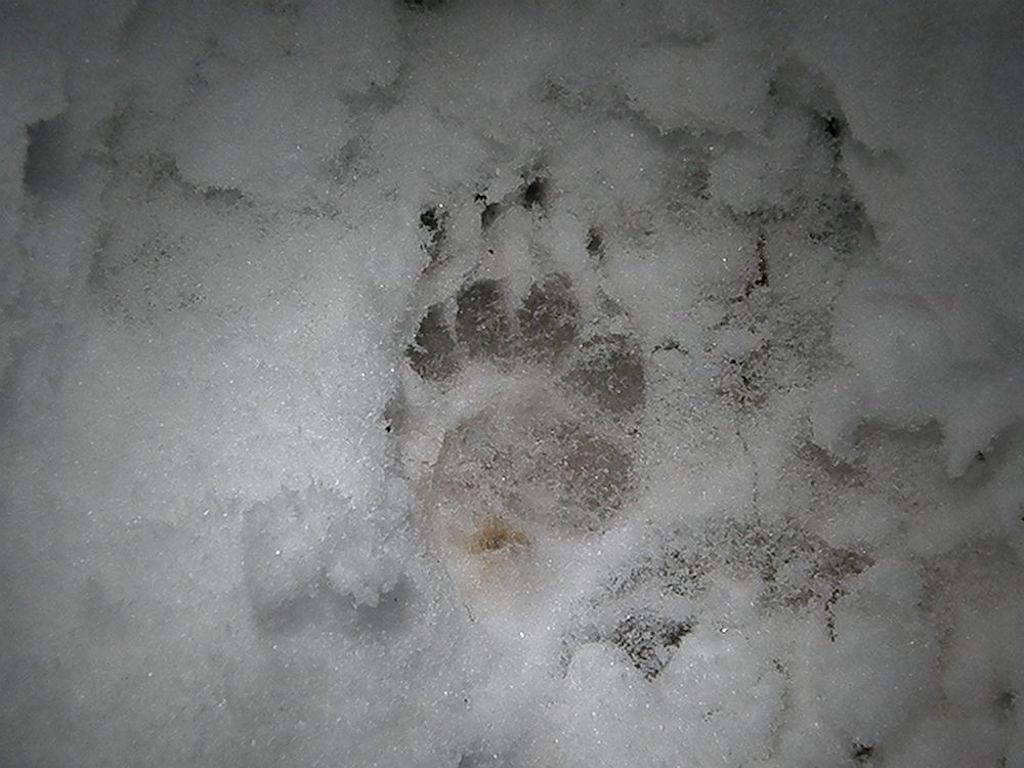
Then, I saw some tracks and was very excited as I immediately knew who had left them, but for the benefit of the article, let’s explore the evidence:
These tracks were left by an animal with five clawed toes. The claw marks are long, and each toe has a pad in front of a wide rear pad.
The front and back paws are slightly different. The front paw has more extended claws, whilst the back paws show the inner toes to be a little further forward.
The tracks are also large and deep in the snow. This tells us that the animal who left them was much larger than a rabbit and would have weighed much more. Each paw print is around 6.5cm wide and 5cm long, with visible claw marks.
This animal doesn’t hibernate but shelters underground through the winter, as its primary food source is unavailable due to frozen ground.
On milder winter nights, they are known to forage for food, including fruits and berries or grains and nuts.
If you haven’t already guessed from the clues, we have found Badger tracks.
They are from a single animal who was out foraging last night. As a sett minder for my local badgers, I followed the tracks to see where they led me.
The tracks crossed the footpath and headed west into the woodlands. I tracked them for at least a kilometre before seeing that they ended at the edge of a thicket of holly surrounding a large oak tree.
I was at least 50 metres away as I didn’t want to disturb the badger, which would now be sleeping. I’m sure this was a young male sleeping in a small burrow or an old outer lying sett.
I did take coordinates and informed the local Badger group of what I had found.
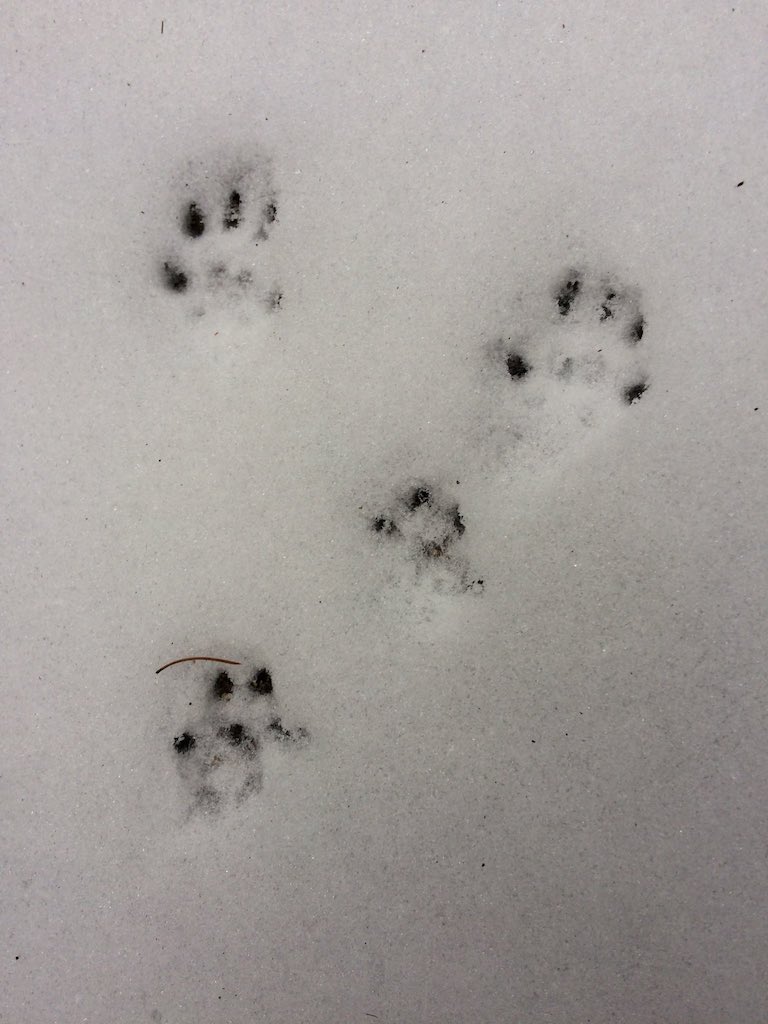
Another set of prints caught my attention as I returned to the main footpath. I hadn’t seen them before, as I was focused on the Badger’s tracks.
These prints are much smaller than the badger prints. They are close, and the two animals may have passed close to each other during the night as both are nocturnal.
They remind me of a star shape with three toes facing forward and two outer toes pointing out on each side.
I am surprised to see these in the snow as this animal does hibernate. However, I am aware that in these days of climate-affected milder winters, they are hibernating for shorter periods and will regularly forage on milder winter nights.
People such as Anne Brummer and the Amazing Grace Project are currently doing a lot of research on the changes in the hibernation of these animals. Find out more about their work here: www.gracethehedgehog.co.uk
However, this is primarily in urban areas with supplementary feeding, but this was evidence that the countryside and woodland dwellers are also out foraging on some winter nights.
Of course, we had found the tracks of a single hedgehog. Still, it is a relatively rare thing to see in the snow.
As I continue along the woodland path, we are heading towards the adjoining common or heathland, an oasis of heather and wildflowers in all seasons but dissolute and Barron in the winter.
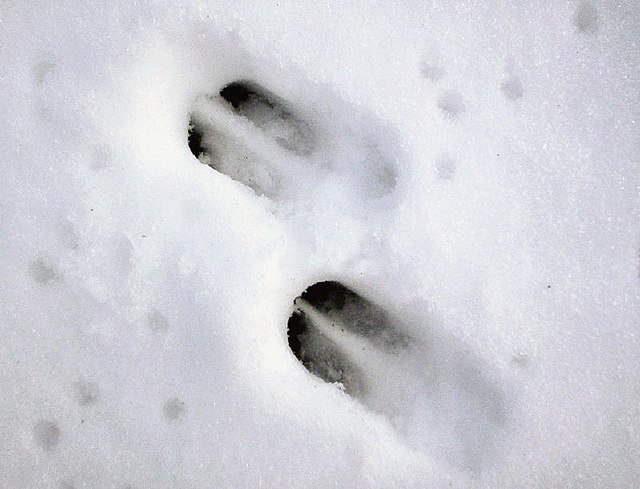
The tracks I’m following now lead me to the woodland edge, which is a great place to find these wild animals.
There are two native species of this animal in the UK, but several have been introduced. This woodland has two of the species, one native and one introduced.
They all have cloven hooves with two oblong and pointed-toe impressions that sit alongside each other, with a slight gap between them, making the shape similar to an upside-down heart.
The main way to tell the different species apart is by the size of their tracks. The smallest species leave tracks about 3cm long, while the largest species leave tracks up to 9cm long.
Today, we are following the tracks of the native animals, which are roughly in the middle range based on size.
Each footprint is approximately 5cm long and 4 cm wide. Three individuals were travelling together. Each had the same length of stride and was similar in weight.
They were browsing the tree line of the woodland, searching for fresh greenery.
These animals are not nocturnal, and there was a good chance they would still be in the area. I checked the direction of the wind, which was coming from behind me, which was not good, but the wind was not strong.
As quietly as possible, I emerged from the woodland towards the common, never leaving the treeline as it disguised and broke up my shape.
And there they were, three Roe Deer Doe, several hundred metres across the heathland from me and browsing along an old hedgerow.
One looked directly at me and stared for a moment before she continued to feed. Then the other two did the same, all aware and keeping an eye on me but happy that I was not a threat to them.
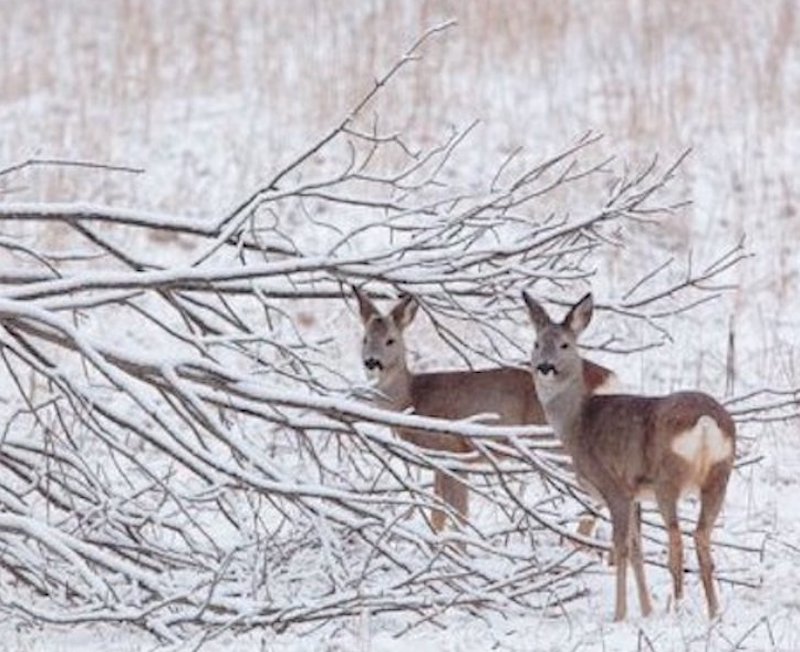
I stayed still and took the time to enjoy them as they browsed the hedgerow—one of the highlights of the day for me.
The other deer species I have seen in this area is the Muntjac, also known as the barking deer.
These are South Asian natives who came to the UK as curiosities in Victorian times.
They are widespread in the southeast but small, around 50 cm tall at the shoulder, or similar in size to a larger dog species like an Alsatian.
They have chestnut red-brown fur with a creamy belly. Males have teeth that protrude from their mouths, like outward-facing vampire fangs. Their hooves are around 3cm long and 2cm wide.
Although Red Deer are present in the south of England, I have never seen them in this woodland. Red Deer are native to the UK and are the largest Deer species. These tracks are 9cm long and 7cm wide.
I should also mention that the Fallow deer, a non-native that tends to live in large herds in London Parks and some larger estates around the country.
They are larger than a Roe deer, and their tracks measure 7cm long by 5cm wide. Small pockets of wild populations exist but are not in the wild in this area.
It is possible to confuse Deer tracks with Sheep tracks. Sheep cloven hooves tend to have more rounded ends, while deer tracks typically come to a point.
I walked away from the deer and along the woodland edge. As I approached a low stone wall that divides the heath from a small paddock area, I saw some interesting tracks in the snow along the wall.
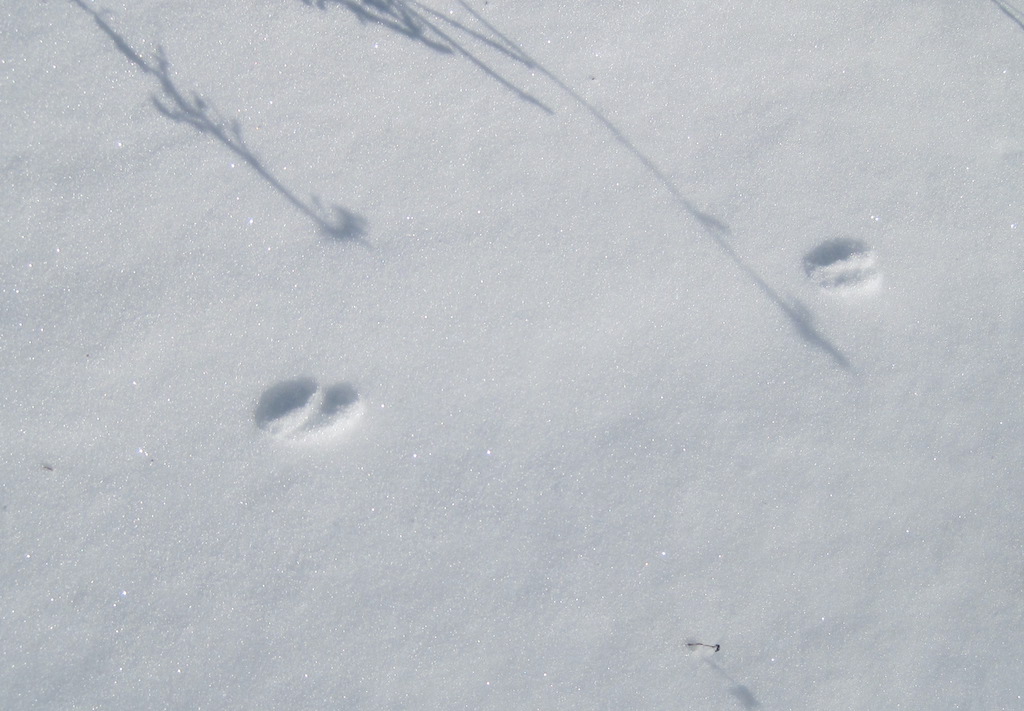
They were similar to the hedgehog tracks I found earlier today but physically much smaller, at around 1 cm in length, but in the familiar star shape. The animal’s claw marks are visible.
The tracks have a distinctive two-to pattern, which means that this animal is almost hopping from its rear to the front paws, and both pairs of paws remain together.
The tracks are also erratic. They don’t follow any set pattern; instead, they twist and wind around rather than follow a direct line, suggesting that the animal who made them was searching rather than going from A to B as quickly as possible.
The tracks all lead to the base of the wall and then up the wall, where they could be seen along the length of the wall for several metres,
So we are looking for a small animal that is comfortable on the ground and capable of scurrying around the sides and tops of a wall. An animal that searches in an erratic pattern.
Whose tracks have we found?
Those of you saying a mustelid are correct. The challenge is which species. Although not a Badger or an otter, it is much harder to differentiate between the tracks of the American mink, a Stoat, or a Weasel. They have slight variations in size, but they are all very similar.
We need to consider habitat here. The semi-aquatic American mink is unlikely to thrive in a heathland or woodland habitat.
Being near woodland and on the edge of now semi-derelict old farm buildings would suit Stoat and Weasels, who need cover from predation and feed on mice and rabbits.
The easiest way to identify them if you see them is to look at the tail. A stoat’s tail is about half the length of its body and has a black tip, whereas a weasel has a smaller, stubby tail that is solid in colour.
So, how can I identify if a stoat or weasel left these tracks? This is where the animal’s movement becomes important. You may recall that I mentioned the paw pattern as two by two as if the animal was hopping while searching. This is characteristic of a stoat’s bounding gait with an arched back.
The smaller weasel is often more direct in route and travels flatter to the ground as it runs.
This stoat had a burrow within the old stone wall. I didn’t see it today, but I would like to think the Stoat has its winter white coat on now, which is another way of identifying them in winter, as the smaller weasel remains brown throughout the year.
I circled the farm buildings, but before I returned to the woodland edge on the far side of the buildings, another set of prints was visible in the snow in front of me.
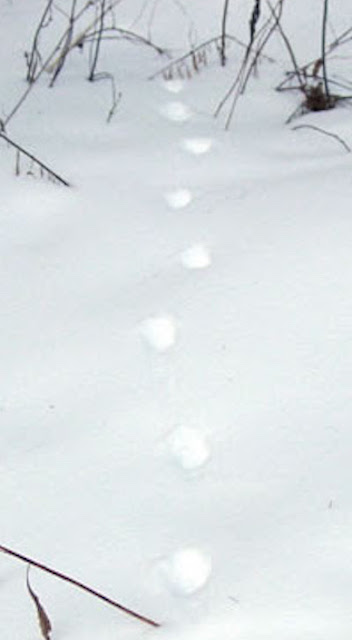
They came from the woodland to the edge of the farm yard. I followed the tracks and saw the animal that made them had jumped over the six-foot wall, and the footprints went straight towards an area of shrubs in the corner of the disused farmyard.
As I looked on, mentally noting the track’s size and straight line, I noticed a second pair of tracks ending in the same small thicket area.
These had come from around the old barn. I moved around the back of the old barn and saw the tracks directly from the heathland. Very clearly, this animal was carrying, almost dragging, something with it.
Both sets of tracks were straight because this wild animal’s back feet tended to overlap with the front foot on the previous step.
The individual prints have four toes, two at the front and one on each side, and each has a roughly oval-shaped pad at the rear.
The claw marks are visible in the tracks where the animal was carrying something, but not on the original set of prints, which are clearly from a second animal.
I have found a pair of the same species living in the dense thicket at the edge of this former farmyard area.
I am confident I have not found a dog’s prints as the tracks are straight, and dogs move more erratically. Also, at just 5cm in length and 4 cm wide, this would be a small dog—not impossible, but the narrow foot shape has a distinctive diamond shape. The decider for me is that the claws are visible in one set of prints and not in the other. Dogs can’t retract their claws.
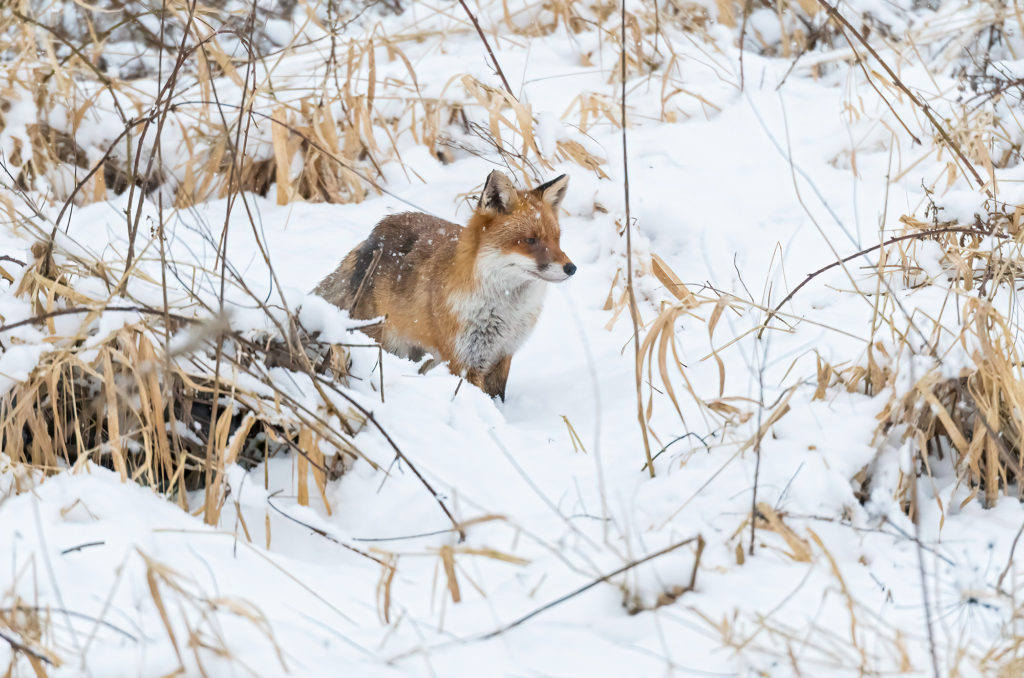
I have found a pair of foxes here. They are a dog fox and a vixen, and they are together at this time of year as they are close to the breeding season.
They are likely alone but may have a daughter or two close by who will be helping with the cubs later this year. The daughter will be independent of the parents now but may still be fed by the dog fox.
The pair set off in different directions to search for food. One headed to the woodlands, and the other headed to the heathlands.
It appears the one from the woodlands returned without a meal, or at best, it was a small meal, easily carried in its mouth.
The other fox, who chose the heathland, had returned with a large meal. I would guess a large adult rabbit that had to be put down and dragged sometimes due to the weight of the prey.
This would have fed both foxes and possibly the retained helper well last night.
That is a perfect place to end today’s adventure by looking at wildlife tracks in the snow.