Join us for a visit to Glastonbury on Summer Solstice morning 2024
It’s 3 am, and my alarm snaps me into life. I take a look outside of the van; it’s dark. I rub my eyes and get up. After getting dressed and drinking a strong, dark coffee, I sat in the van’s sliding door and stared into the still, cool night.
Today was going to be unique. For Summer Solstice 2024, I decided to explore somewhere different, magical, mystical and memorable, which led me to Glastonbury. I parked Raven, my camper van, in the St Dunstan Car park near the centre of Glastonbury and walked around the extensive grounds of Glastonbury Abbey.
I tried to imagine its glory days before Henry VIII dissolved it. The Abbey was built by Saxon King Ine of Wessex around 712, and its history is said to be traced back to the old church in 63 AD.
The legend of King Arthur is also associated with Glastonbury Abbey. In the 12th century, it was believed that the tomb of the folkloric king and his wife, Guinevere, was found there.
The stone Saxon church underwent significant enlargement in the 10th century under the remit of the Abbot of Glastonbury and future Archbishop of Canterbury, St. Dunstan. It was added to the Normans – so much so that the 1086 Doomsday Book listed Glastonbury Abbey as the nation’s wealthiest monastery! Sadly, much of Glastonbury Abbey was destroyed in a great fire in 1184, and a new Great Church was constructed and consecrated in 1213.
Glastonbury town is alive with ancient history and medieval mystique. There is a story waiting to be heard at every street corner, on every pavement, shop or in the magical and mystical marshes that surround the town, in fact magic is alive just about anywhere else you might care to look.
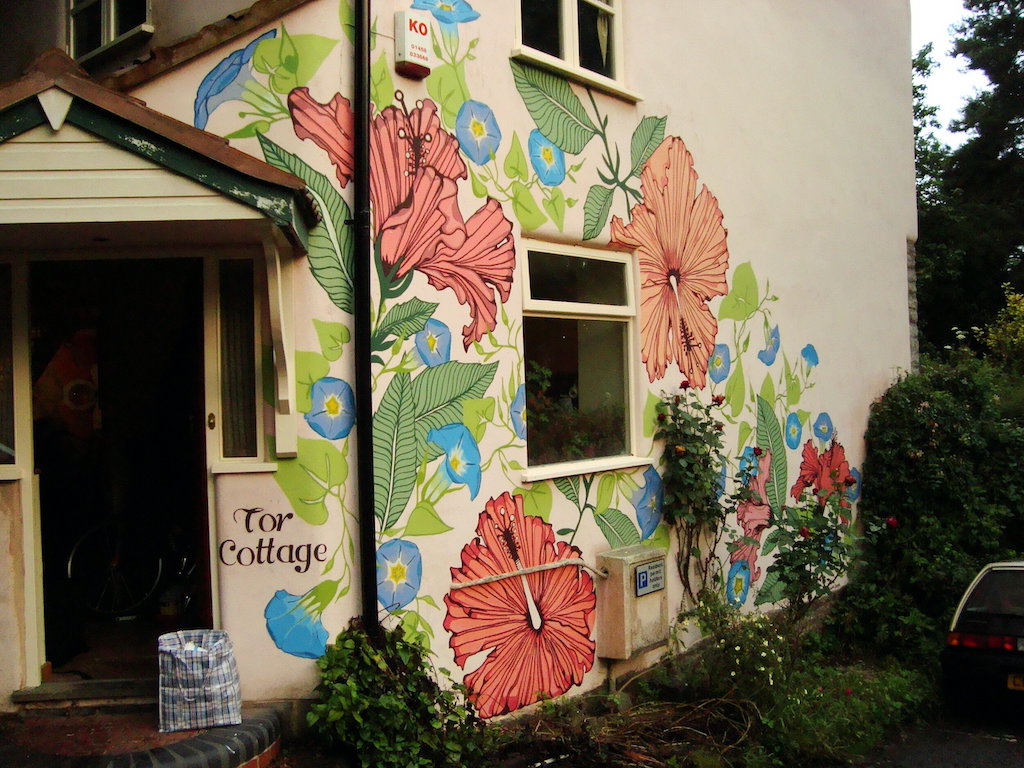
As I leave the Abbey and walk along the streets of Glastonbury, the colourful painted houses that adorn the whole town capture my imagination. Each piece of artwork is as individual as the artist and the people living in the house.
We should all express how we feel and share that in an amateur ‘Banksy style’ on our houses, which would brighten up every village, town, and city in Britain.
Bushy Coombe Garden is one of Glastonbury’s beauty spots and is much used by folk visiting the Tor on foot. There are plenty of seats along the route, some of which have been there for 100 years, which is another sign that multiple generations of folk have used this route to the Tor.
Following the footpath through the gate, banks of trees form a towering hedgerow on the right. Towards the end of the steep incline, an old sycamore on the right has started to consume the fence post placed at its feet.
We walk through the kissing gate at the top corner of the coombe, heading towards Fairy Lane.
At the top of Bushy Coombe is a much-visited grand linden or lime tree across the grass.
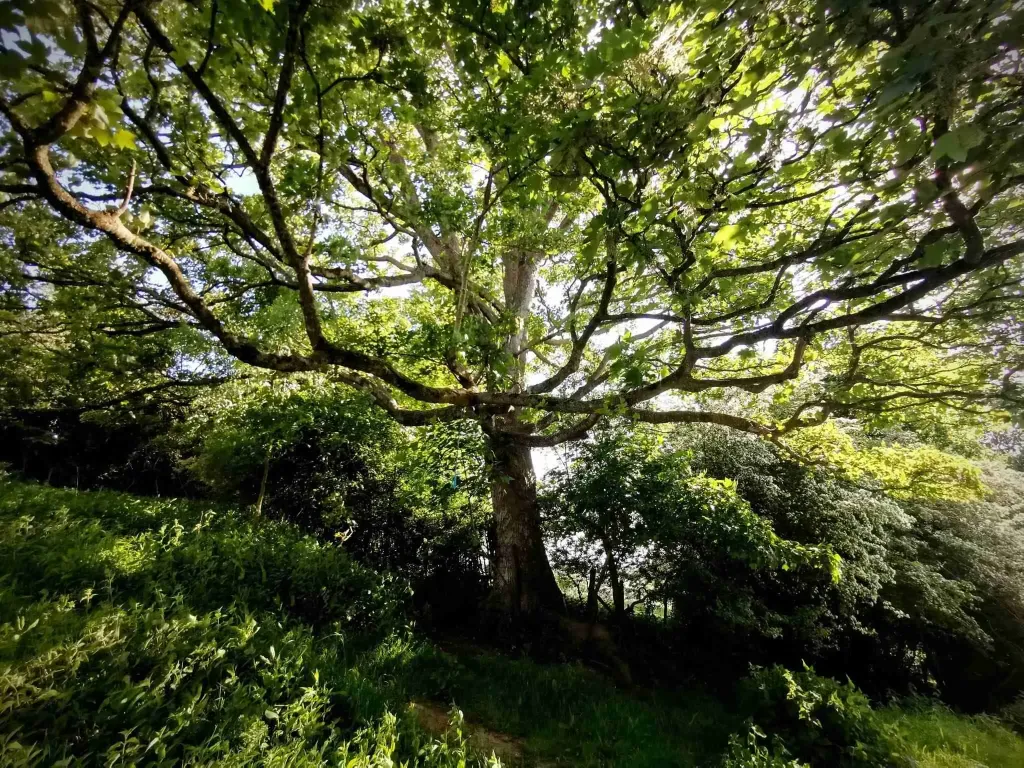
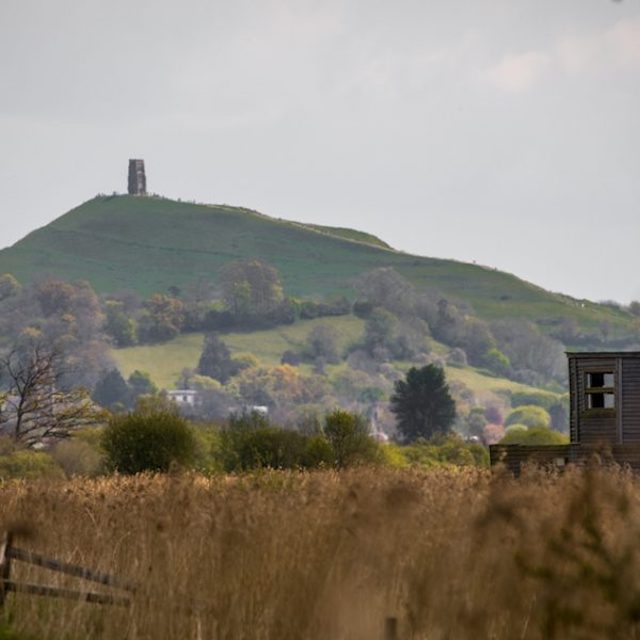
This spot offers a stunning view of the Tor and a perfect photo opportunity. The cosy green hollow is lined by hawthorn, elder, hazel, blackthorn, old field maples, spindle, and magnificent split ash on the left.
Fairy Lane leads into an open field with views of the Tor. If you take a slight detour to the top corner of the field, you will find an English oak standing in the hedgerow. Its branches reach out horizontally, spiralling and twisting, while the two main trunks are fused, resembling snakes mating. This is what the locals call the Wiggly Oak.
We continue walking until we reach the gated entrance to the Tor. Three beech trees are planted at the entrance in dedication to the goddess Bridget. Below them, there is a milestone marking eight miles to Wells. Legend has it that you should announce your arrival by throwing a stone.
Once we pass through the kissing gate leading to the terraces of the Tor, an impressive row of hawthorns is straight ahead. It is a hedgerow that has grown out for a long time. There is also a wayfaring tree on the edge of the hedgerow, another sign of pilgrimage in the past.
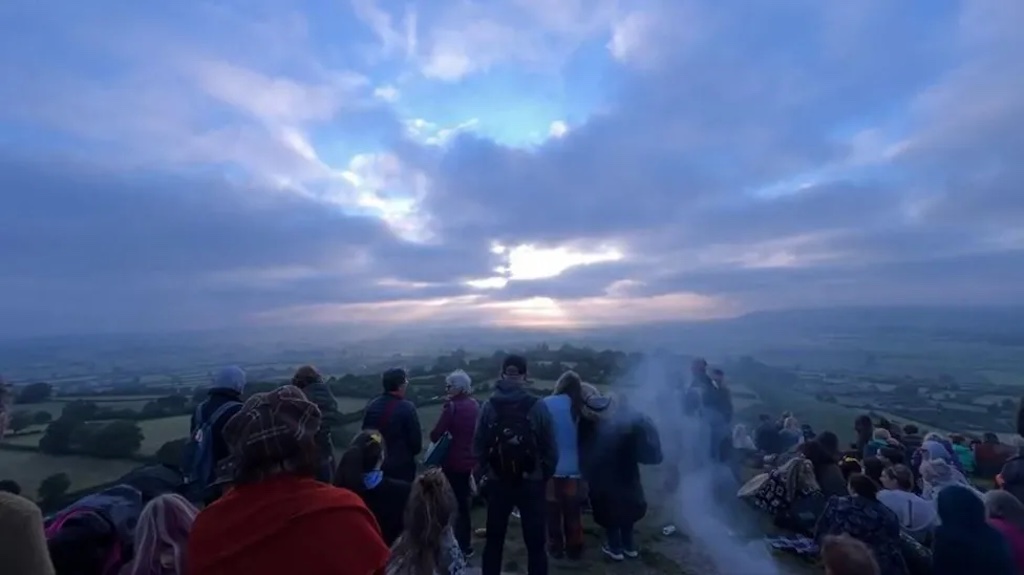
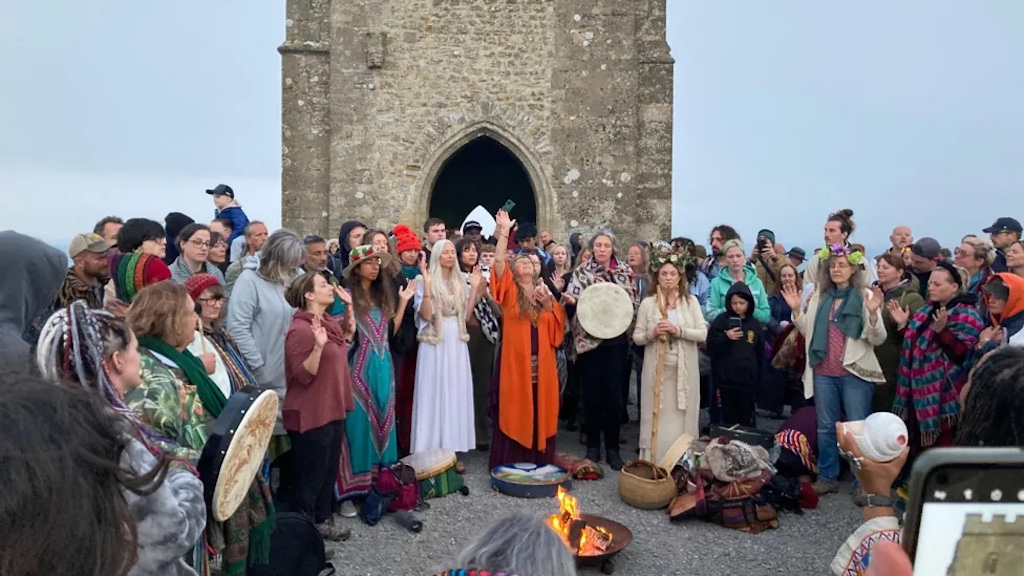
We reached the top of the Tor and joined a large group of people gathered just before sunrise. It was 4:55 a.m., and the sun had cast the first light on a new day.
Many people gathered around a fire, cheering, clapping, and dancing to the steady rhythm of a drum. It was a fun way to welcome the sunrise.
We sat and enjoyed views of the Somerset countryside from what is regarded as one of the most spiritual sites in the UK.
I looked towards Avalon Marshes and began to dream about exploring them, which is another adventure Wildlife Matters will bring you soon.
Just being in a spiritual and mystical place on a solstice dawn is a wonderful experience, and we wanted to soak up every drop of it, so it was a good couple of hours fuelled with coffee and oatcakes before we set off towards the Avalon Orchard.
Avalon means the Isle of Apples, the name coming from the Welsh for apple or apple tree. Here, in Britain, as elsewhere in the world, apples were thought to represent long life, fruitfulness, and health and were often considered magical. The apple was an essential tree to Druids, and along with yew wood, it was used to make their wands.
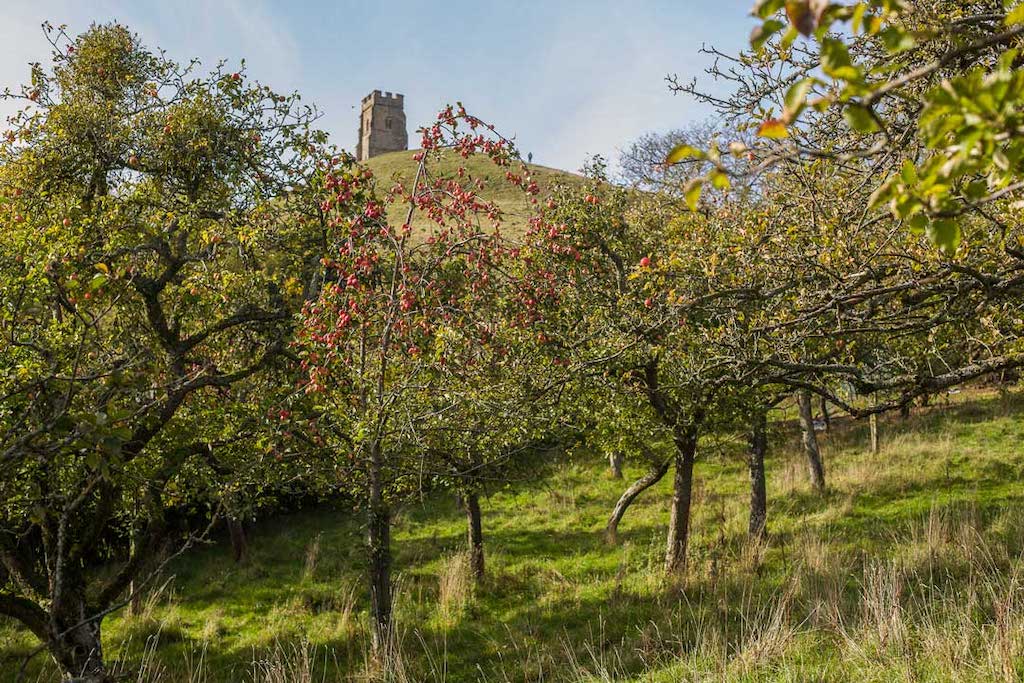
Avalon Orchard is perched on the slope of the Tor. It appears to be largely missed by the thousands of visitors to the Tor, and even today, we have this beautiful orchard all to ourselves.
The National Trust looks after Avalon Orchard as part of the Tor estate, but it doesn’t appear to know much about its origin, age, or what types of apples are grown there.
The trees are undoubtedly old for apple trees, I would have guessed at 100-150 Years and are suitably knarled and covered in lichens.
During a later conversation with a local, I was told that many of the seats in Bushey Coomb were made from fallen apple wood from the Avalon orchard.
At the height of summer, the orchard’s blossom had gone, and the trees were full of young pink to green apples, some still wearing their now rotting pollen bonnets.
It is still clearly a productive orchard, and we noticed that many trees had ribbons tied to their branches. The history behind the use of ribbon trees comes from many places worldwide.
Sometimes known as wishing trees or rag bushes, the Irish call them clotties and the Scots clootie trees.
The orchards or woodlands used for the ribbon trees are often close to holy wells or water, as is the case here at Avalon Orchard.
These trees are often decorated with strips of ribbon or cloth, but always with organic materials that will decompose naturally by visitors who want to fulfil their wishes or in remembrance of a loved one, human or animal that has died.
This sets me thinking about the Arthurian legends that abound here and that, back in Arthurs’s day, Glastonbury, or Avalon as the name, translates to the Island of Apples.
In Arthur’s day, the Tor would have been an island rising out of the marshes, and perhaps that is why it was said that Arthur went to Avalon after his last battle. It is also believed that what we know as Glastonbury was the Isle of Glass, where deceased heroes were said to dwell.
We set off again with a head for mystery and legend, walking down the Tor towards the White Spring.
It is fascinating that two healing springs, one white with calcite and the other touched red with iron, should rise within a few feet of each other from the caverns beneath Glastonbury Tor.
In honour of the Spirit of the White Spring, the Victorians built a magnificent Well House in gratitude for the gift of pure water.
Set apart from the Chalice Well, the well house is very enigmatic, especially when lit with candles at dusk.
The interior consists of three domed vaults 16 feet high, with beautiful, bowed floors—like the hull of a boat moored at the portal to the Otherworld. Its constant temperature and the sound of the perpetually flowing water make it a unique and sacred space.
We move to the open, sunlit gardens of the Red Spring or Chalice Well.
The water in the Chalice Well comes from deep within the earth. Twenty-five thousand gallons or 110,000 litres flow from the well daily, which has never failed, even during drought.
Iron oxide deposits cause the water’s reddish hue. Archaeological finds suggest that humans may have used the spring’s waters for over two thousand years.
Set in a beautiful 4-acre garden, Chalice Well is a place for quiet contemplation and meditation with many tucked-away corners, lawns, flower beds and majestic trees.
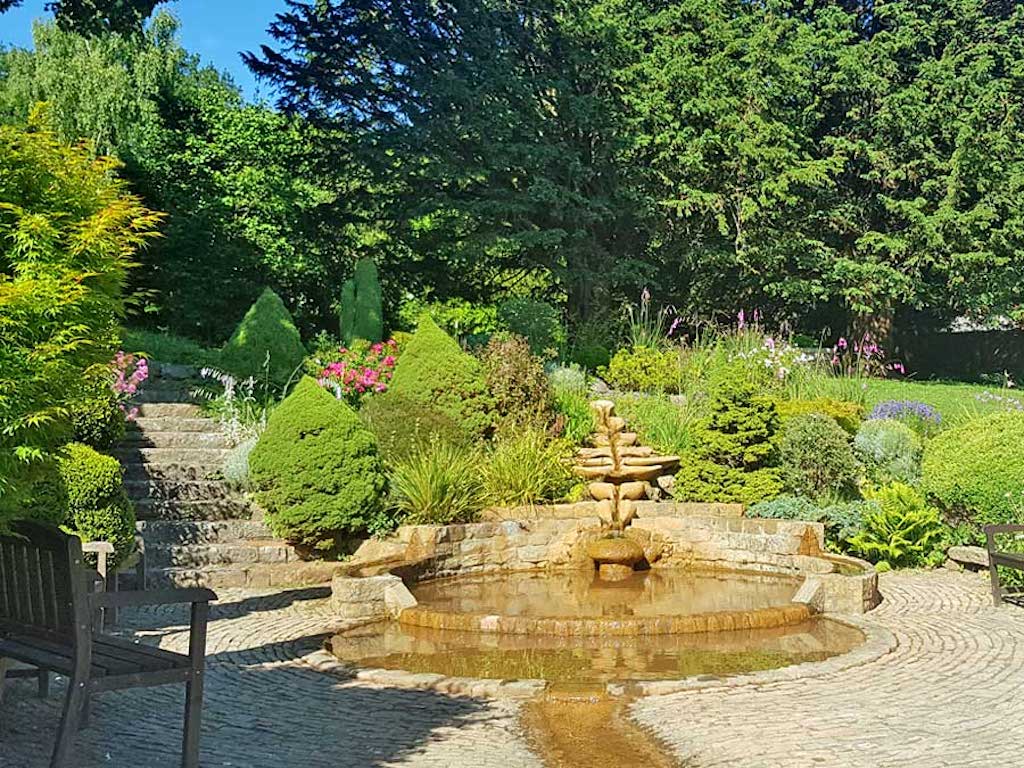
We walk down some steps to the Vesica Pool, a beautiful water sculpture in a rockery.
A few people were here; some sat on benches, others on the lawn, and some were in the shade of two large yew trees.
I start chatting with a lady who tells me that the Yew tree is around 700 years old, while the smaller tree is a spur of the first. I love that they are known as the guardians of the garden.
We move through the central garden into a small walled courtyard known as King Arthur’s Court. This courtyard has a healing pool—a shallow, brick-lined pool surrounded by ferns and ivy and shaded by another ancient yew tree.
People are dipping their feet in the chilly water around the pool to cool down. It’s been a long, warm morning, and we have walked a reasonable distance already, so I quickly remove my boots and join the others, dipping my feet into the calming, cool water —a welcome relief from the scorching summer sun.
With feet refreshed, we walk barefoot across to the Lion’s Head Fountain, set in a sunken garden, to drink the spring water for the first time.
The water tastes so good and is refreshing. I filled my cupped hands several times to quench my thirst and filled the water bottles.
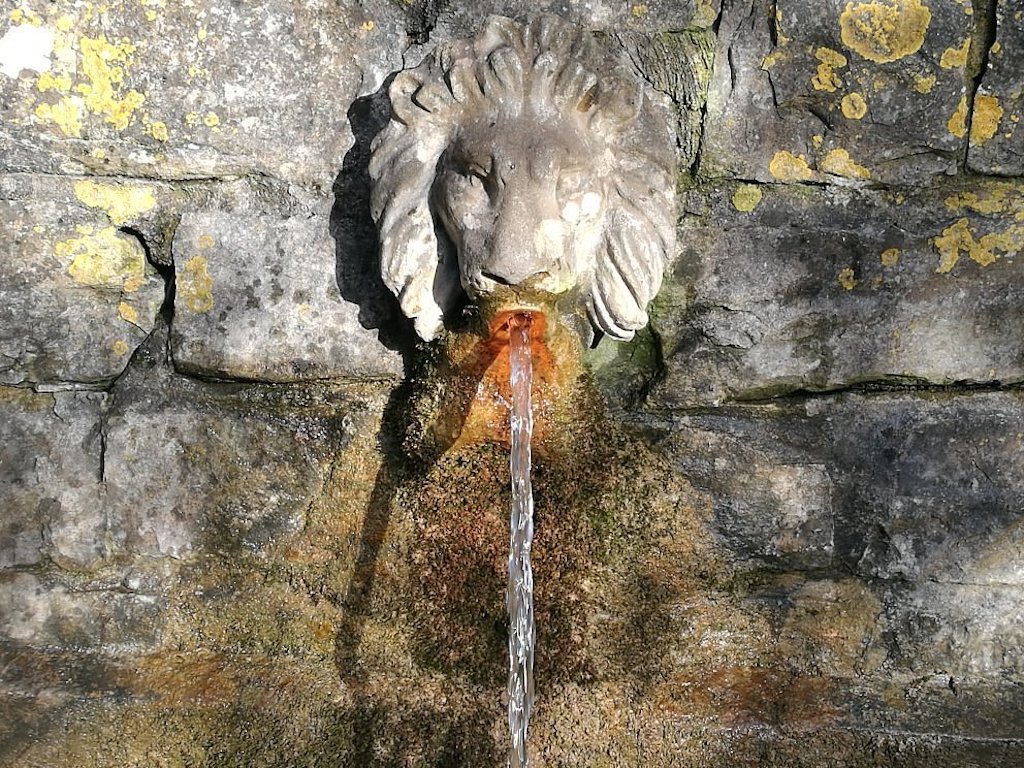
The water is tested regularly, and even when the garden is closed, there is a tap along Wellhouse Lane where you can access water from the fountain. The tap is piped directly from the source of the well.
Just behind us is the Holy Thorn Tree, which I’m told flowers twice every year at Christmas and Easter. According to local legend, this tree is the descendant of the original Holy Thorn Tree that grew from where Joseph of Arimathea drove his staff into the ground near the well.
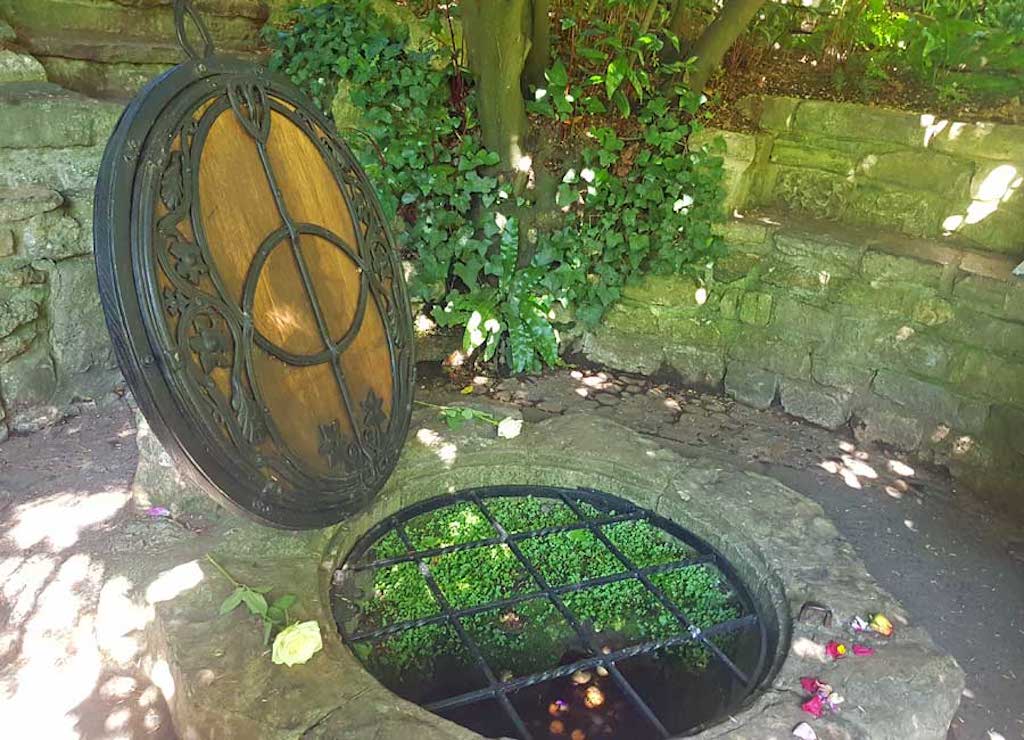
A stone path with beds flanked with traditional English country garden flowers leads to the far northeast corner of the garden, where you will find the beautiful Well Head with its immediately recognisable well lid.
It’s a popular and busy area of the garden, so we stop long enough for me to take a picture before moving on.
As we walk between the places we want to visit, we return to the thoughts of Arthurian legend. Glastonbury, or the Isle of Avalon, is a place seeped in Celtic mythology: it is said that a cave under the hill is the entrance to the fairy realm and the underworld of Gwyn ab Nudd and his Cauldron of Rebirth.
We arrive back at Glastonbury Abbey to look for the tomb of the legendary King Arthur.
Nearly everyone has heard stories about King Arthur: his sword in the stone, his knights of the Roundtable, his kingdom of Camelot…
But there’s little to no historical proof of an early British king, Arthur.
The legendary king supposedly ruled sometime around the late 5th or early 6th century and fought against the invading Saxons. However, the first mention of a warrior named Arthur is a few hundred years later, in 829, when a Welsh monk called him a commander who fought alongside the kings of the Britons.
Then, in 1138, Geoffrey of Monmouth included King Arthur in his History of Kings of Britain – and Medieval storytellers took it from there.
They began circulating fantastic tales of King Arthur and his daring deeds – deeds which seemed to grow with each story.
According to Geoffrey’s original story, when Arthur was mortally wounded, he was put in a boat and taken to the Isle of Avalon in hopes that he could be healed of his wounds. And Geoffrey ends his story there, leaving Arthur in Avalon. But at that time, no one knew where the Isle of Avalon was.
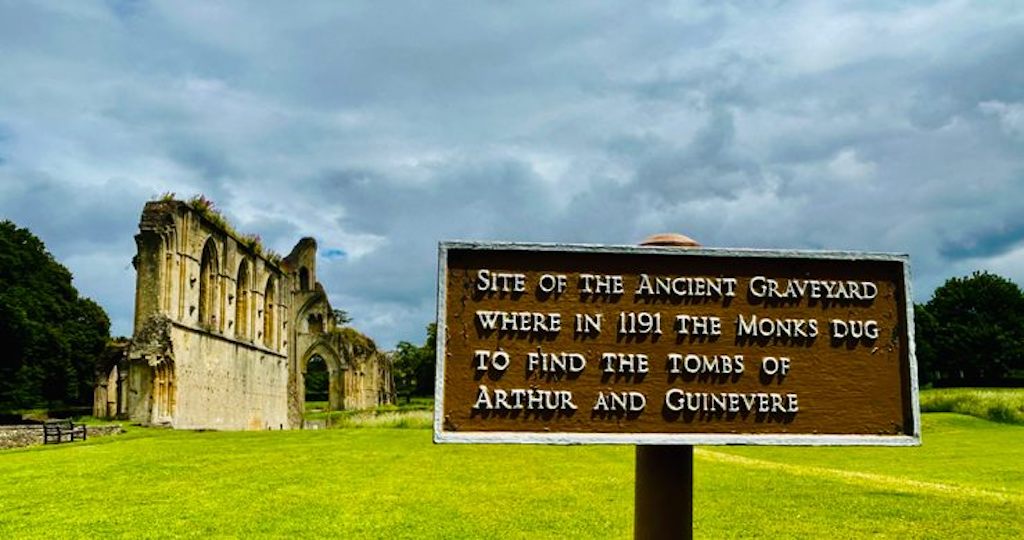
Then, one day, in 1191, the monks of Glastonbury Abbey found something strange in the old Abbey cemetery. They were digging between two old stone pyramids covered in worn, unreadable markings when, deep in the ground, they found a large stone lying flat.
They lifted it out so they could inspect it. A lead cross was attached to the back of the stone – the side facing downward. They pried off the cross and found an inscription hidden on its back–the side facing the stone. All the monks were wondering at this strange sight. Then one translated: “Here lies buried the renowned King Arthur, with Guinevere, his second wife, in the isle of Avalon.” Everyone gasped.
Years earlier, King Henry II had sent word to the monks of Glastonbury about Arthur’s burial. He claimed that an old soothsayer had told him Arthur was buried in a log casket very deep in the earth.
The monks picked up their shovels and began digging again with more vigour. They dug deeper and deeper until, at about sixteen feet, they hit what seemed to be a tree buried horizontally in the earth. It was a large tree trunk coffin-like those used earlier. times
Word spread, and a large crowd gathered (and probably paid) to see the coffin opened.
After the monks had dug all around it, they struggled to lift the top off. As they hoisted the wooden lid out of the pit, the remains of two bodies were revealed: a man and a woman.
There was also a lock of braided blond hair that looked completely intact – however, when a monk went to pick it up, it turned to dust in his hand.
Everyone was astonished when they saw King Arthur’s skeleton: It was enormous.
One monk took the shin bone and held it against the tallest man there. It extended a good three inches above his knee. His eye sockets were a hand’s width apart, and he had at least ten wounds on his large skull. All had been scarred except for one large one, probably the final blow.
The monks carefully lifted the bones from the grave and wrapped them in cloth. They would have a new marble tomb made for Arthur and Guinevere and place it in the church.
The discovery of King Arthur’s tomb changed Glastonbury Abbey’s fortunes, as people from far and wide began making pilgrimages to see it.
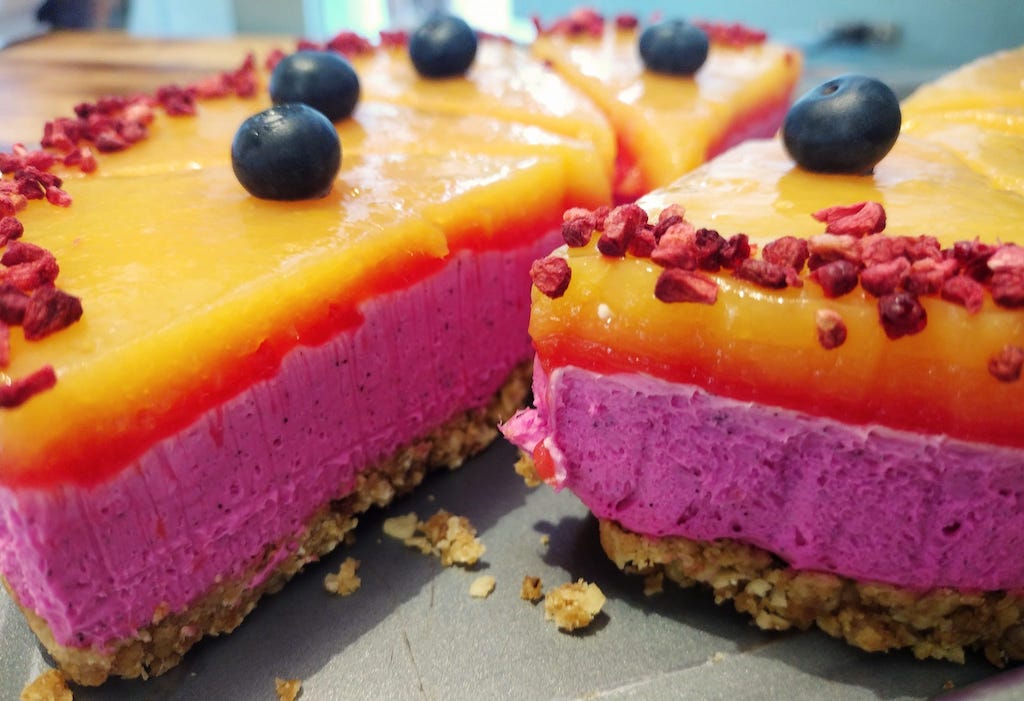
And that was our Summer Solstice adventure in 2024. We took off to the Pyramid Cafe in Glastonbury High Street—an excellent, fully vegan cafe that we recommend you visit and try one of their exquisite cheesecakes—the Dragon Cheesecake—picture below—tasted even better than it looks.